


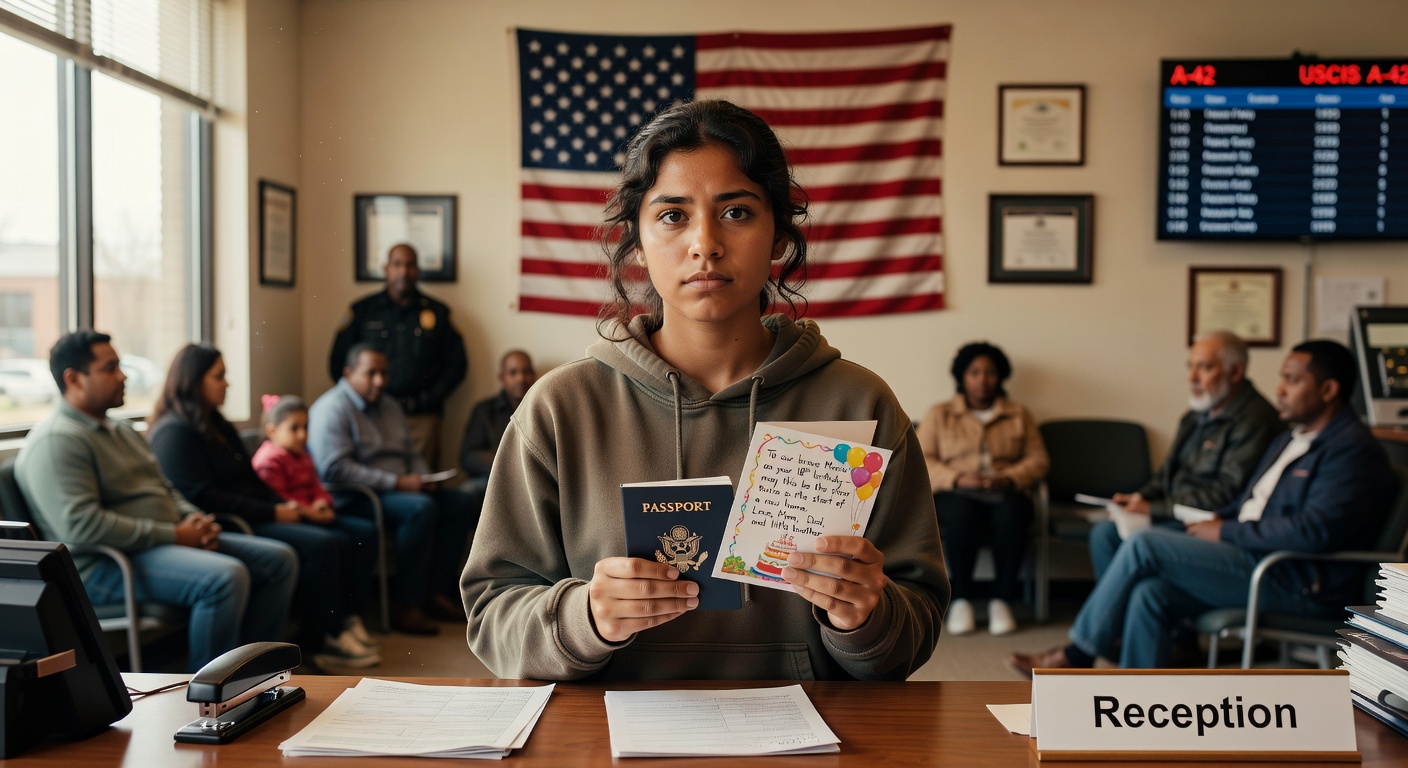
If you started a family-based green card case when your child was 14 and the priority date is still nowhere close, you have probably done the panic math: what happens on their 21st birthday? The fear has a name. It is called "aging out," and for thousands of families in 2026 it is the single biggest threat to a case that is otherwise on track.
The Child Status Protection Act (CSPA) was passed in 2002 specifically to keep that scenario from punishing kids for government delays. But CSPA does not freeze a child's age automatically, the math is non-obvious, and missing a one-year deadline can erase the protection entirely. This guide walks through how CSPA works in 2026, when it saves a case, when it does not, and what families can do right now to preserve their children's place in line.
What "aging out" actually means
In immigration law, a "child" is unmarried and under 21. Once a beneficiary turns 21, they convert to an adult son or daughter — which usually means a different, far slower preference category, and in some cases no eligibility at all to immigrate as a derivative. For a family that has been waiting six, ten, or fifteen years on a priority date, watching a child age out can mean starting over.
- An F2A child of a lawful permanent resident converts to F2B (unmarried son/daughter of LPR) at 21 — F2B has a much longer wait.
- A derivative on an F1, F3, or F4 petition can lose derivative status entirely once they turn 21 and may need a new petition.
- A derivative on an employment-based case (EB-1, EB-2, EB-3, EB-5) loses derivative eligibility on turning 21 unless CSPA holds the age.
The CSPA fix in plain English
CSPA does not stop a child from turning 21 in the calendar sense. What it does is freeze a separate concept — the child's "CSPA age" — for immigration purposes. If the CSPA age stays under 21 at the right moment, the child keeps child status even if their actual birthday has passed.
The formula in family preference and employment-based cases is:
The CSPA Math
CSPA age = (age on the date the visa becomes available) minus (number of days the petition was pending). The visa "becomes available" when the priority date becomes current under the visa bulletin and a visa number can actually be used. That number is then frozen for the case.
A worked example
Maria is a lawful permanent resident. She files an I-130 for her unmarried daughter Sofia (an F2A case) on March 1, 2018. Sofia is 16 at the time. The petition is approved on November 1, 2019 — pending for exactly 610 days. Sofia's priority date becomes current in May 2026. By May 2026, Sofia is 24 years old in actual age.
Without CSPA, Sofia has aged out and converts to F2B. With CSPA:
- Age when visa available: 24 years (8,766 days, roughly).
- Days petition was pending: 610.
- CSPA age: 24 years minus 610 days = roughly 22 years and 4 months.
That number is still over 21, so Sofia still ages out. CSPA only saves the case if the formula puts the CSPA age under 21. In long backlogs, it often does not, and that is the cruel part — many parents assume CSPA is a guaranteed shield, when in reality it is more like a partial credit for petition processing time.
The "sought to acquire" one-year rule — where families lose their CSPA age
This is the most common way families forfeit CSPA protection without realizing it. To lock in the CSPA age, the beneficiary must "seek to acquire" lawful permanent residence within one year of when the visa first becomes available. "Sought to acquire" means filing one of these:
- Form I-485 (adjustment of status) if in the United States.
- Form DS-260 (immigrant visa application) if outside the United States.
- Form I-824 to follow to join a principal who already adjusted.
- A documented written request to the National Visa Center to begin processing.
Miss the one-year window and the CSPA age unfreezes — the beneficiary is back to actual age. Families assume the priority date alone is enough. It is not. The clock starts the month the priority date becomes current under the Final Action Dates chart of the visa bulletin, and one year later the CSPA shield drops if no application has been filed.
Why the one-year deadline trips up so many cases
The visa bulletin moves backward and forward (retrogression). Some families wait, thinking the date will become current again later under better terms, or that they will save filing fees. The "sought to acquire" clock keeps running anyway. Once the year passes, USCIS and consulates have routinely denied CSPA protection on this exact ground.
F2A is different — the automatic conversion rule
For F2A cases (children of lawful permanent residents), there is a separate, often more generous protection. Under section 203(h)(3) of the INA, an F2A child whose CSPA age does push them past 21 converts automatically to F2B and retains the original priority date. They lose child status and the shorter wait, but they do not lose their place in the line entirely. That is significantly better than the result for derivatives on most other petitions.
Already over 21 — opt-in, opt-out, and the case that survives
Even when CSPA cannot keep a beneficiary under 21, several strategic moves are available depending on the petition category:
- Conversion with priority date retention. In F2A cases, the converted F2B case keeps the original priority date, so the wait restarts from where the family already stood, not from zero.
- Self-petition for VAWA-eligible cases. A child who has been abused by a U.S. citizen or LPR parent or stepparent may have an independent path through VAWA that does not depend on CSPA.
- Asylum-derivative considerations. Asylee derivatives are subject to a different CSPA rule that locks the child's age at the date the principal filed the asylum application — a much more protective rule than for family preference cases.
- Refile in a different category. If a U.S. citizen parent or sibling can file a new petition, sometimes that new petition (with its own new priority date) is faster than waiting on the converted F2B line.
Practical steps to protect a child's CSPA age right now
- Date the petition exactly. Pull the receipt notice (Form I-797) and the approval notice. The pending days from receipt to approval are what feed into the formula. Save both notices.
- Track the visa bulletin monthly. The CSPA "visa available" trigger ties to the Final Action Dates chart, not the Dates for Filing chart, in most cases. Subscribe to the bulletin or a monitoring service.
- Calculate the CSPA age now, not when the date becomes current. Knowing in advance whether CSPA will save the case lets you decide whether to refile, switch strategies, or expedite a parent's naturalization to convert F2A to immediate-relative status.
- If a parent will naturalize, time the oath carefully. Naturalization of an LPR petitioner converts an F2A case to immediate-relative (no quota), which can solve aging out. But it also has timing nuances — get advice before scheduling the oath.
- File the visa application within one year. When the priority date becomes current, file I-485 or DS-260 within twelve months — or document a written NVC request — even if the case is otherwise complicated. This is the single most common point of failure.
- Get the case file reviewed by an immigration attorney before the 21st birthday. CSPA strategy is one of the few areas where a one-hour consultation can save a five-year wait.
When CSPA does not help
Honest version: CSPA is not a silver bullet. It does not help in these scenarios:
- Marriage. If the beneficiary marries before adjustment, they lose child status entirely regardless of CSPA age. Marriage converts most family categories or eliminates them.
- Diversity visa lottery selectees. CSPA applies but with a stricter calculation — DV-program math is its own rule.
- K-2 derivatives of K-1 fiance(e) visa holders. CSPA does not protect K-2 derivatives. They must enter the U.S. before turning 21.
- Cases where the formula simply does not produce a sub-21 age. If the math does not work, CSPA cannot create protection out of nothing.
2026 backlog reality
The May 2026 visa bulletin shows F2A current for most countries but with multi-year backlogs in F2B, F1, F3, and F4. EB-2 and EB-3 for India and China are at extreme retrogression. In an environment where waits are this long, more children are aging out than at any point in the last decade — and CSPA is failing to save more cases than it saves. The strategic decisions families make at year three or year five of the wait, not the day before the 21st birthday, are what determines the outcome.
Bottom line
CSPA is real protection but it is partial protection. The earlier a family understands the math for their specific petition, the more options they have — including expediting a parent's naturalization, refiling in a different category, or coordinating filings across siblings. Waiting until a child is 20 years and 11 months to think about CSPA is almost always too late.
Related reading
- F2A Visa Current in 2026: What It Means for Your Case
- Family Sponsorship Green Card Timeline
- I-130 Petition Denied: Next Steps
- I-130 for Parents: 2026 Walkthrough
A child approaching 21 on a pending family-based case? Contact our immigration attorneys at Modern Law Group.
Worried About Aging Out?
CSPA strategy is decided years before the 21st birthday, not weeks. Talk to an immigration attorney early — there are usually more options than families realize.
Schedule a Consultation