




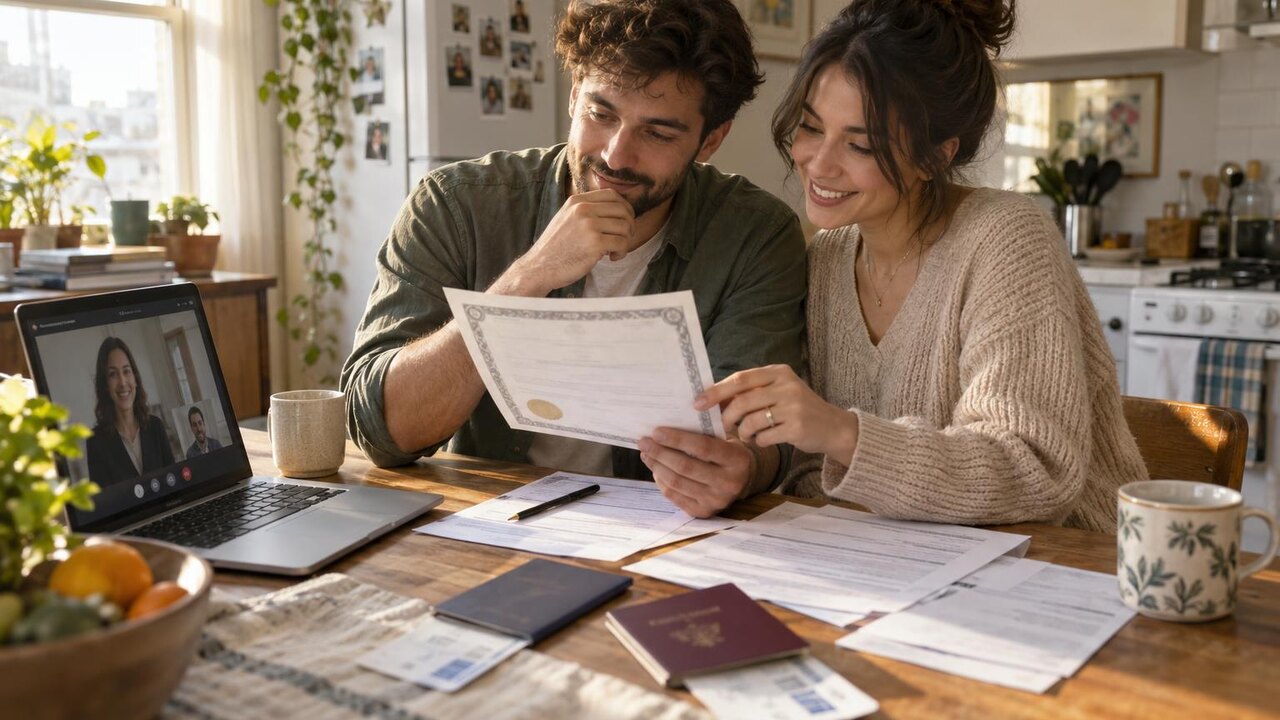
Thousands of couples have married over Zoom through Utah County since 2020. The appeal is obvious: no residency requirement, no travel, a certificate issued by a U.S. state within days. Couples separated by war, visa refusals, or countries that will not let them marry use it every week. Most of them then ask the same question: will USCIS accept this marriage for a green card?
It will, but only if you understand the one rule that catches people. This guide explains what USCIS actually requires, what counts as proof, what happens if you filed too early, and when an online marriage is the wrong tool entirely. Guidance reviewed October 13, 2026.
Why USCIS treats a Zoom wedding like a proxy marriage
Immigration law normally asks one question about a marriage: was it valid where it was celebrated? Utah permits a ceremony where the officiant is physically in Utah and the couple and two adult witnesses appear by live video from anywhere. If the license and ceremony followed Utah's requirements, the marriage is valid in Utah, and USCIS generally respects it.
The Immigration and Nationality Act then adds a second layer. Section 101(a)(35) says the terms "spouse," "wife," and "husband" do not include a spouse by reason of any marriage ceremony where the contracting parties were not physically present in the presence of each other, unless the marriage has been consummated. Congress wrote that rule in 1924 for picture brides and proxy weddings. It still applies, and USCIS has said in its Policy Manual that a virtual marriage where the parties were not physically together for the ceremony must be consummated afterward to count for immigration purposes.
So the question is not whether you married online. The question is whether you were in the same room when you said your vows. A couple sitting on one couch in Dallas with the Utah officiant on screen was physically present with each other, and the consummation rule does not apply to them. A petitioner in Brooklyn marrying a fiancée on camera in Tashkent was not, and it does.
What "consummated" means to USCIS, and what it does not
USCIS does not interrogate your private life. In practice the agency asks for evidence that you were physically together after the ceremony, which makes consummation possible. The Policy Manual lists examples: a child's birth certificate naming both of you after the marriage, passports or airline tickets showing you were in the same place at the same time after the ceremony, or evidence that you lived together afterward such as a joint lease or signed affidavits. A short written statement that you met on specific dates and lived as spouses is routinely included and carries weight when the travel records back it up.
Three things do not satisfy the rule, and we see each of them in denied cases:
- Meeting before the wedding. Time together before the ceremony proves you know each other. It does not prove consummation of a marriage that did not yet exist. The in-person meeting has to come after the ceremony date on the certificate.
- Video calls, messages, and money transfers. These are bona fide marriage evidence. They are not physical presence.
- A planned trip. A booked ticket for next spring is a promise, not proof. USCIS judges eligibility as of the date you file.
The timing trap: eligibility is judged on the filing date
Under 8 C.F.R. § 103.2(b)(1), a petitioner must establish eligibility at the time of filing. If the marriage was not consummated when you filed the I-130, you were not a "spouse" on that date. Meeting your spouse six months later, while the petition is pending, does not cure the defect. USCIS can issue a Request for Evidence, and if the only evidence of physical presence postdates the filing, it can deny.
The sequence that works is simple. Marry online. Travel, or have your spouse travel, and spend real time together. Then file. Couples who reverse the order lose the filing fee and months of processing time, and they often get a denial letter that becomes part of the record for every later filing.
What we see at Modern Law Group
A representative situation, not a specific client: a U.S. citizen in Fort Worth marries his partner in Bishkek over Zoom in January. They had spent two weeks together the previous summer. He files the I-130 in February with photos from that trip, chat logs, and money-transfer receipts. In September USCIS issues an RFE asking for evidence that the parties were physically present with each other after the ceremony. They have none. The only trip was before the wedding.
The fix was not clever. He flew to Bishkek in October, stayed three weeks, and kept everything: boarding passes, passport stamps, hotel folio in both names, photos with location data, a joint statement describing the visit. The RFE response explained why the earlier trip did not count and why this one did. The petition was approved, but it would have been approved eight months earlier, and for one filing fee, if the trip had come before the filing. That is the whole lesson of this article.
Step by step: filing an I-130 after an online marriage
- Confirm the Utah certificate is clean. Check the names, the ceremony date, and that the certificate shows a Utah license and a Utah officiant. Order certified copies. If either of you had a prior marriage, gather the divorce or death records; a defective prior divorce voids the new marriage no matter how it was celebrated.
- Be together in person after the ceremony date. There is no minimum number of days in the statute, but a weekend produces thin evidence. A visit of two weeks or more, with a shared residence, gives the officer something to approve.
- Document the visit as it happens. Save boarding passes, passport entry and exit stamps, hotel or rental records in both names, photos with dates, receipts from the trip, and the airline booking. Ask a relative who hosted you to sign a short declaration.
- Build the bona fide marriage file separately. Consummation proves presence. The marriage must also be genuine under INA § 204(c) and the evidence rules in 8 C.F.R. § 204.2(a). Include the relationship history, communication records, financial ties, and statements from people who know you as a couple. Our guide to the marriage green card interview covers what officers ask.
- Write the cover statement for the officer who has never seen a Utah certificate. Many adjudicators have. Some have not. One page explaining that the marriage was solemnized remotely under Utah law, that the parties were in different locations during the ceremony, and that they were physically together on specific dates afterward, with exhibit references, prevents the RFE.
- File the I-130 only after step 3 is complete. If your spouse is abroad, the case moves to the National Visa Center and a consulate; our article on the consular processing stage after I-130 approval explains the next deadlines. If your spouse is in the United States after a lawful entry, adjustment of status may be available, and our guide for a spouse who overstayed addresses that path.
Four situations where the online marriage is the wrong move
Your fiancé is abroad and you have never met in person. A K-1 fiancé visa requires an in-person meeting within two years before filing. A Utah marriage does not remove that problem; it replaces it with the consummation problem and closes the K-1 door, because K-1 is only for unmarried couples. Read our comparison of marrying first versus the fiancé visa before you book a ceremony.
Your spouse's home country does not recognize the marriage. Utah County itself warns that a remote marriage may be invalid where the parties live. That rarely affects USCIS, which looks to Utah law, but it can affect the consular interview, the spouse's ability to change a passport name, inheritance, and whether a later local marriage is bigamy. Check before you rely on the certificate abroad.
You are both inside the United States. If you can stand in front of a county clerk together, do that. An in-person ceremony avoids the statute entirely and produces no extra evidence burden.
Your spouse is in removal proceedings. A marriage entered during proceedings triggers the heightened bona fide marriage standard under INA § 245(e), and an online ceremony invites extra scrutiny on top of it. The case is still winnable, but it needs counsel from the start. See our article on a marriage green card during removal proceedings.
If USCIS already sent an RFE or a denial
An RFE about physical presence is answered with the trip evidence described above and a statement that explains the dates. If you have not yet traveled, the honest answer is to travel now and respond with the proof before the RFE deadline, which is usually 87 days. Do not send a statement that implies a meeting that did not happen; a misrepresentation finding under INA § 212(a)(6)(C)(i) follows the beneficiary for life.
A denial for lack of consummation at filing is usually not worth appealing, because the facts on the filing date do not change. The practical remedy is a new I-130 filed after the in-person visit, with the earlier denial addressed in the cover statement. Our guide to what to do after an I-130 denial explains when an appeal or motion makes sense and when refiling is faster.
The domicile and income rules for the U.S. citizen petitioner apply to these cases like any other. If you have been living abroad with your spouse, read our article on sponsoring a spouse while living abroad before the consular stage.
Married online and not sure whether your I-130 will survive?
Modern Law Group reviews Utah and other remote marriages every week: certificate validity, the physical-presence timeline, bona fide evidence, and whether to file now or travel first. Bring the certificate, your passports, and any USCIS notice.
Schedule a ConsultationFrequently asked questions
Does USCIS accept Utah online marriages for a green card?
Yes, when the ceremony was valid under Utah law and, if you were in different locations during the ceremony, you were physically together afterward. INA § 101(a)(35) excludes an unconsummated marriage where the parties were not in each other's presence, and USCIS applies that rule to video ceremonies.
We met in person before the Zoom wedding. Is that enough?
No. The in-person time has to come after the ceremony date. A trip before the wedding supports the bona fides of the relationship but does not consummate a marriage that did not yet exist.
Can I file the I-130 first and meet my spouse while it is pending?
That order risks a denial. Under 8 C.F.R. § 103.2(b)(1), eligibility is judged on the filing date. If you were not yet a spouse under INA § 101(a)(35) when you filed, a later visit does not fix the petition. Travel first, then file.
What evidence proves we were together after the ceremony?
Boarding passes, passport stamps, hotel or rental records in both names, dated photos, receipts, a joint lease, a child's birth certificate listing both parents, and short signed statements from you and from people who hosted or saw you together.
Can we use a K-1 fiancé visa instead after marrying online?
No. The K-1 is only for couples who are not yet married. Once the Utah certificate issues, the path is a spouse petition: Form I-130, then consular processing or adjustment of status.
My spouse's country says the marriage is not valid there. Does USCIS care?
USCIS looks to the law of the place of celebration, which is Utah, so foreign non-recognition rarely affects the I-130. It can still create problems at the consulate, with passports and names, and with any later local marriage, so get local advice before relying on the certificate abroad.
USCIS denied the I-130 because we had not met after the ceremony. Should we appeal?
Usually no. The facts on the filing date do not change on appeal. The faster remedy is to spend time together, document it, and file a new I-130 with a cover statement that explains the earlier denial.