





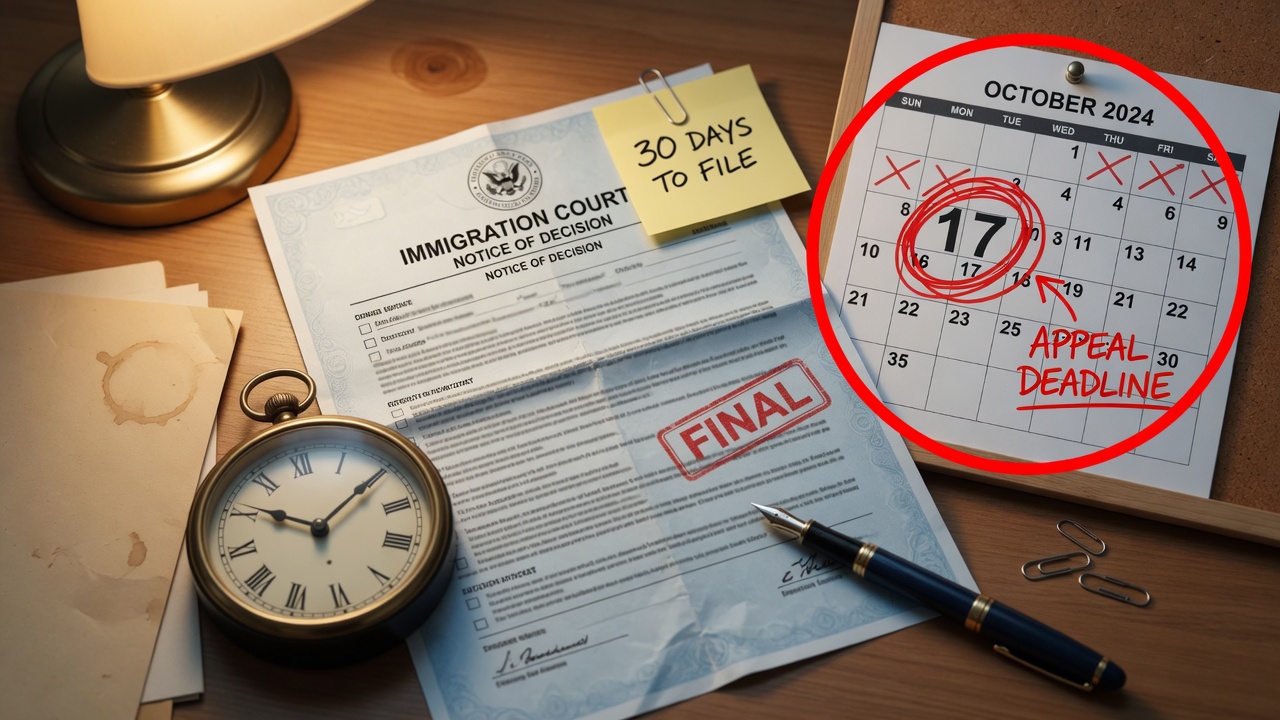
An asylum denial is not the end if the right appeal is filed on time. The first month is unforgiving: a mailing mistake, vague notice, missing fee waiver, or missed address update can decide the case before legal arguments are heard.
Quick answer
If an Immigration Judge denies asylum and enters a removal order, the Board of Immigration Appeals must receive Form EOIR-26 within 30 calendar days of the oral or written decision. Under 8 CFR 1003.38, this is a receipt deadline, not a postmark deadline. A timely direct appeal usually triggers an automatic stay of removal under 8 CFR 1003.6, but that protection depends on the case posture and does not cure a late or defective filing.
This guide is not a general explanation of what the BIA is. For that broader overview, see our article on navigating asylum appeals with the Board of Immigration Appeals. This page is narrower: what must happen in the first 30 days after the Immigration Judge denies asylum.
The deadline is the danger
The most common fatal assumption is that mailing the appeal within 30 days is enough. It is not. The BIA must receive the Notice of Appeal by the deadline. A package sent on day 29 that arrives on day 31 can be treated as late.
When the 30-day clock starts
The clock usually starts when the Immigration Judge issues the decision. If the judge gives an oral decision in court, count from that date. If the judge later serves a written decision, count from the written decision date. The deadline is 30 calendar days, not business days.
At the end of many hearings, the Immigration Judge asks whether the parties reserve appeal. If you reserve appeal, a timely appeal can be filed. If you waive appeal, the order is generally final immediately. That waiver can be hard to undo. If there is doubt about what happened, get the order, notes, and recording or transcript request moving quickly.
For options after a denial, including motions and later federal review, read Asylum Denied: What Are Your Options?. But in the first month, the controlling question is simpler: was the appeal preserved, completed, served, paid for or supported by a fee waiver, and received by the BIA on time?
The first 30 days: survival checklist
- Day 0: identify the decision date. Confirm whether the denial was oral in court or issued later in writing. Save the order and decision. Calendar the 30th day immediately.
- Day 1-3: confirm appeal was reserved. If appeal was waived, treat the case as an emergency. If appeal was reserved, prepare the Notice of Appeal instead of waiting for a transcript.
- Day 1-7: draft specific grounds on Form EOIR-26. Identify real issues, such as adverse credibility findings, corroboration errors, nexus analysis, due process problems, country evidence, or legal standard errors.
- Day 1-10: handle the $110 fee or fee waiver. The EOIR-26 filing fee is currently $110 unless a fee waiver on EOIR-26A is submitted and accepted. A fee problem can create filing trouble, so do not leave it to the last day.
- Before filing: serve DHS and prepare proof of service. The appeal must be served on the opposing party. Keep a signed certificate or proof of service showing how and when DHS was served.
- Well before day 30: file with the correct BIA address or portal. Confirm the current filing method and address from EOIR instructions. Build in delivery time. Keep proof of delivery and a complete copy of everything filed.
- After filing: track the receipt and briefing schedule. The Notice of Appeal is only the beginning. Missing the brief deadline can damage the appeal.
What must be in Form EOIR-26
Form EOIR-26 is the Notice of Appeal from a Decision of an Immigration Judge. It is not the full appeal brief, but it still matters. The form asks why the decision is being appealed. A generic statement like "the IJ erred" is risky because 8 CFR 1003.1(d)(2) allows summary dismissal in certain cases, including where the party fails to adequately specify the reasons for appeal or fails to file a promised brief.
The safest notice identifies concrete issues. In an asylum case, that may mean the judge misread testimony, demanded corroboration without proper analysis, ignored country evidence, applied the wrong nexus standard, treated minor inconsistencies as central, or failed to analyze withholding of removal or Convention Against Torture protection.
The notice also needs the filing fee or EOIR-26A fee waiver, the respondent's correct information, the attorney's appearance documents if represented, and proof of service on DHS. If the respondent moves, EOIR-33 change of address must be filed. A briefing schedule mailed to an old address can become a missed deadline.
Automatic stay: what it does and what it does not do
A timely direct BIA appeal from an Immigration Judge removal order usually carries an automatic stay of removal under 8 CFR 1003.6 while the appeal is pending. That is one reason the 30-day deadline is so important. A timely appeal can preserve review and prevent DHS from executing the order during the BIA case.
But automatic stay rules are not universal. In absentia orders, certain expedited contexts, and some post-order motions may require a separate written stay motion. If ICE may act, do not rely on assumptions. Compare the posture with our guide on how to pause a deportation order.
Mistakes that can forfeit the appeal
- Missing the 30-day receipt deadline. The BIA receiving the appeal late is usually fatal, even if it was mailed before the deadline.
- Sending the appeal to the wrong place. A misaddressed package can arrive too late or never be treated as properly filed.
- No proof of service on DHS. Service defects can create rejection, delay, or procedural attacks.
- Blank or vague grounds for appeal. A notice that gives no specific reason can invite summary dismissal under 8 CFR 1003.1(d)(2).
- Missing the brief deadline. If the EOIR-26 says a brief will be filed and the brief is missed, the BIA may dismiss or decide the case on a thin record.
- Moving without EOIR-33. If notices go to an old address, the respondent may miss the briefing schedule or decision.
- Assuming a fee waiver fixes everything. EOIR-26A must be completed and supported. If the fee issue is mishandled, the filing can be jeopardized.
- Waiting for the transcript before filing the notice. The transcript is for briefing. The Notice of Appeal must be filed within 30 days.
What we see in our practice
We often see families call around day 25 with a denial order, a FedEx envelope, and a belief that "as long as we mail it by day 30, we are okay." That turns the case into a race against delivery. The better practice is to prepare EOIR-26 early, identify appeal grounds, serve DHS, confirm the fee or EOIR-26A, and file with time to prove BIA receipt.
Another pattern is the moved-without-notice problem. The appeal was filed, but the family changed apartments. No EOIR-33 was filed. The BIA briefing schedule went to the old address. By the time anyone realizes it, the brief deadline has passed. That is not a legal argument problem. It is a process failure.
What the BIA can do
The BIA can affirm the Immigration Judge, reverse the decision, or remand the case to immigration court. Many appeals take months, and some take longer than a year, depending on the record, briefing, workload, detention status, and issues presented.
If the BIA denies the appeal, the next possible step may be a petition for review in the proper federal circuit court under INA § 242, usually within 30 days of the BIA decision. That is a separate federal deadline with different stay rules, so review should begin immediately.
Record-building matters
A strong appeal usually starts before the brief. Counsel needs the IJ decision, exhibits, hearing audio or transcript when available, prior filings, address history, and country evidence. If the record is incomplete, a targeted request may be needed. See our guide on FOIA before immigration court for related record issues.
Frequently Asked Questions
The Notice of Appeal, Form EOIR-26, must be received by the Board of Immigration Appeals within 30 calendar days after the Immigration Judge's oral or written decision. Under 8 CFR 1003.38, the deadline is based on receipt by the BIA, not the mailing date or postmark.
In most direct appeals from an Immigration Judge removal order, a timely appeal creates an automatic stay of removal while the BIA appeal is pending under 8 CFR 1003.6. Do not assume the stay applies in every posture. In absentia orders, certain expedited contexts, and other unusual cases may require a separate stay motion.
If you clearly waived appeal after the Immigration Judge's decision, the order is generally final. A later BIA appeal may be rejected because there was no reserved right to appeal. Anyone who believes the waiver was not knowing, voluntary, or accurately recorded should get case-specific legal review immediately.
Yes. The Notice of Appeal must state specific grounds for the challenge. A blank notice or a vague statement such as 'the IJ erred' can risk summary dismissal under 8 CFR 1003.1(d)(2), especially if the later brief is not filed on time.
If the BIA denies the appeal, the next possible step may be a petition for review in the proper federal circuit court under INA section 242. That petition usually has its own 30-day deadline from the BIA decision, and stay rules at that stage are different.
Talk to an Attorney Before the 30-Day Deadline Runs
If an Immigration Judge denied asylum, do not wait for the deadline week. Call Modern Law Group at (888) 902-9285. We can review the decision, confirm the appeal deadline, prepare Form EOIR-26, evaluate stay protection, and protect the next filing deadline.
📚 Related Articles
- Navigating Asylum Appeals with the Board of Immigration Appeals
- Asylum Denied: What Are Your Options?
- Stay of Removal: How to Pause a Deportation Order
- FOIA Before Immigration Court
Appeal deadline approaching? Contact our asylum attorneys at Modern Law Group.
Asylum Denied by an Immigration Judge?
The appeal clock is short. Get a case-specific review before the 30-day BIA deadline controls the outcome.
Schedule a Consultation