


Quick answer
EB-1A is the immigrant green-card category for people who can prove they are already at the top of their field. You do not need an employer, a job offer, PERM labor certification, or the H-1B lottery. You do need strong evidence under INA § 203(b)(1)(A), 8 C.F.R. § 204.5(h), and USCIS' two-step Kazarian analysis: first, meet at least three regulatory criteria or show a one-time major award; second, prove in final merits that your achievements show sustained national or international acclaim and that you will continue work in your area of expertise.
What EB-1A is, and why it is different from O-1A
EB-1A is a permanent-residence category for a person of extraordinary ability in the sciences, arts, education, business, or athletics. The statute is INA § 203(b)(1)(A). The regulation is 8 C.F.R. § 204.5(h). If USCIS approves the I-140 and a visa number is available, the person can move toward a green card through adjustment of status in the United States or immigrant visa processing abroad.
The category is often confused with the O-1A extraordinary ability visa. They overlap, but they are not the same. O-1A is temporary work authorization. EB-1A is an immigrant green-card category. O-1A usually requires a U.S. petitioner or agent. EB-1A allows a true self-petition. O-1A asks whether you qualify for temporary work in the area. EB-1A asks whether you have risen to the very top of the field and will keep working in that field after immigrating.
That higher standard is why a person can win O-1A and still lose EB-1A. It is also why some people who never filed O-1A can win EB-1A if their record is strong enough. The question is not whether the person is talented. The question is whether the evidence proves a level of acclaim that USCIS can recognize as extraordinary under the statute.
The legal test: the two-step Kazarian framework
USCIS uses a two-step analysis drawn from the Ninth Circuit's decision in Kazarian v. USCIS. First, USCIS counts whether the petition meets the regulatory threshold: either a one-time achievement such as a major internationally recognized award, or at least three of the ten criteria in 8 C.F.R. § 204.5(h)(3). Second, USCIS conducts a final merits determination, asking whether the evidence as a whole proves sustained acclaim and top-of-field standing.
This second step is where many weak petitions die. Meeting three criteria is not a green-card guarantee. A founder might show press, judging, and high salary, but the final merits question remains: does this record show extraordinary ability, or merely a successful career? A researcher might show publications, citations, and peer review, but USCIS still asks whether the impact is truly field-leading.
At Modern Law Group, we see the strongest EB-1A cases built like litigation files, not marketing decks. The petition should tell a clear evidence story: who the person is, what field they belong to, what the field values, how the person rose above peers, and why the United States benefits from the person's continued work.
The 10 EB-1A criteria
If you do not have a Nobel Prize, Olympic medal, Oscar, Pulitzer, or comparable one-time award, you usually need to document at least three of these ten criteria. In practice, strong cases often document five or more, because USCIS may discount weak or poorly matched evidence.
1. Lesser nationally or internationally recognized prizes or awards
Awards must be recognized in the field, not merely internal company trophies. Evidence should show who was eligible, how winners were selected, how competitive the award was, and why the award matters.
2. Membership in associations requiring outstanding achievements
Paid membership is not enough. The association must require outstanding achievement judged by recognized national or international experts. Include bylaws, admission criteria, selection rates, and proof of who reviewed the applicant.
3. Published material about you
The media coverage should be about the applicant and their work, not merely a quote or company mention. Strong exhibits include independent press in reputable outlets, author information, circulation data, and translations where needed.
4. Judging the work of others
Peer review, grant review, award judging, conference program committees, startup judging, academic reviewing, and technical evaluation can qualify. The file should prove the judging was selective and tied to the applicant's expertise.
5. Original contributions of major significance
This is often the heart of the case. USCIS wants proof that the contribution changed something beyond the applicant's own job. Use citations, adoption, patents in use, revenue impact, clinical use, standards work, expert letters, and independent evidence.
6. Scholarly articles
Academic publications can help, especially with citations, journal reputation, conference selectivity, and field context. For founders and business leaders, white papers or trade publications may help only if they are respected in the field.
7. Artistic exhibitions or showcases
This criterion matters most for artists, designers, filmmakers, performers, and creative professionals. The petition should show the venue's reputation, selection process, audience, reviews, and the applicant's role.
8. Leading or critical role for distinguished organizations
A fancy title is not enough. USCIS wants proof that the organization is distinguished and that the applicant's role was leading or critical. Use org reputation, revenue, users, funding, awards, hierarchy charts, and concrete outcomes.
9. High salary or remuneration
Compare compensation to others in the same field, geography, seniority, and time period. Use reliable wage data, equity valuation where appropriate, contracts, tax records, pay statements, and expert context.
10. Commercial success in the performing arts
This is narrow. It usually applies to box office, streaming, album sales, ticket sales, royalties, or comparable commercial metrics in performing arts.
Who should consider EB-1A in 2026
EB-1A can be a strong fit for founders, AI researchers, scientists, physicians, engineers, artists, athletes, executives, professors, designers, investors, and public intellectuals whose records show influence outside a single employer. It is especially attractive when the person wants a green card without PERM, when an employer will not sponsor, or when priority-date movement makes EB-1 faster than EB-2 or EB-3.
For some applicants, EB-1A is better than EB-2 National Interest Waiver. NIW focuses on a proposed endeavor, national importance, qualifications, and whether the labor-certification requirement should be waived under Matter of Dhanasar. EB-1A focuses more directly on extraordinary ability and sustained acclaim. A strong person may file both, but the evidence theories should not be copy-pasted.
For employment-based applicants already watching the June 2026 visa bulletin, EB-1 can also matter because EB-2 and EB-3 backlogs can be brutal for India and China. Category choice affects timing, work authorization strategy, travel, and whether adjustment of status is available. Applicants who travel often should also understand re-entry permit strategy and green-card abandonment/removal risk before making long-term plans. That is why EB-1A screening should happen before a person settles for a slower category.
What a strong EB-1A petition looks like
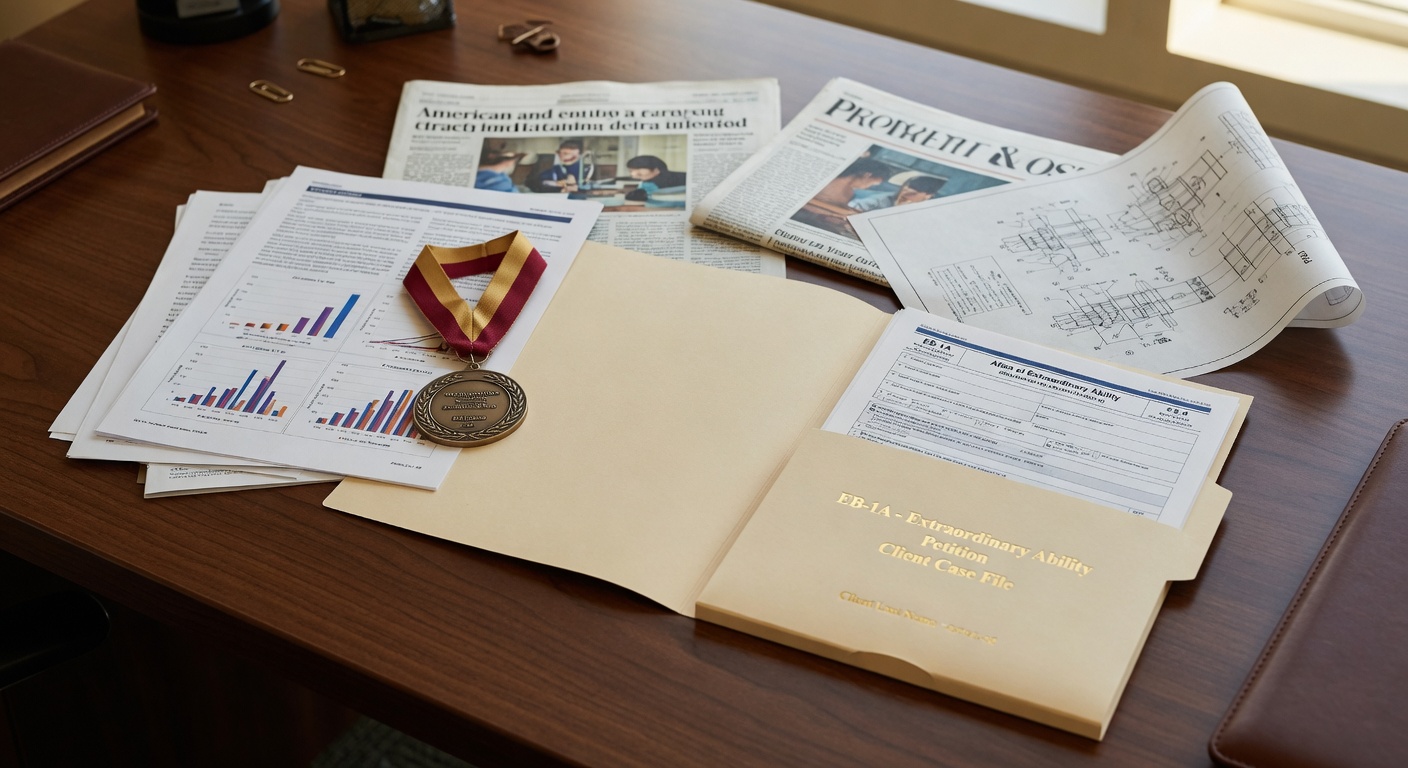
A strong petition is not a pile of exhibits. It is a structured proof package. USCIS officers review a high volume of cases; they should not have to guess why an exhibit matters. The petition letter should define the field, explain the applicant's role in that field, map each exhibit to a criterion, and then make the final merits argument.
Useful evidence often includes:
- Independent media coverage about the applicant and their work.
- Awards with selection criteria and proof of recognition.
- Peer-review invitations, judging records, and evidence of selectivity.
- Publications, citations, patents, open-source adoption, standards work, or product usage.
- Contracts, revenue metrics, funding, user numbers, or other proof of real-world impact.
- Expert letters from credible, independent people who can explain field significance.
- Evidence that the applicant will continue working in the same area after approval.
Expert letters matter, but they cannot carry the whole case. USCIS has become skeptical of generic praise letters. The best letters are specific, sourced, and corroborated by outside documents. A letter saying “she is brilliant” is weak. A letter explaining that her algorithm was adopted by three hospitals, reduced processing time by 38%, and was cited by independent researchers is much stronger.
⚠️ The biggest EB-1A mistake
The biggest mistake is confusing achievement with evidence. USCIS does not approve the life story in your head. It approves the record you file. If the record does not prove selection criteria, field context, independent recognition, and final merits, the case is vulnerable even when the person is genuinely exceptional.
How USCIS attacks weak EB-1A cases
Requests for Evidence and denials usually follow predictable patterns. USCIS may say the award is local, the press is promotional, the judging is routine, the salary comparison is wrong, the membership is open to anyone who pays dues, or the contribution is useful but not major. For founders, USCIS often separates company success from personal acclaim. For researchers, USCIS may say citation counts are not high enough for the field. For executives, USCIS may say the role was important to the company but not evidence of extraordinary ability in the broader field.
The answer is not more adjectives. The answer is better evidence architecture. Define the field narrowly enough to be accurate but not so narrow that it looks invented. Use objective comparisons. Explain why the applicant's work mattered outside their own employer. Tie every exhibit to the regulation. Then make final merits impossible to miss.
Adjustment of status risk after approval
An approved EB-1A I-140 is not the final green card. If the applicant is in the United States, they may still need I-485 adjustment of status. In 2026, USCIS has emphasized discretion in adjustment cases. That means the applicant should preserve lawful status where possible, avoid travel mistakes, disclose immigration history accurately, and prepare a clean adjustment record.
Some applicants consular process abroad. That route has its own risks: interview preparation, administrative processing, country-specific delays, prior status issues, and inadmissibility questions. The EB-1A strategy should be designed with the end path in mind, not just the I-140.
EB-1A versus EB-2 NIW
EB-1A and NIW can both be self-petitioned, but they answer different questions. EB-1A asks whether the applicant has extraordinary ability and sustained acclaim. NIW asks whether the proposed endeavor has substantial merit and national importance, whether the applicant is well positioned to advance it, and whether the United States should waive the job-offer and labor-certification requirement.
EB-1A is usually harder on personal acclaim. NIW may be better for an emerging professional with strong qualifications and a nationally important project but not yet top-of-field recognition. EB-1A may be better for someone with awards, press, judging, high-impact work, or market recognition. In strong cases, filing both can create parallel routes and reduce timing risk.
A practical EB-1A screening checklist
- Define the field. Do not say “technology” if the real field is machine-learning safety, semiconductor packaging, fintech fraud detection, or pediatric oncology research.
- List every possible criterion. Awards, judging, press, publications, original contributions, salary, critical roles, memberships, showcases, and commercial success.
- Separate strong evidence from weak evidence. A national award beats a company plaque. Independent press beats a sponsored profile. Adopted work beats internal praise.
- Build the final merits story. Explain why the evidence proves sustained acclaim, not just eligibility on paper.
- Plan the green-card path. Decide whether adjustment or consular processing is realistic before filing.
- Preserve status and travel strategy. Avoid turning a strong I-140 into a messy I-485 problem.
Frequently asked questions
Can I file EB-1A without an employer?
Yes. EB-1A allows self-petitioning. You do not need a job offer, labor certification, or employer sponsor. You still must show that you will continue working in your area of extraordinary ability.
Do I need to meet all 10 EB-1A criteria?
No. Most applicants must meet at least three criteria, unless they have a major one-time internationally recognized award. But meeting three criteria is only step one. USCIS still conducts a final merits review.
Is O-1A approval enough to win EB-1A?
No. O-1A can help because the standards overlap, but EB-1A is a green-card category with a demanding final merits review. USCIS can approve O-1A and deny EB-1A on the same general profile.
Can founders qualify for EB-1A?
Yes, but founder cases need evidence that the person, not just the company, has extraordinary ability. Press, investment, users, revenue, patents, adoption, awards, judging, and independent expert evidence can help when tied to the founder's personal role.
Can I file EB-1A and EB-2 NIW at the same time?
Often yes. Many strong applicants file both if the facts support both theories. EB-1A and NIW should be argued differently because the legal standards are different.
How Modern Law Group builds EB-1A cases
We start by stress-testing the case before filing. We identify the field, choose the strongest criteria, discard weak filler, and build a final merits argument that an officer can follow. Then we organize exhibits so the petition reads like a proof record, not a scrapbook.
If you are a founder, researcher, artist, executive, physician, engineer, or other high-achieving professional considering EB-1A, Schedule a Consultation. Bring your CV, press, awards, publications, citations, judging records, compensation data, and proof of impact. The right question is not “am I impressive?” The right question is “can we prove it under the EB-1A standard?”