




Quick answer
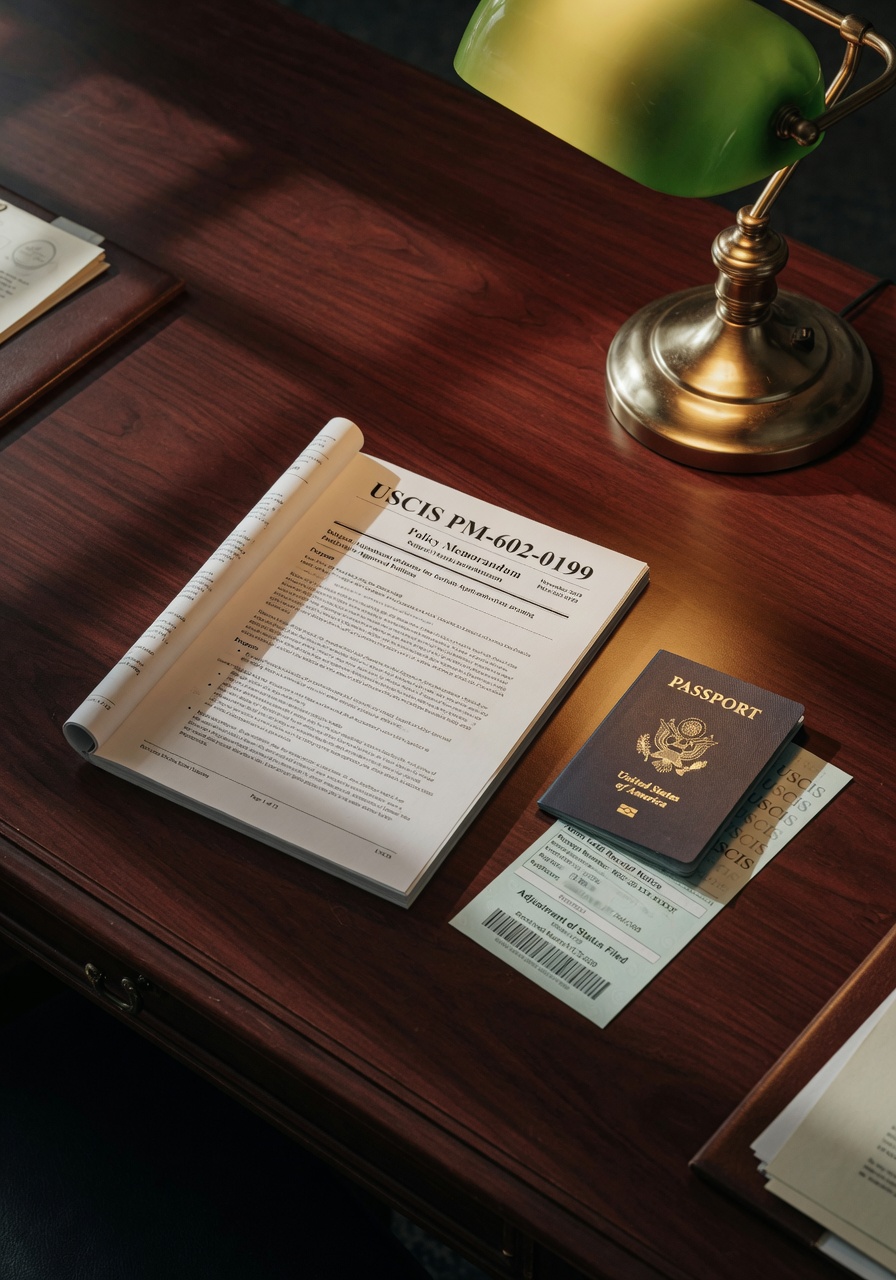
On May 22, 2026, USCIS issued policy memo PM-602-0199, “Adjustment of Status and Discretion.” The memo tells USCIS officers to treat adjustment of status under INA § 245(a) (the in-country I-485 process) as an extraordinary, discretionary form of relief, with consular processing through the Department of State as the new default. I-485 filings are still allowed. What changed is the standard: officers must now weigh the totality of the circumstances — immigration violations, fraud or misrepresentation, conduct after admission, failure to depart, family ties, moral character — before granting adjustment, and they must issue a written reasoned denial when they deny. Dual-intent visa holders (H-1B, L-1, H-4, L-2) are explicitly less exposed but are not exempt. The memo does not set a transition date or address pending I-485s. If you have a pending or planned I-485, do not leave the United States for consular processing until counsel has reviewed your unlawful-presence exposure, § 245(i), 3/10-year bar, and waiver options.
What PM-602-0199 actually changed
Until last week, USCIS treated adjustment of status as the working default for most eligible applicants inside the United States. You filed Form I-485 with USCIS, paid the fee, attended a biometrics appointment and sometimes an adjustment interview, and waited for approval. The statute, INA § 245(a), has always said adjustment “may” be granted — making it formally discretionary — but in practice, officers approved adjustment for applicants who met the eligibility checklist (admitted, eligible category, current priority date, admissible) unless there was a specific negative factor.
PM-602-0199 changes the framing. According to the May 22 USCIS announcement and the memo itself, officers are now told that adjustment of status is an “extraordinary form of relief” and an “act of administrative grace,” not the routine path. The agency points to long-standing Board of Immigration Appeals (BIA) and federal-court decisions saying adjustment is discretionary, and instructs officers to consult those decisions when adjudicating. The result is that the same eligible applicant who would have been approved on the checklist last month may now face a totality-of-circumstances analysis before USCIS will grant the green card from inside the United States.
USCIS Spokesman Zach Kahler framed the policy this way: “An alien who is in the U.S. temporarily and wants a Green Card must return to their home country to apply, except in extraordinary circumstances.” The memo also encourages officers to direct applicants to the State Department’s consular processing route for immigrant visas abroad.
What did not change
This is critical and routinely misreported on social media:
- I-485 filings are still permitted. The memo is directed at adjudicators — how officers decide the case — not at intake. USCIS is not refusing to accept I-485s.
- The eligibility statute, INA § 245(a), is unchanged. Congress has not amended the law. PM-602-0199 is policy guidance interpreting existing law, not a regulation.
- INA § 245(i) and INA § 245(k) eligibility are unchanged. If you grandfathered under § 245(i) by a pre-April 30, 2001 filing, or qualify for the employment-based § 245(k) safe harbor, those provisions still exist.
- Concurrent filing of I-130 + I-485 for immediate relatives is still procedurally available.
- Asylee and refugee adjustment under INA § 209 is governed by a different statute and is not the focus of this memo.
- Section 245(a) bars (entry without inspection, unauthorized employment, etc.) still apply on the eligibility side.
What changed is the discretionary weighting after eligibility is confirmed. A clean-record applicant with no negative factors still has the strongest case. An applicant with a complicated immigration history is exposed in a way the prior practice did not surface.
Who is most exposed under the new memo
USCIS officers are told to weigh, among other things:
- Violations of U.S. immigration laws or conditions of prior status — including overstaying a B-1/B-2, working without authorization, or filing a status change that contradicted the visa’s stated purpose.
- Current or prior instances of fraud or willful misrepresentation in any dealing with USCIS or another government agency — including, for example, misrepresentations on prior visa applications, I-130 petitions, or N-400 forms.
- Whether the original admission or parole violated the law in place at the time — for example, a visa obtained through a misrepresentation never previously charged.
- Conduct after admission inconsistent with nonimmigrant intent — the memo flags conduct “inconsistent with the purpose of that nonimmigrant status” or with representations made to the consular officer.
- Failure to depart as expected. Quarles & Brady’s May 22 summary calls this a “highly relevant” negative factor.
- Family ties, immigration history, and moral character — positive factors that must be weighed against the negatives.
The applicants most exposed are people who entered on a single-intent visa (B-1/B-2 visitor, F-1 student, J-1 exchange) and then married a U.S. citizen or otherwise moved to adjust through I-485. The exposure is sharpest when the I-485 was filed less than 90 days after entry, where the agency’s long-standing “90-day rule” creates a presumption of misrepresentation. The memo does not invent that rule, but it gives officers more room to invoke it as a discretionary negative.
Who is more protected: dual-intent visa holders
The memo itself singles out applicants in dual-intent nonimmigrant categories — primarily H-1B, L-1, H-4, and L-2. Quarles and other practitioners reading PM-602-0199 conclude that adjustment from these categories is not presumed inconsistent with the underlying visa, because Congress and DHS have long recognized that an H-1B or L-1 worker can lawfully hold simultaneous nonimmigrant status and the intent to become a permanent resident.
That is not a get-out-of-discretion-free card. The USCIS memo cautions that maintaining H-1B or L-1 dual-intent status, standing alone, is not enough to compel a favorable exercise of discretion. The officer must still weigh the totality. But the absence of a fundamental purpose-mismatch removes the largest negative factor that drags single-intent adjustment cases.
Other adjustment pathways that fit poorly with single-intent expectations — for example, EB-1A or EB-2 National Interest Waiver self-petitions filed by a current H-1B worker — remain available, and the dual-intent recognition should carry over. EB-5 investors typically already structure their cases around a separate path and have less single-intent exposure.
The six discretionary factors USCIS officers will now weigh
Practitioners reading PM-602-0199 are extracting roughly the same factor list. We line them up here because clients need to know what the officer is now looking at:
- Immigration history and lawful status compliance. Have you held the status you said you held? Did you maintain it without unauthorized employment or overstay?
- Fraud or willful misrepresentation, past and present. Did you tell the truth on prior visa applications, I-130s, I-129s, asylum applications, or N-400s? Misrepresentations to any government agency are now in scope.
- Conduct consistent with the nonimmigrant purpose of admission. Did you do what you told the consular officer or CBP officer you would do?
- Failure to depart as expected. Did you stay past authorized stay, or treat a temporary admission as a permanent move?
- Family ties to the United States. U.S. citizen or LPR spouse, children, parents, siblings — and the duration and depth of those ties.
- Good moral character and overall conduct. Criminal record, tax compliance, contributions to community, and any rehabilitation evidence for past issues.
An officer must weigh all of these in the totality. The memo also reaffirms a longstanding rule: when USCIS denies a benefit request, it must issue a written denial notice explaining the specific reasons — which makes preserving the record for an appeal or motion to reopen more important than ever.
Should you switch to consular processing?
The instinctive reaction to PM-602-0199 is to abandon the I-485 and file a Form DS-260 immigrant visa application abroad. Do not make that decision on instinct. Consular processing has its own hazards, and for many applicants those hazards are worse than the new discretionary risk inside the United States:
- The 3-year and 10-year unlawful presence bars (INA § 212(a)(9)(B)). If you have accrued more than 180 days, or one year, of unlawful presence in the United States, departing for consular processing triggers a 3-year or 10-year reentry bar. A provisional unlawful presence waiver (Form I-601A) is available for immediate relatives of U.S. citizens and certain other family-based applicants, but the wait time for I-601A approvals is currently 36–42 months and the waiver requires extreme hardship to a U.S. citizen or LPR spouse or parent. If your only qualifying relative is a U.S. citizen child, you are not eligible.
- The permanent bar (INA § 212(a)(9)(C)). If you accrued more than one year of unlawful presence and then reentered or attempted to reenter without inspection, the permanent bar applies, and the waiver requires a 10-year departure plus a Form I-212 consent to reapply.
- Family separation risk. Consular processing can take 6–18 months at many posts, and the applicant must stay outside the United States the entire time. Children, jobs, lease obligations, and pending civil matters do not pause.
- Public charge and INA § 221(g) refusals. Consular officers apply their own discretion. A 221(g) refusal sends the case back to the National Visa Center or for administrative processing, sometimes for many months.
- Section 245(i) loss. If you are grandfathered under § 245(i) by a qualifying pre-April 30, 2001 filing, you may be giving up the most valuable procedural protection in the immigration code by leaving.
For applicants without unlawful presence or other inadmissibility issues — for example, H-1B workers in valid status, L-1 transferees, or recently arrived immediate relatives of U.S. citizens — consular processing may now be the cleaner path. For applicants with significant unlawful presence, single-intent visa overstay, or prior misrepresentation history, leaving the United States can convert a discretionary risk into a categorical bar.
What pending I-485 applicants should do this week
If you have an I-485 already filed and pending, do not panic and do not abandon it. The memo does not address pending cases on the transition. Concrete steps:
- Audit your file. Pull your full I-485 packet, prior visa applications, I-129/I-130 history, and any RFE responses. Identify any inconsistencies or admissions that the new discretionary review could weight as a negative.
- Document positive equities. Letters from U.S. citizen and LPR family members, evidence of tax compliance, evidence of employment authorization compliance, community involvement, religious involvement, evidence of property and stable residence.
- Prepare for a 90-day-rule problem if applicable. If you adjusted within 90 days of last entry on a single-intent visa, prepare counter-evidence that the intent to remain developed after admission — not before.
- Consider counsel for the interview. Adjustment interviews historically focused on bona fides of the underlying relationship (for marriage cases) or eligibility category. Under the new memo, expect more discretionary-factor questions: travel patterns, prior visa applications, prior employment, prior tax filings.
- Watch the I-485 RFE pattern. Expect an increase in RFEs targeting the new discretionary factors. Respond fully and document.
What new I-485 applicants should do
If you have not yet filed an I-485 but were planning to:
- Get a written immigration-history audit before filing. The cost of a 2-hour audit is dramatically less than the cost of a discretionary denial.
- Consider the consular-processing tradeoff explicitly. An attorney should walk you through your unlawful-presence exposure, § 245(i) eligibility, waiver eligibility, and the cost of being outside the United States during processing.
- If you are in H-1B, L-1, H-4, or L-2 status, your in-country adjustment path remains the strongest option. The new memo’s dual-intent acknowledgment protects you, and leaving for consular processing would forfeit that protection.
- If you are in F-1, B-1/B-2, or J-1 status, run the dual-intent calculation carefully. Filing an I-485 from a single-intent visa is now a more substantive discretionary call than it was 30 days ago.
Frequently asked questions
Has Congress changed the law?
No. PM-602-0199 is a USCIS policy memo. It interprets INA § 245(a), the BIA’s long-standing position that adjustment is discretionary, and federal-court decisions on discretion in immigration adjudications. Congress has not amended § 245.
Will my pending I-485 be denied?
Not automatically. The memo does not direct a categorical denial of pending I-485s. It directs officers to apply the discretionary framework when they adjudicate. Clean-record applicants with no negative factors remain in the strongest position; applicants with negative factors should expect more searching review.
I have an interview scheduled next month. What should I do?
Prepare for both eligibility and discretionary questions. Bring documentation of family ties, tax compliance, employment authorization history, travel records, and any positive equities. Consider having counsel present.
I am on H-1B with an approved I-140 and an I-485 pending — am I in trouble?
You are in the most protected category. The memo singles out H-1B and L-1 dual-intent applicants as less affected. Maintain valid H-1B status while the I-485 is pending and document compliance — pay stubs, LCA-compliant wages, current H-1B extension records.
I came on a tourist visa and married a U.S. citizen 4 months after entry. Should I still file?
You can still file. Whether you should depends on your facts, especially the 90-day-rule presumption and any prior visa history. An attorney should walk through the misrepresentation analysis and the consular-processing tradeoff before you file.
What about EB-5 investors?
The memo does not address EB-5 specifically, and investor adjustment cases typically come with different documentary foundations. Standard EB-5 discretionary considerations continue to apply; the new memo does not appear to create a heightened bar for EB-5 adjustment.
What about asylees and refugees adjusting under INA § 209?
Asylee and refugee adjustment is governed by INA § 209, a different statute, and the memo focuses on § 245(a) discretion. While § 209 adjustment is also formally discretionary, the framework historically differs and PM-602-0199 does not target it.
If I leave for consular processing, will I trigger an unlawful-presence bar?
If you accrued more than 180 days of unlawful presence after age 18 and then depart, you are subject to the 3-year bar; more than one year, the 10-year bar. Some applicants can request a provisional waiver (I-601A) before departure if they have a qualifying relative and can show extreme hardship. Do not depart until a waiver strategy is in place.
When does the memo take effect?
The memo is dated May 21, 2026 and was announced May 22, 2026. USCIS has not published an implementation date for pending cases. The agency may issue further category-specific guidance.
Can I appeal a discretionary denial?
I-485 denials are generally not appealable to the Administrative Appeals Office in family-based cases, but you can file a motion to reopen or reconsider before USCIS, or seek review in immigration court if you are placed in removal proceedings. The written denial notice required by the memo will be the foundation for any challenge.
A Modern Law Group practice note
We have spent the past 72 hours pulling the I-485 file on every pending case in our practice and re-grading each one against the discretionary factors PM-602-0199 highlights. The pattern is consistent: clean-record applicants are still clean. The cases that need new work are the ones with single-intent entry followed by a status change inside the United States, prior misrepresentation history that was never raised, or extended periods of unauthorized work. For those clients, the right next move is rarely “leave the country.” It is usually a documented totality-of-circumstances response, prepared in advance, that makes the discretionary call easy for the officer to resolve in the applicant’s favor.
If your I-485 is pending, do not wait for an RFE to start documenting equities. If you have not yet filed, get the analysis before paying the filing fee. If you are weighing consular processing, do not depart the United States until your unlawful-presence math and any waiver strategy are confirmed by counsel.