



Bottom line
The green card interview is the last gate between you and your permanent residence, and in 2026 almost every I-485 applicant has to walk through it. The good news: the interview rewards preparation more than anything else. Officers are looking for consistency, credibility, and complete documents. If you know what they will ask, bring the right originals, and can describe your own life and application without contradicting your paperwork, most interviews are short and end in approval. This guide walks you through exactly how to get ready, from six weeks out to the moment the officer says "congratulations."
How to prepare for a green card interview, in one paragraph
Gather the originals of everything you filed, re-read your own I-485 and I-130 line by line so nothing surprises you, and prepare to answer honestly about your relationship, your background, and your finances. Update your address with USCIS so the interview notice actually reaches you, bring an organized copy set for the officer, dress like you would for a job interview, and arrive early. If your file has any complication — a prior overstay, an arrest, a gap in your evidence — have an attorney review it before the interview, not after. Everything below is the detailed version of that paragraph.
Six weeks out: build your file before the notice pressure hits
Most green card interview problems trace back to one mistake: the family waited until the appointment notice arrived to start preparing, and by then they had two or three weeks. Start the moment your case is filed, or the moment you read this if it is already pending. Here is the timeline that works.
Step 1 — Lock down your address
The interview notice goes to the address in your USCIS file. If you have moved since filing, update it immediately: file Form AR-11 online and update the address on your pending I-485 through your USCIS online account or your attorney. A notice that goes to an old address is a missed interview, and a missed interview can be treated as abandonment.
Step 2 — Re-read your own application
Pull your complete I-485, the underlying I-130, and every supporting document you submitted. Read them as if you were the officer. The dates, addresses, employers, and entries you listed are what you will be asked to confirm under oath. If anything is wrong, incomplete, or has changed since filing — a new job, a new address, a new child — note it so you can explain it clearly at the interview instead of being caught off guard.
Step 3 — Refresh your evidence up to today
Your filing evidence may be a year or more old by interview day. For marriage cases especially, add current proof of a shared life: recent joint bank statements, a current lease or mortgage statement, updated insurance naming each other, and photos from the months since you filed. For all cases, get the sponsor's most recent tax return and pay stubs so the I-864 financial picture is current.
Step 4 — Address any red flags with counsel
Prior visa overstay, a prior removal order, an arrest or conviction, a prior misrepresentation, or a public charge concern will come up. These are exactly the issues an attorney should review before the interview so you walk in with a prepared, truthful explanation and any waiver or supporting documentation already in hand.
What to bring: the green card interview document checklist
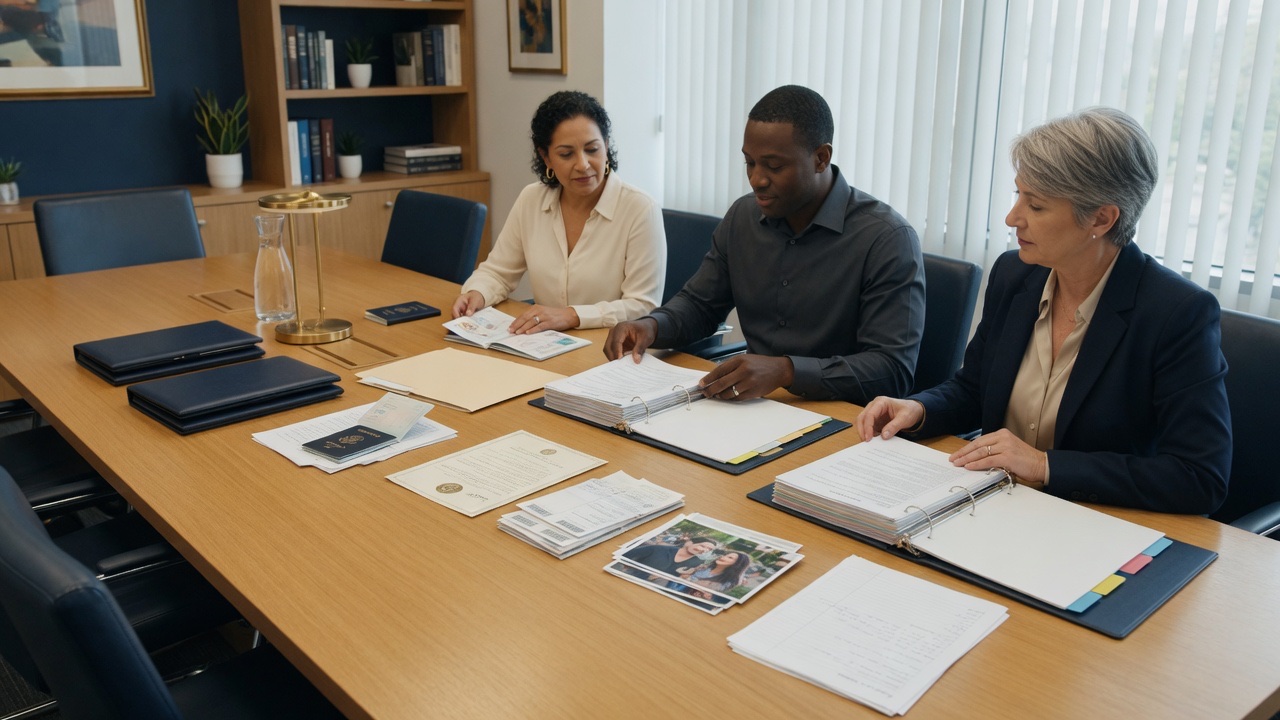
Your appointment notice lists what USCIS wants, and that list controls. Beyond it, this is the standard set our clients bring to an adjustment of status interview. Bring originals plus one organized copy set for the officer.
- The appointment notice and a government-issued photo ID for each person attending
- Passports (current and expired) and all I-94 records and entry stamps
- Original civil documents: birth certificates, marriage certificate, and any divorce decrees or death certificates ending prior marriages
- The I-130 approval notice and a copy of the full I-485 package you filed
- Financial support: the I-864 Affidavit of Support, the sponsor's most recent federal tax return and W-2s, recent pay stubs, and a current employment verification letter
- Marriage bona fides (marriage cases): joint bank and credit card statements, lease or mortgage, joint utility bills, insurance policies naming each other as beneficiaries, and photographs spanning the relationship
- Medical exam: the sealed Form I-693 if you have not already submitted it
- Certified dispositions for any arrest, citation, or criminal charge, even if dismissed
Organize it, do not just carry it
Officers form an impression in the first minute. A labeled folder where you can hand over any requested document in ten seconds signals a credible, well-prepared applicant. A grocery bag of loose papers signals the opposite and invites closer scrutiny.
What the officer will actually ask
A green card interview is not a test you can fail by not knowing a fact. It is a credibility and eligibility check. The questions fall into three buckets.
1. Confirming your application under oath
The officer places you under oath and walks through your I-485: your name, date and place of birth, addresses, employment, immigration history, and how you entered the United States. This is why re-reading your application matters. You are not expected to memorize it, but your live answers should match what you filed. If something has changed since filing, say so plainly.
2. Relationship questions (marriage and family cases)
For marriage-based cases, the officer probes whether the marriage is genuine. Expect questions about how and when you met, your wedding, where you live, your daily routine, who pays which bills, how you spend holidays, and details about each other's family, work, and habits. The goal is not to trip you up on trivia — it is to confirm that two people who claim to share a life actually do. Answer from your real experience; couples who try to script identical answers often sound rehearsed and raise more suspicion, not less.
3. The Part 8 background questions
Every applicant answers the Form I-485 Part 8 eligibility questions: arrests and convictions, prior removals or deportations, immigration fraud or misrepresentation, membership in certain organizations, and public charge history. Answer these truthfully. A disclosed problem is often waivable; a concealed one that surfaces later is frequently fatal to the case and can support a fraud finding. If you answered yes to any of these on your form, this is where the officer asks for the details and documentation.
⚠️ The separate-room interview
Most married couples are interviewed together. But if the officer sees inconsistencies or suspects a marriage entered into for immigration purposes, they can separate spouses into different rooms and compare answers question by question — sometimes called a Stokes interview. There is no way to bluff through this. The only protection is a genuine marriage you can both describe consistently, and, for higher-risk cases, an attorney present who can intervene if the questioning becomes improper.
The day of: logistics, dress, and demeanor
- Arrive early. Plan to be at the field office at least 30 minutes before your appointment to clear security. Bring only what you need; many offices restrict large bags and electronics.
- Dress like a job interview. Neat, clean, business-casual. You are not being judged on fashion, but respect for the process registers.
- Bring your interpreter if you need one. If you are not fluent in English, bring a qualified interpreter (USCIS has specific rules on who can serve). Do not guess at questions you did not understand — ask for them to be repeated or translated.
- Answer the question asked. Listen fully, then respond directly. Do not volunteer information beyond the question or speculate. "I don't know" and "I don't remember" are acceptable answers when they are true.
- Tell the truth, even when it is uncomfortable. Credibility is the currency of the interview. One caught inconsistency can turn a routine approval into a Request for Evidence or a fraud referral.
- Stay calm and courteous. Officers deal with nervous applicants all day; nerves are normal and expected. Hostility and evasiveness are the things that hurt you.
What happens after the interview
There are four common outcomes:
- Approved on the spot. The officer tells you the case is approved or recommended for approval. You will see the online status update within days to weeks and receive your physical green card by mail.
- Held for review. The officer needs to finish background checks or review your file. This is common and not a bad sign by itself; watch your case status online.
- Request for Evidence (RFE). Something is missing or needs corroboration. Respond completely and before the deadline. A well-prepared response usually resolves it.
- Notice of Intent to Deny (NOID) or denial. The officer has serious concerns. This is the stage where legal representation matters most, because you have a limited window to rebut the government's stated reasons before the denial becomes final.
Common mistakes that sink green card interviews
- Treating the interview as a formality and never re-reading the application that will be quoted back to you
- Bringing copies instead of originals, or leaving required documents at home
- Failing to update an address, so the interview notice never arrives
- Trying to memorize or script answers instead of describing a real, lived relationship
- Guessing at questions you did not understand rather than asking for clarification
- Concealing a prior arrest, overstay, or misrepresentation that the officer can already see in the record
- Walking into a case with a known legal complication without an attorney
What we see at Modern Law Group
We have prepared clients for adjustment of status interviews at field offices across Texas and California, and the pattern is consistent: preparation is almost everything. The interviews that go sideways are rarely the ones with a genuinely weak case. They are the ones where nobody looked at the file between filing and the appointment, where a document was missing, or where a prior issue that could have been explained was instead discovered live by the officer. The interviews that go smoothly are the boring ones — organized documents, an applicant who knows their own record, and a truthful, consistent account of their life.
Frequently asked questions
What should I bring to my green card interview?
Bring the original of every document you copied into your I-485 packet: passports and all I-94 records, birth and marriage certificates, the I-130 approval notice, your interview appointment notice, government photo ID, and the I-864 sponsor's most recent tax returns, W-2s, and pay stubs. For marriage cases, bring updated joint-life evidence: lease or mortgage, joint bank and credit card statements, insurance policies naming each other, and photos across the length of the relationship. Always bring originals plus one copy set.
What questions does the officer ask at a green card interview?
The officer first confirms the answers on your I-485 under oath, including the Part 8 background questions about arrests, prior removals, and misrepresentation. In marriage cases they then ask about your relationship and daily life: how you met, your wedding, your daily routine, who handles the finances, and details about each other's family and habits. Answer truthfully and directly; do not guess or volunteer beyond the question.
Will my spouse and I be interviewed separately?
Not usually. Most marriage-based interviews are conducted with both spouses in the room together. But if the officer sees inconsistencies or suspects a non-genuine marriage, they can split you into separate rooms and compare your answers question by question, which is often called a Stokes interview. Being able to describe your shared life consistently is the best protection against that escalation.
What should I wear and how should I act at a USCIS interview?
Dress as you would for a job interview: neat, clean, business-casual. Arrive at least 30 minutes early to clear security, silence your phone, and treat the officer with courtesy. Listen to the full question before answering, tell the truth even when it is uncomfortable, and say you do not understand or ask for your interpreter rather than guessing. Demeanor matters, but credibility and consistency matter far more than clothing.
What happens after the green card interview?
The officer may approve you on the spot, tell you the case is being held for review, or issue a Request for Evidence or Notice of Intent to Deny if something is missing or inconsistent. If approved, you typically see the status update online within days to weeks and receive your physical green card by mail. If you get a Request for Evidence, respond fully and on time; an attorney can help you cure the issue before it becomes a denial.
Can I bring a lawyer to my green card interview?
Yes. You have the right to be represented by an attorney at your adjustment of status interview, and the lawyer files Form G-28 to appear with you. An attorney cannot answer the factual questions for you, but can object to improper questions, clarify the record, address prior issues in your file, and step in if the officer moves toward a separate-room Stokes examination. For cases with any complication, representation is strongly advised.
A Modern Law Group practice note
The applicants who sail through their green card interviews are not the ones with the simplest cases — they are the ones who prepared. They updated their address so the notice arrived, they re-read their own file, they walked in with organized originals, and they told the truth without rehearsing it into something that sounded false. Where a prior issue existed, they had already addressed it with counsel instead of hoping the officer would not notice. If your I-485 is pending and you have not looked at your file since the day it was filed, that review is the single highest-value thing you can do before your interview.