


Bottom line
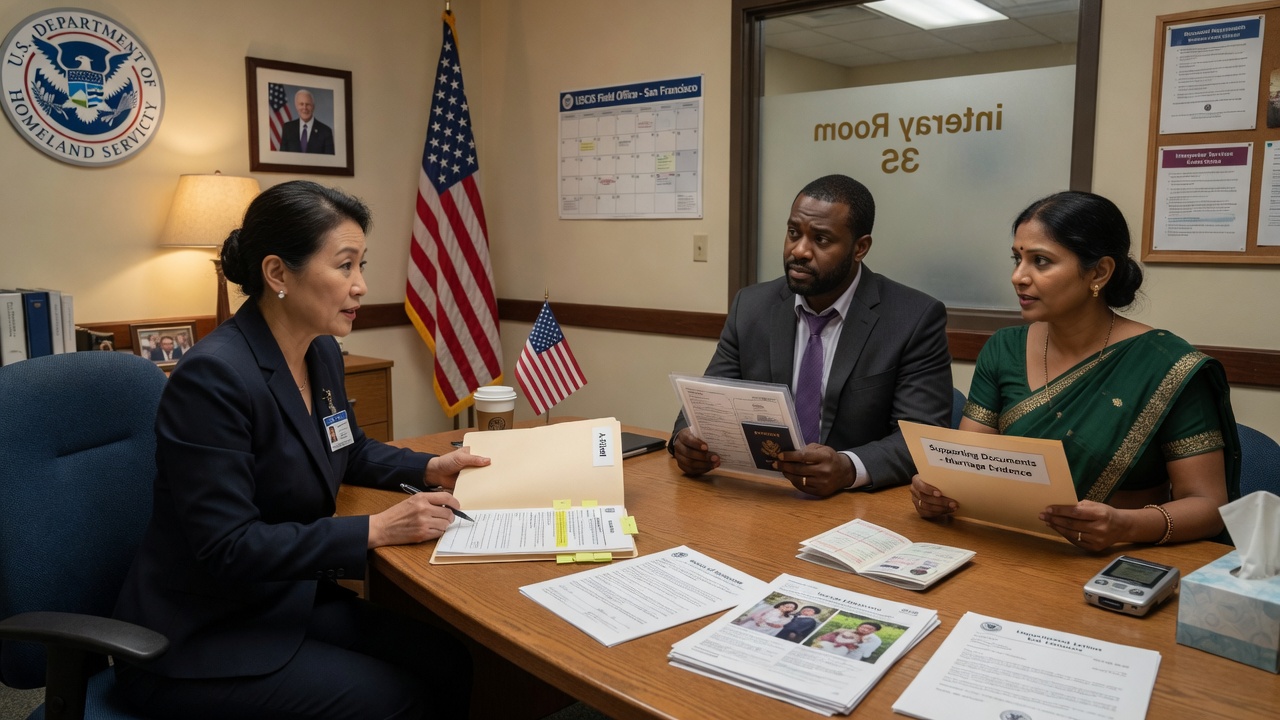
If you filed or are about to file an I-485 adjustment of status application in 2026, plan on attending a mandatory in-person interview at a USCIS field office. The widespread interview waivers of the prior administration are gone. USCIS now treats face-to-face interviews as the default for virtually every applicant — and officers are using them more aggressively than before. Here is what changed, who it affects, how long you can expect to wait, and what you should be doing right now to protect your case.
What Changed: The End of the Waiver Era
From roughly 2018 through 2024, USCIS exercised broad discretion to waive in-person interviews for two major categories of I-485 applicants:
- Family-based cases (I-130 spouses, parents, children) where the petitioner had already been vetted and the relationship appeared straightforward on paper
- Employment-based cases (EB-1, EB-2, EB-3) where the I-140 petition had been approved and the supporting documentation was complete
During that period, many applicants went from filing to approval without ever speaking to an officer. The waiver program reduced USCIS backlog pressure and cut processing times at busy field offices.
In 2026, that approach has reversed. USCIS field offices are now scheduling in-person interviews for nearly all I-485 filers — including many whose cases were filed during the waiver period and were sitting in limbo awaiting adjudication. The policy is not a guidance memo or a preference. It is a directive: show up, answer questions, bring your documents.
Who Is Affected
The reinstatement of mandatory interviews hits these categories hardest:
- Marriage-based I-485 filers — always required interviews at some offices; now universal across all field offices
- Family-based I-485 filers (parents, adult children, siblings) — largely waived before, now being called in
- Employment-based I-485 filers — EB-1, EB-2 NIW, EB-3 cases previously waived are increasingly receiving interview notices
- Pending filers — if your I-485 has been pending for over a year without an interview, expect a notice; USCIS is working through the backlog
The only category where interview waivers remain available is a narrow slice of employment-based cases at specific USCIS field offices with active waiver programs. These are increasingly rare and not guaranteed.
What Officers Are Looking For Now
USCIS officers in the 2026 interview environment are not simply confirming paperwork. They are actively scrutinizing five areas in particular:
1. Relationship Bona Fides
For marriage-based and family-based cases, officers probe whether the qualifying relationship is genuine. Expect questions about how you met, your daily routine, shared finances, housing, children, and any periods of separation. Officers cross-reference the I-130 petition against the I-485 and look for inconsistencies between what was claimed at petition and what applicants say at interview. Spouses are often interviewed in separate rooms and answers are compared.
2. Prior Immigration Violations
Any period of unlawful presence, prior visa overstay, or prior removal order gets examined closely. Officers check Form I-485 Part 8 background disclosures against USCIS, CBP, and DOJ databases. If you disclosed something on your I-485 that you did not fully explain — or failed to disclose something — the interview is where it surfaces. Incomplete disclosure is a common ground for denial even when the underlying issue would have been waivable.
3. Social Media and Public Record
USCIS officers may review publicly available social media content as part of background review. Posts that suggest a relationship is not genuine, that contradict statements on the application, or that raise national security or criminal concerns can stop a case. This is not theoretical — it happens at field offices and the results can delay or sink an otherwise approvable case.
4. Public Charge Factors
Officers review the I-864 Affidavit of Support, the I-944 Declaration of Self-Sufficiency where required, and income documentation. Cases where the sponsor is marginally above the 125% Federal Poverty Guideline threshold or where the applicant has prior public benefits use receive closer attention. Officers ask follow-up questions about employment, income stability, and household finances.
5. Document Authenticity
Officers are trained to identify altered documents, fraudulent translations, and inconsistent evidence. If supporting documents — birth certificates, marriage certificates, financial records — look inconsistent with known country-of-origin document standards, officers may request originals, additional verification, or issue a Request for Evidence. Original documents should always be brought to the interview; certified copies alone are sometimes not sufficient.
How Long to Wait for a 2026 Interview Notice
Interview scheduling depends heavily on the local USCIS field office. As of mid-2026, the general ranges across our practice:
- High-volume offices (Los Angeles, New York, Chicago, Miami): 12 to 18 months from I-485 filing to interview notice
- Mid-size offices (Dallas, Houston, Phoenix): 8 to 14 months
- Smaller offices: 6 to 10 months, though scheduling backlogs are increasing everywhere
Cases filed under the waiver era and still pending are being pulled into the interview queue first, which is extending wait times for newly filed I-485 applications. Cases with pending waivers, medical issues, or national security holds can wait longer. At Modern Law Group, we track field office scheduling trends and can give you a realistic estimate based on where your case will be adjudicated.
Five Steps to Take Right Now
If your I-485 is pending or you are about to file, these five steps matter most:
- Verify your address with USCIS. Interview notices go to the address on file. If you have moved since filing, update immediately using Form AR-11 and an I-485 address update through the USCIS online portal or your attorney. A missed notice is a missed interview is a potential denial.
- Gather and organize your original documents. The interview notice will list what to bring, but standard documents include: original passports and all I-94 records; tax returns and W-2s for the past three years; pay stubs; joint bank account statements; lease or mortgage documents; birth certificates for any U.S. citizen children; and the original I-130 approval notice.
- Review your application for consistency. Inconsistencies between your I-130, I-485, and supporting documents are the most common interview problems. Have an attorney conduct a full file review before your interview date. What looks like a minor discrepancy on paper can become a credibility issue in person.
- Prepare for relationship questions. Marriage-based applicants should be able to answer detailed questions about daily life, finances, and shared history — separately from each other, since officers often interview spouses in different rooms. Preparation is not coaching to fabricate answers; it is making sure both spouses can accurately describe their genuine life together.
- Address any prior issues proactively. If there is a prior visa violation, prior removal order, prior criminal matter, public charge concern, or any Form I-485 Part 8 disclosure in your file, address it with an attorney before the interview. Officers will ask about it. Walking in without a prepared explanation is the fastest way to turn a solvable problem into a denial.
What We See at Modern Law Group
We have guided hundreds of clients through USCIS interviews at field offices across Texas and California. Since the mandatory interview policy reinstated in 2026, we have seen a clear pattern: cases that were prepared as if the interview would be waived — with loose documents, unreviewed inconsistencies, and no interview coaching — are the ones generating Requests for Evidence, extended delays, and denials. Cases with thorough preparation go smoothly even when officers probe hard.
The mistake we see most often: families who filed their I-485 during the waiver era, never expected an interview, and are now receiving notices with two or three weeks to prepare. At that point, problems that should have been addressed during filing become urgent. If your I-485 is pending and you have not reviewed your file since it was filed, now is the right time.
Frequently asked questions
Does everyone filing an I-485 now have to attend an interview?
Yes, for the vast majority of applicants. USCIS reinstated nearly universal in-person interviews for adjustment of status in 2026. Only a narrow category of employment-based cases at certain USCIS field offices may still receive interview waivers, and those are becoming rare.
What changed from the previous interview waiver policy?
Under prior administrations, USCIS widely waived interviews for many family-based and some employment-based I-485 filers whose paperwork appeared complete and whose backgrounds were clear. The 2026 policy reverses that: USCIS now treats interviews as mandatory for virtually all applicants, using them to probe credibility, document authenticity, and admissibility issues that were previously screened only on paper.
How long will I wait for my green card interview in 2026?
Field office wait times vary significantly. Many applicants are seeing notices 8 to 18 months after filing, depending on the local office. High-volume offices like Los Angeles, New York, and Miami have the longest queues. Officers are working through a backlog of cases that were filed under the waiver era and now require scheduling.
What does USCIS look at differently in the new interview era?
Officers in 2026 are paying close attention to: the bona fides of the underlying relationship (marriage, family, employer); any period of unlawful presence or prior immigration violations; social media history; public charge factors under the updated I-944 framework; and any discrepancies between the petition and the I-485 supporting documents.
Can my case still be approved without an interview?
It is possible but increasingly rare. Some employment-based I-485 filers at specific USCIS field offices may still have their interview waived if the officer determines one is not necessary. For family-based cases, waivers are now exceedingly uncommon. If your case is interview-waived, USCIS will notify you in writing.
What happens if I miss my USCIS interview notice?
Missing a USCIS interview notice without rescheduling can result in your I-485 being administratively closed or denied for abandonment. If you cannot attend, you must contact USCIS before the interview date to request a reschedule. An attorney can file the reschedule request and flag any address or notice delivery issues.
A Modern Law Group practice note
The I-485 interview cases that go wrong share a recognizable pattern: the family assumed the interview would never happen, the file was never reviewed after the initial filing, and the first time anyone looked closely at the documents was the week before the appointment. The cases with real leverage look different. Counsel reviews the full file months before the interview, addresses inconsistencies while there is still time to correct them, and prepares the applicant to answer every question the officer is likely to ask — not to script responses, but to make sure the truth comes through clearly under pressure. If your I-485 is pending and you have not reviewed your file since it was filed, that is where to start.