





Quick answer
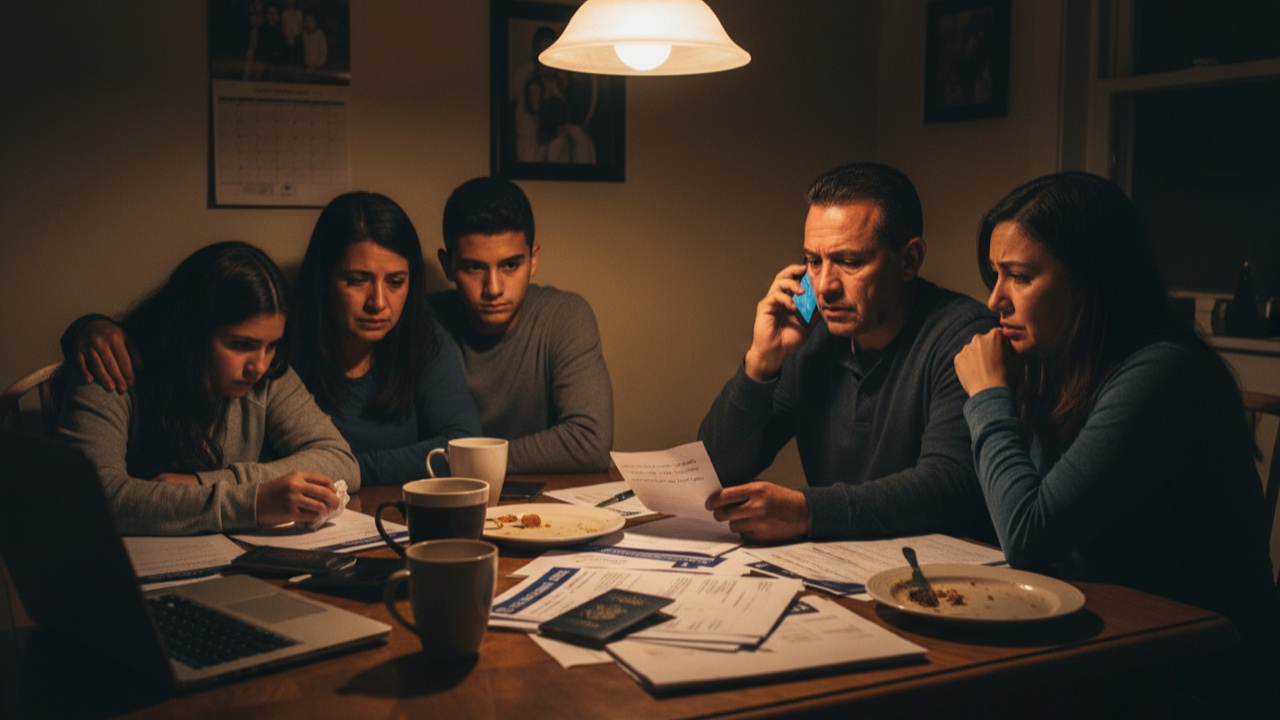
ICE booked a record 43,138 people into detention in June 2026 — the highest single month of the current administration, according to a Guardian analysis of ICE data released July 20. If your husband, wife, parent, or child was just detained, the first 48 hours decide more than any other stretch of the case. Three things matter now, in order: locate the person and record their A-number, get an immigration attorney on the phone, and make sure they sign nothing. Bond comes next. This is the hour-by-hour playbook.
The numbers behind the fear are real. ICE recorded more than 43,000 new bookings into detention in June 2026, an average of roughly 1,400 a day, with a late-June surge that reached about 2,000 arrests a day. The detained population has stayed elevated in the tens of thousands. For the family on the receiving end, the statistic is one phone that stops answering, one person who did not come home from work, one voicemail from a facility 600 miles away.
What families almost never have is a plan for the first two days. They lose hours to panic, to calling the wrong agency, to waiting for a callback that does not come — and in that window the detained person is often moved across state lines, pressured to sign a removal document, and processed into a system that gets harder to reverse with every passing hour. The good news is that the first 48 hours are also the most controllable part of the whole ordeal, if you know exactly what to do. Below is the sequence we walk families through, grounded in the statutes and the practical mechanics of how detention actually works.
Why the June surge changes the math for your family
Two features of the June enforcement surge matter for how you respond. First, the pace of transfers has increased. When ICE books thousands of people a week, local jails and initial processing centers fill quickly, and detainees are moved to contract facilities — frequently in Louisiana, Mississippi, Texas, Georgia, and Arizona — often within 24 to 72 hours of arrest. A person arrested in Chicago on a Tuesday can be in a Louisiana facility by Friday. The family that waits a week to act is often looking for someone who is no longer in the state where they were taken.
Second, the information lag has grown. The ICE Online Detainee Locator at locator.ice.gov is the public tool for finding a detained person, but it can lag the actual booking and transfer by 24 to 72 hours. During a surge, that lag stretches. This is precisely why the first hours — the ones where you can still gather information directly — are so valuable. What you write down at hour one is often better than what any database will show you at hour twenty.
Quick context
Most interior ICE arrests are administrative, not criminal. They are made under 8 U.S.C. § 1357 (INA § 287), which lets an immigration officer arrest without a judicial warrant a noncitizen the officer believes is in the country in violation of immigration law. That means there is usually no criminal court, no public docket, and no automatic right to appointed counsel. The family is the case's first responder. That is not a metaphor — it is the structural reality of the system.
Hour 0 to 6: Find them and lock down the basics
The first six hours are for gathering, not deciding. Every piece of information you collect now saves hours later and gives an attorney what they need to move fast. Work this checklist:
- Get the A-number. The "alien registration number" (an A followed by 8 or 9 digits) is the single most important identifier in the entire system. It is on any prior immigration paperwork — an EAD card, a prior notice from immigration court, an old application receipt. If you can find it in a drawer tonight, do it. Everything downstream — the locator, the field office, the bond — runs on the A-number.
- Record the arrest facts. Full legal name, date of birth, country of birth, the exact location of the arrest, the time, the names or badge numbers of any officers, and the agency named on any paper they left. Photograph any document left behind.
- Find the witnesses. Anyone who saw the arrest — a coworker, a neighbor, a passenger. Get their phone numbers tonight. Memories and availability both fade fast.
- Do not post the details publicly. Avoid broadcasting the person's status, entry history, or case facts on social media. Those posts can be seen, and they can hurt the case.
The document your relative must not sign
The most expensive mistake made in the first 48 hours happens inside the facility, not outside it. Officers may present a detained person with a Form I-826 ("Notice of Rights and Request for Disposition"), a voluntary departure request, or a stipulated removal order. Signing any of these can waive the right to see a judge and can end the case before a lawyer ever gets involved. Get word to your relative, through the facility or through counsel, to say one sentence and repeat it: "I want to speak to a lawyer before I sign anything." That sentence is not a magic spell, but it is a legal right, and it preserves every option that matters.
Hour 6 to 24: Get counsel and work the locator
By the end of the first day you want a lawyer engaged and the detained person located in the system. These run in parallel.
Call an immigration attorney — before you call anyone else back
Immigration detention is administrative, which means there is no public defender assigned. An experienced immigration attorney can identify the field office, file a Form G-28 notice of appearance, and often reach the detained person faster than the family can. If you do not yet have counsel, call an established immigration firm or a major nonprofit program (Catholic Charities, RAICES, or the AILA lawyer-referral service). Have the A-number and arrest facts ready when you call — it is the difference between a five-minute call and a five-day delay.
Search the ICE Online Detainee Locator
Go to locator.ice.gov. Search by A-number plus country of birth, or by full name plus country plus date of birth. If the person does not appear, that usually means the data has not caught up, not that they are not in custody. Check every few hours. Note the facility the moment it appears.
Identify the ERO field office
The Enforcement and Removal Operations (ERO) field office covering the place of arrest is the unit with operational control. Each detainee is assigned a Deportation Officer. The field office has a public line. Counsel typically makes this contact, but knowing the office lets you understand where the case physically sits.
Set up phone access
Detained people usually cannot receive incoming calls. To talk to your relative — and for the attorney to reach them — you often need to open a prepaid account with the facility's phone provider (Securus, ViaPath/GTL, or similar). Do this as soon as the facility is known. Communication is oxygen for the case.
Hour 24 to 48: Bond eligibility and the detention-authority divide
Once the person is located and counsel is engaged, the question becomes release. Whether your relative can even ask an immigration judge for bond depends on which statute they are held under — and this is where cases are won or lost early.
- 8 U.S.C. § 1226(a) — discretionary detention. Most people arrested in the interior after living in the U.S. for years are held here. They are generally eligible for a bond hearing before an immigration judge. The judge weighs flight risk and danger using the factors from Matter of Guerra, 24 I&N Dec. 37 (BIA 2006): fixed address, length of residence, family ties, employment, criminal history, record of appearance at prior hearings, and community ties. A well-prepared bond packet — proof of residence, letters of support, tax returns, evidence of a sponsor — is what moves the number down or wins release.
- 8 U.S.C. § 1226(c) — mandatory detention. People with certain criminal convictions are held without the possibility of a bond hearing. Whether a conviction actually triggers § 1226(c) is a technical legal question that is frequently gotten wrong at intake; an attorney can sometimes show the person does not fall within it.
- INA § 235(b)(1) — expedited removal and arriving-status detention. People treated as recent entrants (present under two years and unable to prove longer presence) can be placed in expedited removal, where the path narrows to a credible-fear interview. Under the Supreme Court's decision in Jennings v. Rodriguez, people held under the arriving/§ 1225 framework generally are not entitled to a standard bond hearing, which is why documentary proof of long-term presence — leases, pay stubs, tax records — is so important to assemble immediately.
If bond is denied or unavailable, the next tool is often a habeas corpus petition under 28 U.S.C. § 2241 in federal district court, challenging the lawfulness or length of the detention. That is a lawyer's motion, but families should know it exists so that a "no bond" answer is not mistaken for the end of the road.
A realistic vignette
The following is a composite. Identifying details are changed.
M.A. is a 38-year-old who has lived in Nashville for twelve years, married to a lawful permanent resident, with two U.S. citizen children and no criminal record beyond a single 2021 speeding ticket. On a Wednesday morning in late June 2026, he is arrested by ICE outside his workplace during the enforcement surge. He does not come home. His wife spends the first evening calling the local police (who know nothing) and refreshing a detainee locator that shows no result.
The next morning she does the sequence in this article. She finds M.A.'s A-number on an old work-permit card in a shoebox. She writes down the arrest location and the name of the coworker who watched it happen. She calls an immigration attorney, who files a G-28 and, using the A-number, confirms within hours that M.A. has already been moved to a Louisiana facility. Counsel gets a message to M.A.: sign nothing. He had been handed a form the night before and, not understanding it, had set it aside — exactly the right instinct.
Because M.A. has twelve years of presence and no disqualifying conviction, he is held under § 1226(a) and is bond-eligible. Counsel assembles a bond packet — lease, tax returns, the LPR spouse's pay stubs, letters from his employer and church — and files early. At a hearing ten days after the arrest, the immigration judge sets a $6,000 bond. M.A. is released to fight his case from home, on the non-detained docket, instead of from a facility a thousand miles from his children.
Two lessons. First, the wife's second day — the organized one — is what saved the case; the first, panicked evening accomplished nothing. Second, even a strong case needed counsel within 24 hours to prevent a transfer from becoming a signed removal. Preparation buys the time; a lawyer uses it.
How Modern Law Group handles a fresh detention
We have rebuilt our detained-docket practice around exactly this timeline, because the surge has made the first 48 hours the whole ballgame. What that looks like:
- Rapid-response intake. A dedicated line for families whose relative was just detained. We move on locating the person, filing a G-28, and reaching them before a removal document gets signed.
- Bond and custody litigation. Bond motions and packets before immigration judges nationwide, arguments against wrongly applied § 1226(c) mandatory detention, and habeas petitions under 28 U.S.C. § 2241 where bond is unavailable.
- Venue and transfer response. When ICE moves a client across the country, we address venue and coordinate representation in the Fifth, Ninth, and Eleventh Circuits, where most transfers land.
- The underlying relief. Cancellation of removal, asylum, withholding, adjustment of status, and waivers — the long-term case that release makes it possible to win.
None of this is a guarantee. It is what a serious response to a detention looks like when ICE is booking more than 40,000 people a month.
Frequently asked questions about the first 48 hours after an ICE arrest
How do I find someone who was just detained by ICE?
Use the ICE Online Detainee Locator at locator.ice.gov. Search by A-number plus country of birth, or by full name plus country plus date of birth. During the June 2026 surge the database can lag the actual booking by 24 to 72 hours, so if the person does not appear, keep checking every few hours and do not assume they are not in custody. An attorney can often confirm the location through the ERO field office faster than the public tool.
What is an A-number and why does it matter so much?
The A-number (alien registration number) is an "A" followed by 8 or 9 digits that identifies a person throughout the immigration system. It appears on prior immigration documents such as an EAD card, an immigration court notice, or an application receipt. It is the key to the detainee locator, to contacting the field office, and to any bond filing. Finding it in the first hours is the highest-value thing a family can do.
What should my detained relative refuse to sign?
Do not sign a Form I-826 disposition electing removal, a voluntary departure request, or a stipulated removal order without speaking to a lawyer first. Signing can waive the right to a hearing and end the case before counsel is involved. The correct response to any document is: "I want to speak to a lawyer before I sign anything."
Can a detained person get out on bond?
It depends on the detention authority. People held under 8 U.S.C. § 1226(a) — most long-term residents arrested in the interior — are generally eligible for a bond hearing before an immigration judge. People held under § 1226(c) mandatory detention (certain criminal convictions) are not, though whether a conviction truly triggers § 1226(c) is often contestable. People treated as recent entrants under INA § 235(b)(1) generally are not bond-eligible under Jennings v. Rodriguez, which makes proof of long-term presence critical.
How fast can ICE move my family member out of state?
Often within 24 to 72 hours. During the June 2026 surge, initial holding facilities fill quickly and detainees are frequently transferred to contract facilities in Louisiana, Mississippi, Texas, Georgia, or Arizona. This is why acting on the first day — before a transfer — matters so much.
Do I need a lawyer, or can I handle the first steps myself?
The information-gathering steps in the first hours — A-number, arrest facts, witnesses, the locator search — you can and should do yourself immediately. But because immigration detention provides no appointed counsel and the deadlines are unforgiving, retaining an experienced immigration attorney within the first day is the single strongest move to prevent a transfer from hardening into a signed removal and to prepare a bond request.
What if bond is denied or my relative is held with no bond?
A "no bond" determination is not always the end. Depending on the facts, an attorney can challenge a wrongly applied § 1226(c) mandatory-detention classification, or file a habeas corpus petition under 28 U.S.C. § 2241 in federal district court challenging the legality or length of the detention. These are lawyer's motions, but families should know the paths exist.
How does Modern Law Group help in the first 48 hours?
We run a rapid-response intake for freshly detained cases: locating the person, filing a Form G-28, reaching the detainee before a removal document is signed, assessing the detention authority, and preparing an early bond packet. From there we handle bond hearings, § 1226(c) challenges, habeas petitions, venue issues after transfers, and the underlying relief — cancellation of removal, asylum, withholding, and adjustment of status.
Was a Family Member Just Detained by ICE?
The first 48 hours matter most. Talk to an experienced immigration attorney now about locating your loved one, protecting their case, and preparing for a bond hearing.
Schedule a Consultation