





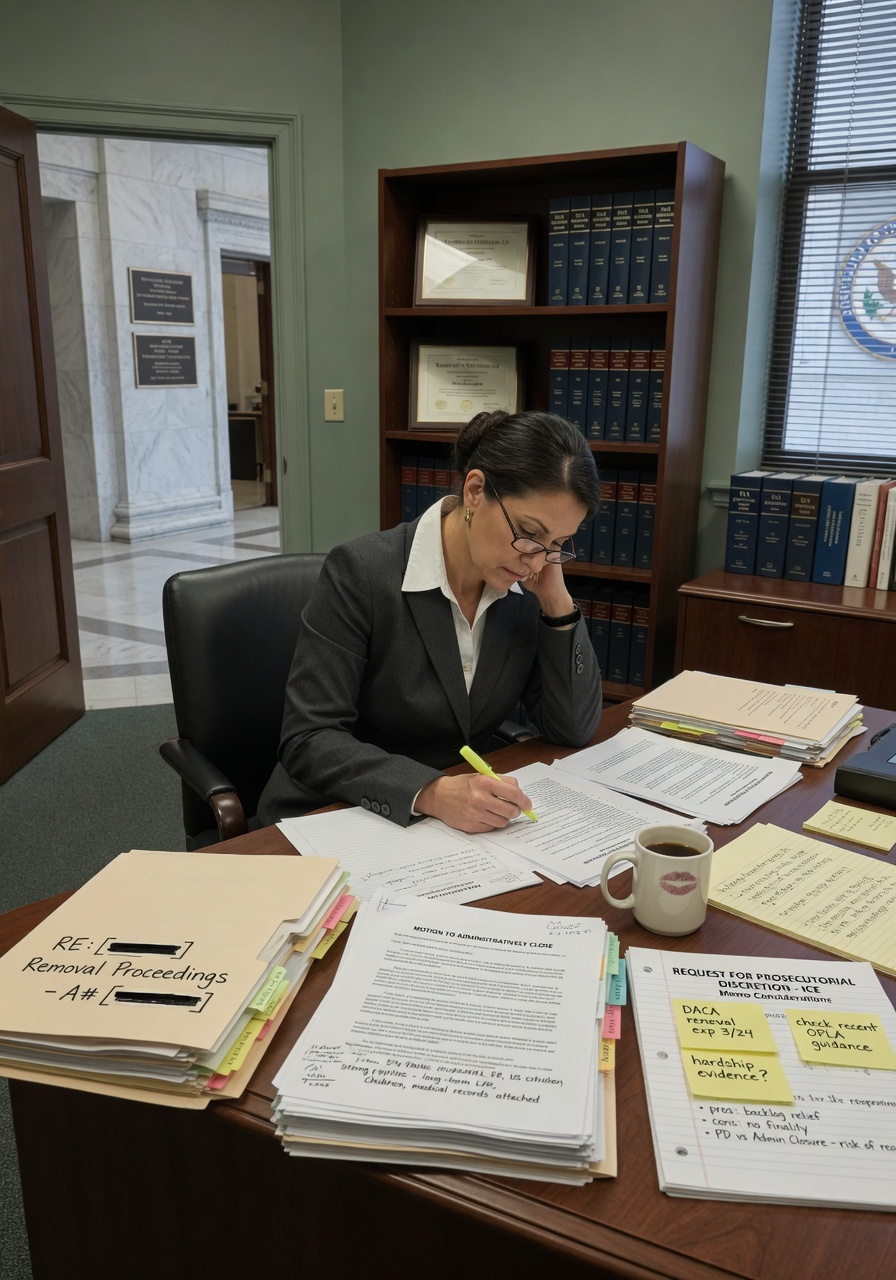
Quick answer
Yes, prosecutorial discretion and administrative closure still exist in 2026 — but they look very different than they did a few years ago. DHS has narrowed how it uses prosecutorial discretion, and the broad category-based programs are largely gone. At the same time, EOIR regulations at 8 C.F.R. Part 1003 still let immigration judges and the Board of Immigration Appeals administratively close or terminate certain cases, sometimes even without DHS agreement. Whether either tool is realistic in your case depends on your court, your judge, and your specific equities.
For years, prosecutorial discretion (PD) and administrative closure were two of the most useful ways to pause or step out of a removal case. Then the rules swung back and forth with each administration. In our practice, the most common question right now is simple: do these tools still exist at all? The honest answer is that they exist, but the path is narrower and far more dependent on strategy than it used to be.
What prosecutorial discretion actually means
Prosecutorial discretion is the government's power to decide how to use its limited enforcement resources. DHS — not the immigration judge — holds this power. In immigration court, PD has historically shown up in several ways:
- Choosing not to file a Notice to Appear in the first place.
- Agreeing to dismiss or not oppose closing a case.
- Declining to appeal a grant of relief.
- Agreeing to a continuance, administrative closure, or termination.
- Setting bond or release decisions for detained individuals.
The key point is that PD is a DHS decision. An immigration judge cannot order DHS to exercise discretion. Under current enforcement directives, judges in many courts are not even permitted to ask the DHS attorney whether the government intends to exercise PD. That single change has made PD much harder to obtain through the court process.
The 2026 reality
Broad, category-based prosecutorial discretion programs have largely been rescinded. Do not assume you qualify just because you would have under an earlier policy. PD today is far more individualized, discretionary, and case-specific.
What administrative closure means
Administrative closure is different. It is a tool of the immigration court, not DHS. When a case is administratively closed, it is taken off the active calendar and paused — but it is not over. There is no final decision, no order of removal, and no grant of status. The case simply sits, and either party can later ask to put it back on the calendar (recalendar it).
This matters because administrative closure can give a person breathing room: time to pursue a benefit with USCIS, to wait for a visa to become available, or to let a separate application play out. It is a pause button, not a finish line.
Administrative closure vs. termination
Administrative closure
Pauses the case and removes it from the active docket. The proceedings still technically exist and can be recalendared. No order of removal is entered, but you also do not "win" — you wait.
Termination
Actually ends the removal proceedings. Unlike closure, termination closes the case out. If DHS wants to pursue removal again, it generally has to start over with a new Notice to Appear.
For many people, termination is the stronger outcome because it fully ends the case rather than just pausing it. But termination is also harder to get and depends on the legal grounds available.
The current legal framework: 8 C.F.R. Part 1003
EOIR regulations finalized in 2024 and codified at 8 C.F.R. Part 1003 spell out when immigration judges and the BIA may administratively close or terminate proceedings. Importantly, these regulations allow closure or termination in a range of scenarios — and in some situations permit the judge to act even without DHS agreement.
That is a meaningful shift. Earlier case law (including Matter of Castro-Tum) had sharply limited judges' authority to close cases. The current regulatory framework restored a defined set of circumstances where closure and termination are available. But the regulations are applied differently across circuits, and some judges remain reluctant to use that authority in a hostile enforcement climate.
Circuit and judge sensitivity
Whether administrative closure is realistic can depend heavily on which circuit you are in and which judge hears your case. The same motion can succeed in one courtroom and fail in another. Local strategy matters.
Who might still qualify
There is no single checklist, but in practice the strongest candidates for a pause or termination usually have one or more of these:
- A pending benefit with USCIS that could resolve the case (for example, an approvable family petition or U visa).
- Strong equities: long U.S. residence, U.S. citizen or LPR family, caregiving responsibilities, or serious medical issues.
- A legal defect in the Notice to Appear or the charging documents.
- Eligibility for relief that is being processed elsewhere.
- Humanitarian factors that make active prosecution a poor use of resources.
If your case is at the early scheduling stage, it helps to understand how the master calendar hearing works, and how a closure or termination request fits into that timeline. If your case is heading toward trial, see our guide on the individual merits hearing. If you ultimately need to fight removal on the merits, review cancellation of removal as a defense, and if you already have a removal order from a missed hearing, see reopening an in absentia removal order.
How to request prosecutorial discretion or administrative closure
1. Identify the right tool
PD is requested from DHS. Administrative closure or termination is requested from the immigration court by motion. Many strong strategies use both — asking DHS not to oppose while filing a motion with the judge.
2. Build the equities record
Gather proof of family ties, length of residence, employment, tax compliance, community involvement, medical needs, and any pending applications. The decision-maker needs reasons, not just a request.
3. File the motion properly
The motion must be filed with the correct court, served on the DHS attorney, and supported by evidence and legal argument tied to 8 C.F.R. Part 1003 and any favorable circuit law.
4. Prepare for denial
Given the current climate, assume the request may be denied and have a backup plan: pursue relief on the merits, preserve appeal rights, and keep all deadlines.
Common mistakes
What sinks these requests
Assuming an old policy still applies, asking for a pause with no supporting evidence, missing filing deadlines, confusing closure with a grant of status, or relying on DHS goodwill that no longer exists under current enforcement priorities.
What this means for your case
Prosecutorial discretion and administrative closure are not dead, but they are no longer easy or automatic. The smart move in 2026 is to treat them as one part of a larger strategy, not a shortcut. A pause can buy time for a real benefit to come through — but only if you are also building toward an actual, durable form of relief. If you only have a pause and nothing behind it, you are simply delaying the same fight.
Frequently asked questions
Does prosecutorial discretion still exist in 2026?
Prosecutorial discretion still exists as a concept, but how DHS uses it has narrowed sharply under current enforcement priorities. Some forms, like agreeing not to oppose relief or choosing not to file a case, still happen, but broad categorical PD programs have largely been rolled back.
Can an immigration judge still administratively close my case?
Yes, in many situations. Under the EOIR regulations at 8 C.F.R. Part 1003, immigration judges and the BIA can administratively close or terminate proceedings in defined circumstances, sometimes even without DHS agreement, though outcomes vary by circuit and judge.
What is the difference between administrative closure and termination?
Administrative closure pauses a case and takes it off the active calendar without ending it. Termination actually ends the removal proceedings. Closure can be reopened later; termination closes the case unless the government starts a new one.
Is administrative closure the same as winning my case?
No. Administrative closure is a pause, not a grant of status. You usually do not get a green card or work permit from closure alone, and the case can be put back on the calendar if circumstances change.
How do I request prosecutorial discretion or administrative closure?
Through your attorney, usually by motion to the immigration court and/or a request to the DHS attorney, supported by evidence of equities such as family ties, long residence, health issues, or eligibility for other relief. The right approach depends heavily on your court and judge.
Facing removal proceedings?
Whether prosecutorial discretion, administrative closure, or termination is realistic depends on your court, your judge, and your equities. Modern Law Group can assess your case and build the strongest available strategy.
Schedule a Consultation