





Quick answer
Your individual merits hearing is your immigration court trial. This is the hearing where the immigration judge decides whether you win asylum, cancellation of removal, withholding, adjustment, or another form of relief. The judge will hear testimony, review exhibits, watch how you answer questions, listen to cross-examination by the government attorney, and either issue a decision or reserve the decision for later.
For many clients, the merits hearing is the day that decides the rest of their life in the United States. The master calendar hearing may feel stressful, but it is usually administrative. The merits hearing is different. It is the trial day. It is where preparation, credibility, evidence, and courtroom discipline all meet in one room.
In our practice, we see the same pattern again and again: clients worry most about “what the judge will ask,” but the bigger issue is whether the case has been built in a way that makes the testimony believable, legally relevant, and supported by documents. A strong story is not enough. The story has to fit the legal standard and survive cross-examination.
Merits hearing vs. master calendar hearing
A master calendar hearing is usually short. The immigration judge confirms your identity, your address, your attorney, your pleadings, and your requested relief. The court may set deadlines for evidence and schedule the individual hearing.
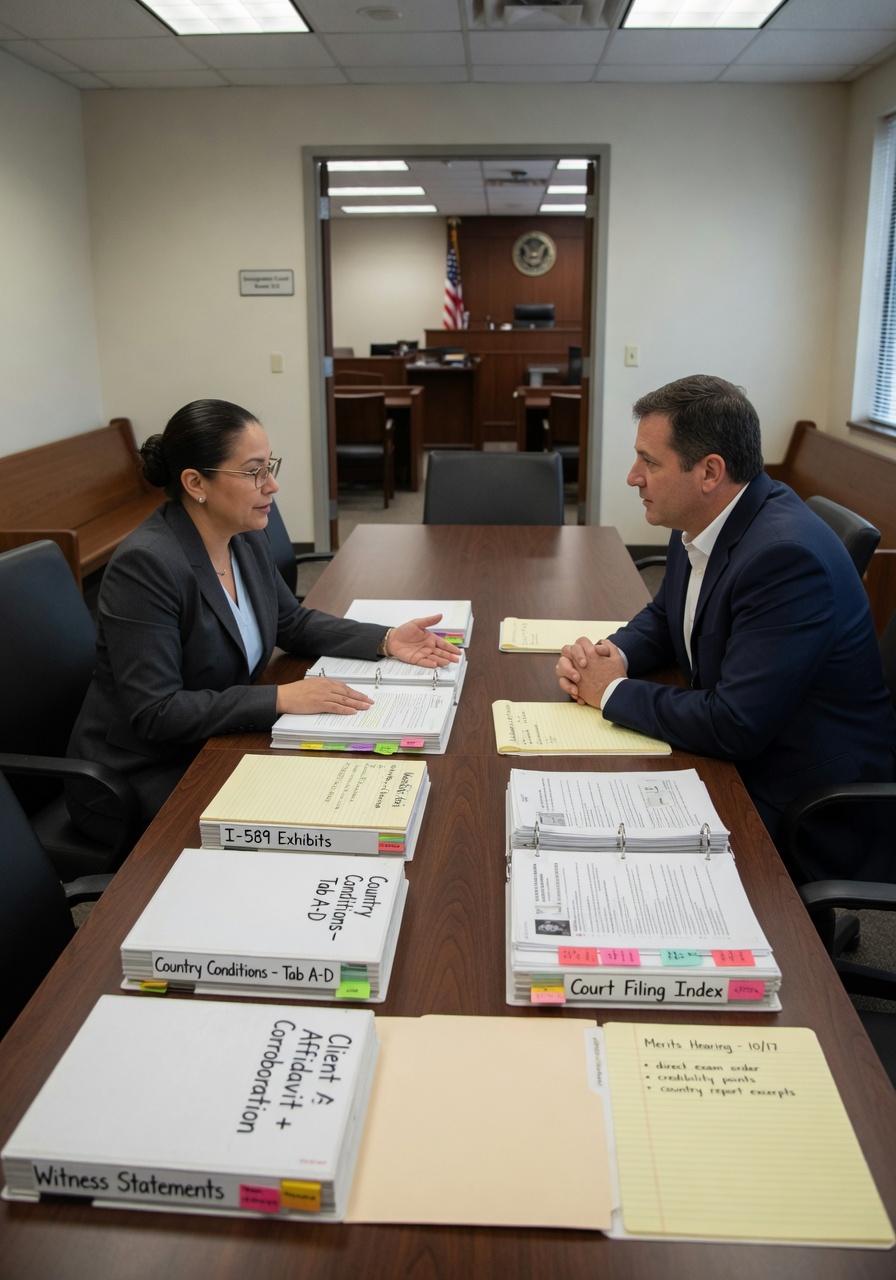
The individual merits hearing is the full evidentiary hearing. In plain English, it is the trial. The government attorney represents DHS. The immigration judge runs the courtroom. Your attorney presents your case. You testify under oath. Witnesses may testify. Documents are offered as exhibits. The government can object, cross-examine, and argue that relief should be denied.
Do not confuse the two hearings
If you treat the merits hearing like another scheduling date, you are in trouble. By the time the merits hearing starts, your evidence should already be organized, filed, served on DHS, and tied to the exact legal elements you must prove.
What the judge is deciding
The judge is not simply asking whether you are a good person or whether your story is sad. The judge must decide whether you qualify under a specific statute, regulation, or form of discretionary relief. The legal question depends on the case.
- Asylum: whether you suffered past persecution or have a well-founded fear of future persecution on account of race, religion, nationality, political opinion, or membership in a particular social group.
- Withholding of removal: whether it is more likely than not that you would be persecuted on a protected ground if removed.
- CAT protection: whether it is more likely than not that you would be tortured with government involvement or acquiescence.
- Cancellation of removal: whether you meet the time, character, qualifying-relative, and hardship requirements.
- Adjustment of status: whether you are eligible, admissible, and deserving of a favorable exercise of discretion.
That is why trial preparation is not just “practice telling your story.” It is matching each fact to a required legal element. EOIR proceedings are formal. The Immigration and Nationality Act, federal regulations, BIA precedent, and credibility rules matter.
Before trial day: what should already be done
1. Evidence filed before the deadline
Immigration courts set filing deadlines. Missing them can mean key documents are excluded. Your exhibits should be indexed, paginated, translated if necessary, and served on the DHS attorney.
2. Witnesses prepared
Witnesses should know where to go, what time to arrive, what topics they will cover, and how to answer questions truthfully without exaggeration.
3. Testimony rehearsed, not scripted
Good preparation is not memorizing a script. The goal is to understand the timeline, the legal elements, the weak spots, and the likely government questions.
4. Problems confronted before DHS confronts them
If there are arrests, prior inconsistent statements, missed deadlines, fraudulent documents, border statements, or prior applications, your attorney should deal with them directly.
5. Relief theory narrowed
The court needs to understand exactly what you are asking for and why. The strongest hearings usually have a clear theory: what happened, why it meets the law, and why the judge should grant relief.
What happens when you arrive at court
Arrive early. Bring identification, hearing notice, copies of key documents, medication if needed, and contact information for your attorney. If you need an interpreter, confirm one is available. Do not discuss your case loudly in the hallway.
When your case is called, the judge will confirm appearances. The judge may address preliminary issues: interpreter, exhibits, objections, witnesses, remote appearances, or late filings. If there are unresolved motions, such as a motion to continue or motion to suppress, the judge may handle those first.
The order of a typical merits hearing
Opening issues and exhibit admission
The court identifies what applications are pending and what evidence is in the record. The government may object to exhibits. Your attorney may respond. The judge decides what comes in.
Direct examination
Your attorney questions you first. This is where the core story is presented: who you are, what happened, what you fear, what hardship exists, what rehabilitation exists, or why you qualify for the requested relief.
Cross-examination
The DHS attorney questions you next. This is often the most stressful part. The government may test inconsistencies, dates, omissions, criminal history, prior border statements, or why you did not take certain actions earlier.
Judge questions
Immigration judges often ask their own questions. Sometimes those questions are neutral. Sometimes they reveal the judge’s concerns. Answer respectfully and directly.
Witness testimony
Family members, experts, therapists, employers, or community witnesses may testify. Each witness should have a purpose. Bring witnesses who prove facts the law cares about.
Closing argument and decision
After testimony, attorneys may make closing arguments. Some judges issue an oral decision immediately. Others reserve and mail a written decision. If denied, the appeal clock is short.
How testimony can win or lose the case
Credibility is everything. Under immigration law, the judge can consider consistency, detail, demeanor, plausibility, responsiveness, and whether the testimony matches the documents. A small inconsistency may not matter. A pattern of inconsistency can be fatal.
Clients often think the safest answer is the most dramatic answer. It is not. The safest answer is the truthful answer. If you do not know, say you do not know. If you do not remember, say you do not remember. If you made a mistake, explain it plainly. Do not guess just because the room is quiet.
What hurts credibility
Changing dates, adding new facts for the first time at trial, blaming every inconsistency on the interpreter, exaggerating injuries, hiding arrests, or pretending not to remember obvious facts can make the judge distrust the entire case.
Cross-examination: what DHS is trying to do
The government attorney is not there to help you. DHS may try to show that you are not credible, not eligible, or not deserving of discretion. That does not mean the government attorney is being unfair. It means this is litigation.
- Why your written declaration left out an important fact.
- Why you told border officers something different.
- Why you waited to apply for asylum.
- Why you traveled through other countries without seeking protection.
- Why police reports, medical records, or witness letters are missing.
- Why a criminal conviction should not defeat discretion.
- Why your claimed hardship is beyond normal family separation.
Documents that often matter
- Personal declaration or affidavit.
- Country condition reports for asylum, withholding, or CAT.
- Police reports, medical records, psychological evaluations, or protection orders.
- Birth certificates, marriage certificates, divorce decrees, and proof of family relationships.
- Tax returns, employment records, school records, and community letters.
- Criminal court records and rehabilitation evidence.
- Proof of U.S. citizen or lawful permanent resident qualifying relatives.
- Expert reports where appropriate.
If the case involves prior attorney mistakes, a motion to reopen or Lozada-related issue may also matter. If the case involves a missed hearing, read our guide on reopening an in absentia removal order. If asylum has already been denied, the strategy may overlap with post-denial options. If your case is still at the scheduling stage, compare this with the master calendar hearing.
What happens if you win
If the judge grants relief, the result depends on the relief granted. Asylum provides protection and a path to permanent residence after one year. Cancellation of removal can result in lawful permanent resident status. Adjustment can result in a green card. Withholding or CAT protection prevents removal to the feared country but does not give the same full immigration benefits as asylum.
What happens if you lose
If the judge denies the case, you generally have 30 days to appeal to the BIA. That deadline is serious. A late appeal can end the case. The BIA usually reviews the written record. It does not normally hear new testimony or let you fix missing evidence.
After a denial, the right move depends on what went wrong. Was it credibility? Legal eligibility? Discretion? Missing evidence? Bad lawyering? Changed country conditions? Each problem has a different strategy. Sometimes appeal is right. Sometimes reopening is right. Sometimes a new family-based or humanitarian pathway should be screened.
Practical checklist before your hearing
- Know your legal theory in one sentence.
- Review every prior statement you made to immigration, police, border officers, asylum officers, or USCIS.
- Read your application and declaration more than once.
- Prepare for the five hardest questions DHS can ask.
- Organize evidence by legal element, not by emotion.
- Make sure every foreign-language document has a proper translation certificate.
- Confirm witnesses know when and where to appear.
- Do not post about the case on social media before trial.
- Sleep the night before. Exhaustion causes bad testimony.
- Tell the truth even when the truth is uncomfortable.
Frequently asked questions
Is a merits hearing the same as a master calendar hearing?
No. A master calendar hearing is usually a short scheduling and pleading hearing. An individual merits hearing is the trial where the judge hears testimony, receives evidence, and decides whether to grant relief from removal.
Can the immigration judge decide my case the same day?
Yes. Some judges issue an oral decision at the end of the hearing. Others reserve decision and send a written order later. Either way, deadlines for appeal can move quickly.
Do I have to testify at my individual hearing?
Usually yes if your eligibility depends on facts only you can explain, such as fear of return, hardship, family history, or credibility. Your attorney should prepare you for direct examination and cross-examination.
What happens if I miss my merits hearing?
Missing a merits hearing can lead to an in absentia removal order. If that happens, reopening usually requires strict proof that you lacked notice or had exceptional circumstances.
Can I bring witnesses to immigration court?
Yes, if they are relevant and properly prepared. Witnesses can help prove hardship, family relationships, country conditions, abuse, rehabilitation, or other facts, but weak or inconsistent witnesses can hurt the case.
Preparing for an immigration court trial?
The merits hearing is not the day to improvise. Modern Law Group prepares clients for testimony, evidence, cross-examination, and the legal standard the judge must apply.
Schedule a Consultation