




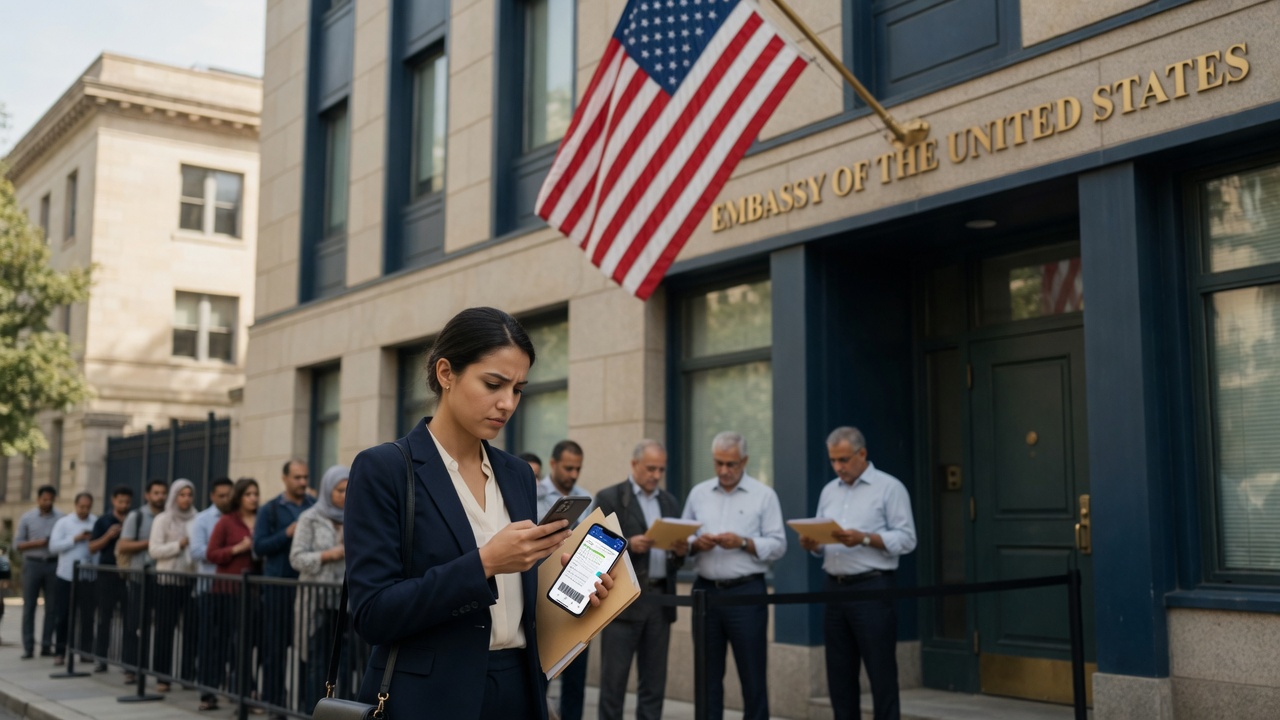
⚖️ The Short Answer — Should You Pay the $750?
It depends on how time-sensitive your travel is. From July 1 through December 31, 2026, the U.S. State Department is running a six-month pilot that lets B-1 (business) and B-2 (tourism) visitor visa applicants pay an optional $750 fee to secure a consular interview within 10 business days at select participating posts. Here is the honest breakdown:
- It buys speed, not a visa. The $750 only moves your interview earlier. It does not guarantee approval, change your eligibility, or create any advantage in the interview room.
- It is on top of the regular fee. The $750 is in addition to the standard MRV application fee (currently $185 for a B-1/B-2), not a replacement — combined, roughly $935 in government fees.
- Not every post participates. The State Department designates which embassies and consulates are in the pilot. You must check your specific post.
- It does nothing for 221(g). If your case goes into administrative processing after the interview, the fee does not speed that up.
- Worth it for genuine, time-critical, legitimate travel — an urgent business deal, medical care, or a family emergency at a post with a long wait. Skip it if your travel is flexible or your case is weak.
What the State Department Just Launched
For anyone who has tried to schedule a U.S. visitor visa interview in the last few years, the frustration is familiar. You fill out the DS-160, pay the fee, log into the appointment system — and the first available interview date is four, six, sometimes twelve months away. At a handful of the busiest consular posts around the world, the wait for a routine B-1/B-2 appointment has stretched so long that people simply give up on trips they had every legal right to take. Business travelers miss deals. Grandparents miss weddings and births. Patients miss treatment windows.
On July 1, 2026, the U.S. Department of State launched a response to that bottleneck: a six-month pilot program, running through December 31, 2026, that lets B-1 and B-2 visitor visa applicants pay an optional $750 fee to lock in a consular interview appointment within 10 business days at participating embassies and consulates. It is, in plain terms, a paid fast lane for the interview appointment — a way to jump the scheduling queue at posts where the standard line has grown unreasonably long.
The idea is straightforward, and for the right applicant it can be genuinely useful. But it is also easy to misunderstand in exactly the ways that cost people money and hope. This article walks through what the pilot actually does, what it deliberately does not do, how to tell whether your post is even part of it, and — most important — how to decide honestly whether the $750 is worth it in your specific situation. We will be blunt where bluntness protects you, because in immigration, an expensive misunderstanding is worse than no option at all.
The One Sentence That Matters Most
Before anything else, absorb this: the $750 buys you a faster interview, not a visa.
That distinction is the entire key to using this pilot wisely. The fee changes when you are seen. It does not change what happens when you are seen. The consular officer applies the exact same law, weighs the exact same evidence, and makes the exact same decision they would have made at a standard appointment three months from now. If your application is strong, paying to be seen sooner simply gets you your visa sooner. If your application is weak, paying to be seen sooner simply gets you refused sooner — and you are out the $750 with nothing to show for it.
We labor this point because we have watched people treat expedited or "premium" government options as if speed and approval were the same thing. They are not. Speed is a scheduling service. Approval is a legal judgment. The pilot sells the first and has nothing to do with the second.
⚠️ A Fast "No" Is Still a "No"
Paying $750 to be interviewed within ten business days does not make a refusal any less likely. If your case would have been denied under INA 214(b) at a routine appointment, it will be denied at an expedited one too — just faster, and after you have spent the extra money. The fee never touches the merits of your case.
How the Pilot Actually Works
Here are the mechanics, laid out plainly so you can see exactly what you are — and are not — buying.
Who Is Eligible
The pilot is limited to two nonimmigrant categories: the B-1 business visitor visa and the B-2 tourism/visitor visa (often issued together as a combined B-1/B-2). If you are applying for a student visa, a work visa, a fiancé visa, or any other classification, this particular pilot does not apply to you. It is aimed squarely at short-term visitors — people coming to the United States temporarily for business meetings, tourism, family visits, or medical treatment, who intend to return home afterward.
What You Pay
You pay the $750 expedited-appointment fee on top of the standard $185 MRV fee — the machine-readable visa application fee that every nonimmigrant visa applicant already owes. The $750 does not replace or discount the MRV fee. It is an add-on. So an applicant who opts in pays roughly $935 in combined government fees before considering any attorney fees, travel costs, courier charges, or reciprocity fees that may apply at particular posts. Budget for the full amount, not just the headline number.
What You Get
In exchange, participating posts offer you a consular interview appointment within 10 business days, instead of the weeks or months a standard appointment might require. That is the whole of it. You get an earlier seat at the interview window. Everything downstream of the interview — the officer's decision, any administrative processing, visa printing, and passport return — proceeds on its normal timeline.
Where It Applies
The pilot operates only at select, State-Department-designated posts — chosen primarily because they have the longest visitor-visa interview backlogs. It is not available at every U.S. embassy and consulate worldwide. If your post is not designated, the expedited option will not appear when you schedule, and there is no way to buy into a post that is not participating. This is why checking your own specific post is non-negotiable before you plan around the pilot.
When It Runs
The pilot is a six-month experiment: it began July 1, 2026 and is scheduled to end December 31, 2026. Because it is a pilot, its terms, participating-post list, and even its continuation are subject to change. The State Department could expand it, contract it, adjust the fee, or let it lapse at year's end. Treat any plan built around it as provisional until you have confirmed the current terms at your post.
What the $750 Does Not Do — Read This Twice
Understanding the limits of this pilot is more valuable than understanding its benefits, because the limits are where people get hurt. Here is a clear inventory of what your $750 does not buy.
It Does Not Guarantee Approval
Nothing about paying the fee tilts the decision in your favor. Consular officers do not know or care whether you paid to expedite; even if they did, it would be legally irrelevant. Your visa is granted or refused on the same standard as everyone else's.
It Does Not Change Your Eligibility Under INA 214(b)
Every B-1/B-2 applicant faces the presumption of immigrant intent built into Section 214(b) of the Immigration and Nationality Act (INA). By law, the officer must presume you intend to immigrate — to stay in the United States — unless you prove otherwise. You overcome that presumption by demonstrating strong ties to your home country (a steady job, property, family, financial and social roots) and a clear, temporary, legitimate purpose for the trip. The $750 does not lower this bar by a single inch. If your ties are thin and the officer is not persuaded you will return home, you will be refused under 214(b) regardless of how quickly you were seen.
It Does Not Stop or Speed Up 221(g) Administrative Processing
Sometimes, at the end of an interview, an officer neither approves nor flatly denies the case. Instead they issue a refusal under Section 221(g) of the INA and place the application into "administrative processing" — a holding pattern for additional security checks, background review, or missing documentation. This can take weeks or months, and it happens after the interview. The $750 fee has no effect whatsoever on 221(g) processing. You paid to reach the interview faster; you did not pay to shorten anything that comes after it. If your case lands in administrative processing, you wait like everyone else. We have seen applicants assume the premium fee would carry them through this stage too — it does not, and that assumption can wreck a carefully planned trip.
It Does Not Cover Every Post or Every Cost
As noted, the pilot is limited to designated posts and covers only the appointment itself. Reciprocity fees, courier and passport-return fees, and any post-specific charges are separate. And if your post is not in the pilot, the option does not exist for you at any price.
🚫 The Most Expensive Misunderstanding
The costliest mistake is believing that "expedited" means "easier" or "guaranteed." It does not. If you pay $750, get seen in ten business days, and are refused under INA 214(b), the money is gone and — depending on your post's terms — likely non-refundable. Never pay the expedited fee to rescue a weak application from scrutiny. Scrutiny arrives on schedule either way; the fee just makes it arrive sooner.
The Refund Question: Is the $750 Non-Refundable?
This is where applicants need the clearest possible warning. The $750 pays for a service — the expedited appointment — rather than for an outcome. Because you are buying the scheduling service, the fee is generally treated as non-refundable once the expedited appointment has been provided, even if the visa is ultimately denied. In other words, if you pay, get your fast interview, and walk out with a 214(b) refusal, do not expect the $750 back.
That said, the exact refund, cancellation, and transfer terms are set by the Department of State, and they can differ from post to post and can change during a pilot. Some scenarios — cancelling before the appointment is scheduled, a post cancelling on its end, technical failures — may be handled differently than a simple denial. The only responsible course is to read the specific terms shown in your post's appointment system before you pay, and confirm in writing (where possible) what happens to your money if you cancel, miss the appointment, or are refused. Assume the worst case — that the fee is gone once you use the appointment — and only pay if the trip justifies that risk.
"Treat the $750 like a non-refundable plane ticket for a meeting you must attend. If the meeting is real and the date is fixed, it can be worth every dollar. If the trip is flexible or the case is shaky, you are paying a premium for a faster way to be told no."
What We're Advising Visitor-Visa Clients Right Now
In our practice, the pilot has added a new question to the very first conversation we have with someone applying for a visitor visa: "Is your travel genuinely time-sensitive, and is your post even in the program?" Those two facts, more than anything else, decide whether the $750 makes sense.
We are advising clients to reach for the expedited option in a narrow set of situations. A business owner with a signed contract requiring their physical presence at a closing or a trade show on a fixed date, at a post where the standard wait would blow past that date — that is a strong candidate. So is a parent who needs to reach a seriously ill child receiving medical care in the United States, or someone facing a genuine family emergency such as a funeral, where days matter and the standard queue would make the trip pointless. For these clients, ten business days versus a five-month wait is not a convenience; it is the difference between making the trip and missing it entirely.
We are advising most other clients to think hard before spending the money. If your travel is flexible — a vacation you can move, a visit with no fixed deadline — the standard appointment will get you there without the premium. If your local post already offers reasonably prompt appointments, there is little backlog to buy your way past. And critically, if your application is weak on ties and likely to be refused under 214(b), we tell clients plainly: paying $750 to be refused faster helps no one. The better investment in that case is strengthening the application itself — documenting employment, property, family obligations, and a credible, temporary travel purpose — not buying a faster trip to the same refusal.
We are also reminding clients of the calendar. The pilot ends December 31, 2026. As that date approaches, an applicant whose travel is not urgent may be better served waiting for a standard slot rather than paying a premium for a program that is winding down. And because the pilot's terms can shift, we verify the current rules at the client's specific post before recommending anyone pay a dollar.
✅ Our Practical Bottom Line for Clients
Pay the $750 only when three things are all true: your travel is genuinely time-sensitive and legitimate, your post participates and has a long standard wait, and your underlying case is strong enough to be approved on the merits. If any one of those is missing — flexible travel, a non-participating or fast-moving post, or a weak 214(b) profile — the money is better spent elsewhere or not at all.
Practical Checklist: How to Decide and What to Do
Use the following steps to work through the decision in order. Each one narrows the question until the answer is clear.
Step 1 — Confirm Whether Your Post Actually Participates
Go to your specific U.S. embassy or consulate's official appointment page and check the U.S. Department of State visa wait-time information for your city. If your post is designated for the pilot, the expedited option and its $750 fee will appear when you schedule. If it does not appear, your post is not participating, and no amount of money changes that. Never assume — verify your own post, not a neighboring one.
Step 2 — Compare the Standard Wait to Your Real Deadline
Find the current standard B-1/B-2 interview wait time at your post, then compare it against the actual date you need to travel. If the standard appointment comfortably precedes your trip, you do not need to pay. The expedited option only earns its cost when the standard wait would cause you to miss a specific, fixed, legitimate deadline.
Step 3 — Be Honest About Whether Your Travel Is Time-Sensitive
Ask yourself: is this trip tied to a real, dated event — a business closing, a medical treatment window, a family emergency — or is it flexible? "I'd prefer to go sooner" is not the same as "I must be there by this date." The $750 is justified by genuine urgency, not mere preference. If the trip can move, let it move and save the money.
Step 4 — Assess the Strength of Your Case Under INA 214(b)
Before paying to be seen faster, make sure you would pass on the merits. Do you have strong ties to your home country — steady employment, property, close family, financial roots — and a clear, temporary, lawful purpose for the visit? If your ties are thin or your purpose is vague, fix that first. Paying to expedite a weak case only accelerates a likely refusal. See our guide on why some visa applications are refused and how to strengthen yours.
Step 5 — Read the Refund Terms Before You Pay a Dollar
Because the fee is generally non-refundable once the appointment is used, read your post's specific cancellation and refund terms carefully before paying. Confirm what happens if you cancel, miss the appointment, or are refused. Assume the money is gone once you use the expedited slot, and only proceed if the trip is worth that risk.
Step 6 — Remember What the Fee Does Not Cover
Even after you pay and are seen quickly, a refusal under 214(b) or a hold under 221(g) administrative processing can still happen — and the $750 does nothing to prevent or speed the resolution of either. If your case is placed in administrative processing, plan for a wait regardless of what you paid. Build that possibility into your travel plans rather than assuming the premium fee carries you all the way through.
- Verify your post is in the pilot. Check the official appointment system for your exact consulate before planning anything around the expedited option.
- Match the standard wait against a real deadline. No fixed deadline usually means no need to pay.
- Budget the full cost. $185 MRV + $750 expedited ≈ $935 in government fees, before travel and other charges.
- Strengthen the case first. Ties and a credible temporary purpose beat speed every time under INA 214(b).
- Read the refund terms. Assume non-refundable once used; confirm your post's specifics before paying.
- Plan for 221(g). Administrative processing can still happen and the fee will not shorten it.
- Mind the December 31, 2026 end date. As the pilot winds down, non-urgent applicants may simply wait for a standard slot.
When the $750 Is Worth It — and When It Is Not
To make the decision concrete, here is a side-by-side of the situations where paying tends to make sense against those where it usually does not. Treat it as a guide, not a rule — your post, your timeline, and your case strength always control.
| Situation | Pay the $750? | Why |
|---|---|---|
| Urgent business trip with a fixed, dated event; long wait at your post | Likely YES | Ten business days can save a trip a five-month wait would kill — if the case is strong. |
| Serious medical treatment or family emergency (illness, funeral) | Likely YES | Days matter; the standard queue would make the trip pointless. |
| Flexible vacation or visit with no fixed deadline | Usually NO | You can simply take a standard appointment and keep the money. |
| Your post already offers prompt standard appointments | Usually NO | There is little or no backlog to buy your way past. |
| Weak ties / high risk of a 214(b) refusal | NO — fix the case first | Paying only accelerates a likely refusal; strengthen the application instead. |
| Your post is not designated for the pilot | Not possible | The option does not exist at non-participating posts, at any price. |
| Non-urgent travel close to the December 31, 2026 end date | Usually NO | The pilot is winding down; a standard slot may serve just as well. |
How the B-1/B-2 Interview Fits the Bigger Picture
It helps to remember where the interview sits in the overall visitor-visa process, because the pilot touches only one link in a longer chain. A B-1/B-2 application generally moves through these stages: completing and submitting the DS-160 online application; paying the $185 MRV fee; scheduling the interview appointment; attending the interview at the consulate; and, if approved, waiting for visa printing and passport return. The $750 pilot compresses only the third link — scheduling the interview. Everything before it (the paperwork and fees you owe regardless) and everything after it (the officer's decision, any 221(g) processing, and passport return) is untouched.
That framing matters because it keeps expectations honest. Buying a faster appointment does not make the DS-160 any less important, does not reduce the evidence of ties you need to bring, and does not shorten the tail end of the process if administrative processing intervenes. It moves one milestone earlier. When the rest of your case is in order, that single move can be exactly what you need. When the rest of your case is not in order, moving that milestone earlier changes nothing about the outcome.
If your prior application was refused or your case has an added wrinkle — a past overstay, a prior denial, a complicated travel history — the interview is not the place to improvise, expedited or not. Those situations call for preparation and, often, professional guidance well before you pay any fee. Speed cannot substitute for a well-built case, and at times a well-built case is what turns a likely refusal into an approval.
A Word on Interview Waivers Versus Expedited Interviews
People sometimes confuse two very different tools: the interview waiver (sometimes called "dropbox," where eligible applicants renew without appearing in person) and this new expedited interview pilot. They are not the same thing and do not overlap. An interview waiver removes the interview for those who qualify; the $750 pilot speeds up the interview for those who must attend one. If you may be eligible to skip the interview altogether, that path can be faster and cheaper than paying to expedite — so it is worth checking first. Our overview of the in-person interview waiver for visa applicants explains who qualifies and how it differs from paying for a faster appointment.
Why an Honest Assessment Beats a Fast One
The temptation with any "premium" or "expedited" government option is to treat money as a shortcut through uncertainty. In immigration, it rarely works that way. The consular interview is a legal proceeding governed by the INA, and the officer's judgment is not for sale — not for $750, not for any amount. What money can buy here is time, and only time, and only at certain posts. That is a genuine benefit for the person who truly needs it. It is a wasted expense for the person who does not, and a false comfort for the person whose real problem is a weak case rather than a slow calendar.
So the most useful thing we can tell any visitor-visa applicant weighing the $750 is this: do the honest math first. Is your post in the pilot? Would the standard wait actually cause you to miss a specific, legitimate, dated trip? And is your case strong enough to be approved on the merits when you sit down at the window? If all three answers are yes, the pilot may be one of the better $750 you spend this year. If any answer is no, keep your money, and put your energy where it actually moves the needle — into building a case that earns the visa, on whatever timeline you are seen.
Frequently Asked Questions
Is the $750 expedited interview fee refundable if my visa is denied?
The $750 pays for the faster interview appointment, not for a visa. Because it buys the scheduling service rather than an outcome, the fee is generally treated as non-refundable once the expedited appointment is provided, even if the consular officer later denies the visa under INA 214(b) or places the case into 221(g) administrative processing. The Department of State sets the exact refund and transfer terms, and those terms can differ by post and can change during the pilot. Before you pay, read the specific terms shown on your post's appointment system and confirm what happens to the fee if you cancel, miss the appointment, or are refused. Do not assume you will get the money back if the visa is denied.
Does paying $750 guarantee that I will get my B-1/B-2 visa?
No. This is the single most important thing to understand. The $750 only moves your interview earlier on the calendar. It does not change the legal standard the consular officer applies, does not create any presumption in your favor, and does not guarantee approval. Every B-1/B-2 applicant must still overcome the presumption of immigrant intent under INA 214(b) by showing strong ties to their home country and a genuine temporary purpose for the trip. A weak application that would have been refused in a standard appointment will still be refused in an expedited one — just sooner. The fee buys speed, not a decision.
Which consulates and embassies participate in the $750 expedited pilot?
Not every U.S. embassy or consulate is included. The State Department designates which posts participate in the pilot, and the list is aimed at posts with long visitor-visa interview wait times. The only reliable way to know whether your post offers the expedited option is to check that specific embassy or consulate's official appointment page and the U.S. Department of State visa wait-time information for your city. If your post is not on the list, the $750 option simply will not appear when you schedule, and you cannot buy your way into a post that is not participating. Always verify your own post rather than relying on what is available somewhere else.
Is the $750 on top of the regular visa fee, or does it replace it?
It is on top. The $750 expedited-appointment fee is in addition to the standard nonimmigrant visa application fee, known as the MRV fee, which is currently $185 for a B-1/B-2 visitor visa. Paying $750 does not waive or replace the MRV fee — you pay both. So an applicant who uses the expedited option pays the $185 MRV fee plus the $750 expedited fee, for a combined out-of-pocket cost of roughly $935 in government fees before any attorney or travel costs. The $750 does not cover reciprocity fees, courier fees, or any other charge that may apply at your post.
How fast is the expedited interview, and what exactly does the pilot cover?
Under the pilot, applicants who pay the $750 are offered a consular interview appointment within 10 business days at participating posts, instead of waiting the weeks or months that some posts require for a standard appointment. The pilot runs for six months, from July 1, 2026 through December 31, 2026. It is limited to B-1 business and B-2 tourism visitor visas. It covers only the scheduling of the interview. It does not speed up any administrative processing that happens after the interview, does not shorten 221(g) reviews, and does not change how long visa printing or passport return takes at your post.
Does the $750 fee affect 221(g) administrative processing after my interview?
No. This is a common and costly misunderstanding. Section 221(g) of the Immigration and Nationality Act allows a consular officer to refuse a visa temporarily and place the case into "administrative processing" for additional review, security checks, or missing documents. That review happens after the interview and can take weeks or months. The $750 expedited fee gets you to the interview faster, but it has no effect on 221(g) processing. If your case is placed in administrative processing, you wait like everyone else, and the fee does not buy you a faster resolution or move you to the front of that line. Our guide on what to do when your visa is stuck in 221(g) explains this stage in detail.
When is paying the $750 worth it, and when should I skip it?
It can be worth it when your travel is genuinely time-sensitive and legitimate — an urgent business meeting or trade show, a medical treatment that cannot wait, a family emergency such as a seriously ill relative or a funeral, or a documented event with a fixed date — and your local post has a long standard wait that would otherwise cause you to miss the trip. It is usually not worth it when your travel is flexible, when your post already offers reasonably prompt appointments, when your application is weak on ties and likely to be refused under INA 214(b), or when you are close to the pilot's December 31, 2026 end date and could simply wait. The honest test is whether ten business days versus the standard wait actually changes your ability to make a specific, real trip. Schedule a Consultation with Modern Law Group if you want help making that call.
Schedule a Consultation — Make the $750 Decision With Clear Eyes
The new expedited-interview pilot is a real tool, and for the right applicant at the right post it can rescue a trip that a long wait would otherwise sink. But it is also easy to misread — to pay for speed when the real problem is a weak case, or to spend $935 in government fees only to be refused faster. The difference between a smart use of the pilot and a wasted one usually comes down to two questions most people cannot answer alone: is my post participating, and is my case actually strong enough to be approved?
At Modern Law Group, visitor-visa and consular-processing work is part of what we do every day. We help clients assess whether their travel is genuinely time-sensitive, whether their post is in the pilot, and — most important — whether their application is strong enough under INA 214(b) to earn the visa on the merits, expedited or not. When it is, we help them use the fast lane wisely. When it is not, we tell them the truth and help them build a case worth approving.
If you are weighing the $750 expedited interview, do not guess. Schedule a Consultation with our immigration attorneys today. Call us directly at (888) 902-9285 or text us at (619) 889-6476. A short, informed conversation now can save you both money and a missed trip.
Thinking About Paying for a Faster Visa Interview?
Before you spend $750, find out whether your post participates and whether your case is strong enough to be approved on the merits. Modern Law Group will help you decide when the fast lane is worth it — and when your money is better spent building a stronger application.
Schedule a Consultation (888) 902-9285