





Quick answer
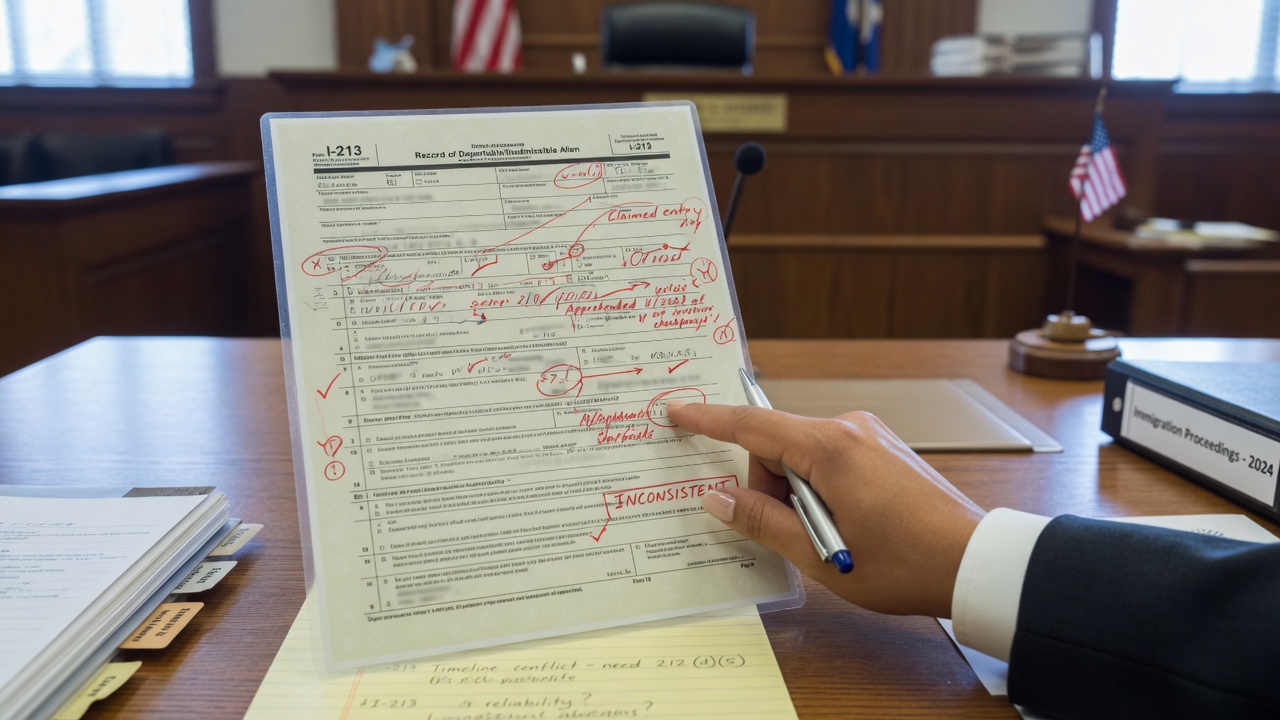
Form I-213 is the government's paperwork backbone in many immigration court cases. It is the DHS officer's Record of Deportable/Inadmissible Alien: a narrative summary of what the officer says happened, what the respondent allegedly admitted, and why DHS believes the person is removable or inadmissible. Immigration judges often admit it because removal court evidence rules are looser than criminal court and because older BIA cases treat I-213s as generally reliable unless the respondent shows the information is wrong or was obtained by coercion. That does not mean the form is bulletproof. A good challenge attacks the form with specifics: false biographical facts, unsupported gang or fraud claims, hearsay layered through another agency, interpreter problems, coercive questioning, missing source information, contradictions with FOIA or court records, and any constitutional or regulatory violation behind the statement. The worst move is to wait until the final hearing. The best move is to get the I-213 early, compare it line by line against the record, object before admitting alienage or removability, and build a factual record the immigration judge and the Board of Immigration Appeals cannot ignore.
What Form I-213 actually is
DHS uses Form I-213 to record the basic facts behind an immigration arrest or encounter. The form can include name, aliases, country of birth, citizenship, manner of entry, immigration status, criminal history, alleged gang information, family information, and statements the officer attributes to the respondent. In a removal case, DHS may offer the I-213 to prove alienage, removability, inadmissibility, or discretionary facts that affect bond, relief, or credibility.
The problem is obvious: the form looks official, but it is still an officer-created narrative. It may contain the officer's assumptions, information copied from another database, police allegations that were never tested, statements taken without a competent interpreter, or facts attributed to the respondent after a stressful stop. In practice, a single sentence in an I-213 can become the government's whole case if nobody challenges it.
Why immigration judges often rely on it
Immigration court is civil. The Federal Rules of Evidence do not apply in the same way they apply in criminal court. Under 8 C.F.R. § 1240.7, an immigration judge may receive material and relevant prior statements. EOIR practice also gives judges broad control over evidence so long as admission is fundamentally fair. That creates a low admissibility threshold.
The leading BIA line, including Matter of Mejia and Matter of Barcenas, treats Form I-213 as inherently trustworthy absent evidence that it is inaccurate or that the information was obtained by force or coercion. In 2026, the BIA's Matter of Mercado-Martinez again discussed I-213 reliability in the context of DHS proof. The lesson is not that respondents should give up. The lesson is that a challenge must come with evidence, not just suspicion.
Judges hear vague objections every day: "the form is hearsay," "I do not agree," or "ICE lies." Those objections usually lose. The stronger objection says: this line is wrong, here is the passport or birth certificate; this statement was translated incorrectly, here is the declaration; this gang allegation was copied from a police contact with no conviction, here is the disposition; this alleged admission came after a warrantless home entry, here is the suppression motion.
The difference between admissibility and weight
Fighting an I-213 is not always an all-or-nothing suppression fight. Sometimes the judge admits the form but gives part of it little weight. That can still matter. If DHS needs the form to prove alienage, date of entry, manner of entry, a criminal ground, or an allegation that blocks relief, reducing the weight of a key paragraph can change the case.
Think of three levels of attack:
- Exclude it. Ask the judge not to admit the form because using it would be fundamentally unfair, because the statements were coerced, or because it is fruit of an egregious constitutional violation. This overlaps with a motion to suppress in immigration court.
- Limit it. Ask the judge to admit only uncontested portions while refusing to credit unsupported or prejudicial allegations, especially hearsay from unnamed sources.
- Rebut it. Offer declarations, documents, certified court records, FOIA results, and testimony showing why the form is wrong or unreliable.
What we see in practice
In practice, the dangerous I-213 is rarely the one that looks dramatic. It is the ordinary-looking form with one unsupported line that becomes decisive: a supposed admission about entry without inspection, a police allegation repeated as fact, a gang label copied from another record, or a date that quietly contradicts the client's actual travel history. Families often focus on the Notice to Appear because it looks like the charging document. The I-213 is where DHS often stores the story it wants the judge to believe. That is why we treat it like a witness statement: who supplied the fact, how did the officer know it, what record backs it up, and what evidence proves it wrong?
Common I-213 problems we look for
A useful review is not a general complaint. It is a line-by-line audit. Common defects include:
- Wrong identity information: misspelled names, wrong birth date, wrong country, confused aliases, or facts copied from another person's file.
- Bad entry history: incorrect date of entry, incorrect port of entry, assumed entry without inspection, or failure to mention later parole, admission, or lawful status.
- Unsupported criminal allegations: arrest allegations stated like convictions, dismissed charges treated as facts, or police narratives repeated without certified records.
- Gang or security labels: vague claims based on clothing, tattoos, neighborhood, social media, or unnamed informants. These allegations can poison bond and relief if not confronted.
- Interpreter defects: no interpreter listed, wrong language, dialect problems, or statements attributed to someone who did not understand the questions.
- Coercion or force: statements after threats, prolonged detention, home raids, handcuffs, weapons, or pressure on family members.
- Hearsay stacked on hearsay: the DHS officer repeats what a police officer, database, or unnamed source supposedly said, with no underlying record.
- FOIA contradictions: the I-213 says one thing while A-file records, CBP records, criminal court records, or prior immigration filings say another.
How to build the challenge
The challenge starts before the master calendar hearing if possible. Get the I-213 from DHS. File FOIA requests if the case history is unclear. Pull certified criminal dispositions. Compare every factual claim against immigration filings, passports, I-94 records, family documents, court files, medical records, school records, and witness accounts.
Then decide the procedural vehicle. If the problem is an illegal arrest or coerced statement, a written suppression motion may be required. If the issue is reliability, file a written objection and supporting evidence. If DHS depends on an officer's disputed assertions, ask for the officer to appear for cross-examination. If the form contains inflammatory but unproven allegations, ask the judge to give those paragraphs no weight.
Most importantly, do not concede facts that you intend to challenge. If the respondent admits alienage, removability, or the factual allegations in the Notice to Appear without understanding the I-213 problem, DHS may no longer need the disputed form. A strong evidence issue can be lost in two minutes of careless pleadings.
When the I-213 matters most
The form matters in almost every contested removal case, but it is especially important when:
- DHS uses it as the main proof of alienage or entry without inspection.
- The respondent is seeking bond and the form contains criminal, gang, or flight-risk allegations.
- The case involves reinstatement, expedited removal history, or prior encounters at the border.
- The person is applying for asylum, withholding, cancellation of removal, adjustment, or another benefit where credibility and discretion matter.
- DHS is relying on police allegations that never became convictions.
For family members, the practical point is simple: if the I-213 sounds wrong, do not treat it as a harmless government form. It may be the paper trail the judge reads first and remembers most.
Related defense tools
An I-213 challenge often connects to other strategies. If the form came from an unlawful arrest, read our guide to motions to suppress evidence from illegal ICE arrests. If the government cannot prove the charge after the evidence is weakened, the next step may be a motion to terminate removal proceedings. If the missing documents are in the government's file, a FOIA request before immigration court can expose contradictions. If the case is moving too quickly, a continuance request may be needed to gather records.
Frequently asked questions
What is Form I-213?
Form I-213, Record of Deportable/Inadmissible Alien, is a DHS report summarizing the facts an officer says establish alienage, entry history, status, arrests, statements, or other grounds for removal.
Is an I-213 automatically admitted in immigration court?
Usually it is admissible if it is probative and fundamentally fair, but it is not untouchable. A respondent can object, ask for the officer, file rebuttal evidence, or move to suppress if the information was obtained unlawfully.
How do you challenge an I-213?
Compare it against records, declarations, FOIA results, body-camera or phone evidence, criminal files, interpreter facts, and witness accounts. Then object with specifics: incorrect facts, unreliable source, coercion, lack of foundation, or unfair prejudice.
Can a bad I-213 end a removal case?
Sometimes. If the government relies on the I-213 to prove alienage or removability and the judge gives it little weight or excludes it, DHS may be unable to carry its burden.
Should I admit the facts in the I-213 at the first hearing?
Not without understanding the consequences. Careless admissions can give the government the proof it needs even if the I-213 itself has serious defects.
Do I need a lawyer to fight an I-213?
Yes, in any serious case. These objections depend on evidence rules, burden of proof, preserved objections, and a clean record for appeal.
A Modern Law Group practice note
The I-213 cases that go badly usually share the same pattern: nobody gets the form early, the respondent admits too much at the first hearing, and the family starts looking for proof only after the judge has already credited the government's narrative. The cases with real leverage look different. Counsel gets the I-213, audits every paragraph, pulls the underlying records, files targeted objections, and gives the judge a concrete reason to distrust the government's paperwork. If DHS is using an I-213 against you or a family member, treat it like evidence, not background paperwork. Read it line by line and challenge what is wrong before the record closes.