





Quick answer
At a US port of entry, your Fourth and Fifth Amendment protections are sharply weaker than they are inside the country. Under 19 U.S.C. § 1582 and INA § 235 (8 U.S.C. § 1225), CBP can pull anyone — green card holder, visa holder, or US citizen — into secondary inspection for any reason or no reason. CBP can search your phone and laptop without a warrant under the border search exception, with advanced forensic searches requiring reasonable suspicion under CBP Directive 3340-049A. Green card holders cannot be summarily denied entry; visa holders can be put on the next flight home under expedited removal in INA § 235(b)(1) with a five-year bar. US citizens cannot be denied entry at all but can be detained and delayed. The decisions you make in those 30 minutes — what you say, what you sign, what you refuse — can determine whether you get in, lose your status, or get banned for years.
The phone calls we get from clients in secondary inspection always start the same way: a quiet voice, an unfamiliar number, "they pulled me aside, I'm in a back room, what do I do?" The window for legal help is short. Officers may or may not allow a call. The traveler is usually exhausted from a long flight. And every form pushed across the counter is dressed up as routine paperwork when in fact each one is a permanent immigration consequence with a five- to ten-year tail.
This article walks through the law of CBP secondary inspection at airports in 2026 — the statutes and directives that govern it, the rights every traveler has by status, the two forms that destroy status most often (I-407 and I-275), the phone-search rules, what you must answer, what you must never say, and the step-by-step protocol if you end up in the back room. It is written for the actual situation: a green card holder coming home, a visa holder visiting family, a naturalized citizen who set off a TECS alert, a tourist whose social-media posts triggered a referral.
What is CBP secondary inspection?
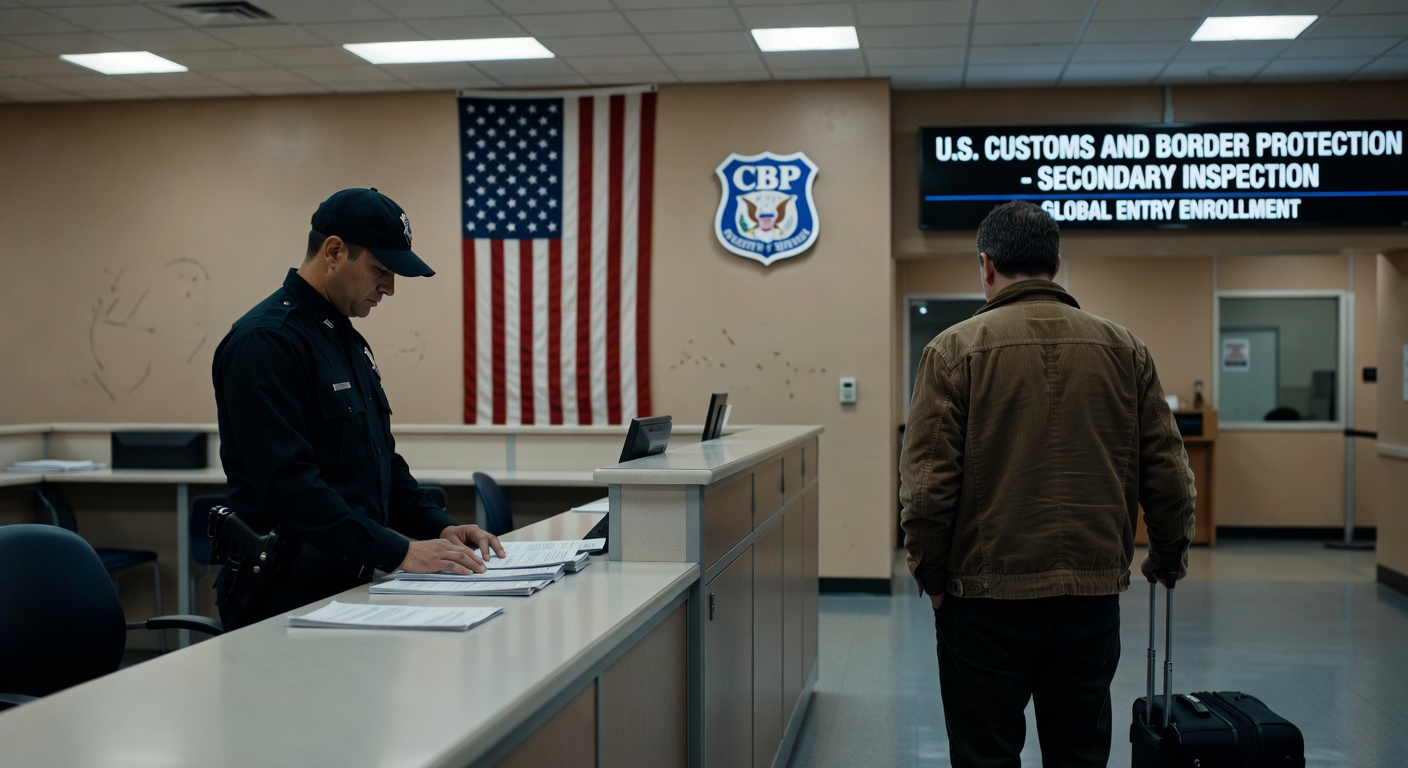
"Primary inspection" is the first booth — the officer who scans your passport, asks a handful of questions, and either admits you or refers you. "Secondary inspection" is the back office: a separate room, additional officers, longer questioning, often device review, sometimes a search of your bags, sometimes referral to ICE. Both happen at every international airport, every land port, and every seaport in the United States, and both fall under CBP's broad inspection authority in 19 U.S.C. § 1582 and INA § 235 (8 U.S.C. § 1225).
CBP is not TSA. TSA screens for weapons and explosives at domestic security checkpoints and has no immigration authority. CBP screens for admissibility, customs, and agriculture at international arrival points and has plenary inspection authority over every person and item entering the United States. The two agencies sit under different chains of command — TSA under DHS's Transportation Security Administration, CBP under DHS's Customs and Border Protection — and the legal regime in a CBP secondary room is nothing like the one at a TSA line.
Anyone can be sent to secondary. Roughly 5% of arrivals are referred randomly. Many more are referred for cause: a database hit, a watchlist match, a travel-pattern anomaly, a social-media flag, a tip from another agency, an unresolved prior immigration record. The length of the inspection ranges from 30 minutes to many hours. Complex cases — device review, ICE referral, credible fear interviews — can run overnight.
Why YOU might be pulled into secondary
Travelers often assume secondary is for "other people." It is not. The most common reasons we see in our intake calls:
- Country-of-origin watchlists. Travelers from Iran, Cuba, Venezuela, Syria, North Korea, and certain African and South Asian countries are routinely flagged at primary and sent to secondary. The flag is automatic; it does not require any individualized concern.
- Past immigration violations. Any prior overstay, prior visa denial, prior withdrawal of application, prior expedited removal, or prior voluntary departure shows up in TECS, the Treasury Enforcement Communications System database CBP uses at the booth. The hit can be decades old.
- Social-media flags. USCIS social-media vetting now extends to CBP at the border. Posts about political activism, support for entities the US has designated, or content perceived as inconsistent with a visitor-visa purpose can produce a secondary referral. Many cases involve nothing more than a single shared post or a comment under a public account.
- Travel-pattern anomalies. Frequent short trips into the US on a visitor visa, recent long stays followed by quick re-entries, unexplained transit through certain countries, or a passport with stamps from sensitive jurisdictions.
- Agency tips. CBP receives lookouts from ICE, FBI, USCIS Fraud Detection and National Security, and foreign liaison services. Any open ICE investigation flags the traveler at every port for years.
- Random selection. Approximately 5% of all arrivals, with no individualized basis.
- Past criminal charges — even without conviction. Arrests that did not result in conviction still appear in NCIC and TECS. Dismissed charges, sealed records, and even some expunged records remain visible to CBP.
- TECS and lookout records. Any "lookout" placed by any partner agency at any time — including older lookouts that are no longer active investigations — can drive a referral.
Almost no one is told why they were sent to secondary. CBP is not required to disclose the basis at the counter, and officers typically do not. The reason can be requested through a FOIA filing after the fact.
What CBP can do — and cannot
The legal regime at a port of entry is not the regime inside the United States. The Fourth Amendment's warrant requirement is largely suspended under the border search exception. The Fifth Amendment right to remain silent does not, in practice, protect a noncitizen who refuses to answer admissibility questions. The right to counsel does not attach during inspection.
Within that framework, CBP can, lawfully and routinely:
- Question anyone about citizenship, immigration status, purpose of travel, length of stay, contacts in the US, and source of funds.
- Search bags and personal effects without a warrant and without suspicion.
- Conduct a basic manual search of phones, laptops, tablets, and third-party drives without a warrant and without individualized suspicion (border search exception).
- Conduct an advanced forensic search of devices using third-party equipment with reasonable suspicion of activity in violation of laws CBP enforces, or a national-security concern, per CBP Directive 3340-049A. See United States v. Cano, 934 F.3d 1002 (9th Cir. 2019), limiting warrantless forensic searches at the border to digital contraband.
- Photograph and fingerprint the traveler.
- Detain a noncitizen for as long as is reasonably necessary to complete the inspection.
- Deny entry to a visa holder under expedited removal in INA § 235(b)(1), with a five-year bar to re-entry.
- Revoke a visa on the spot under 22 C.F.R. § 41.122.
- Refer the case to ICE for removal proceedings, custody determination, and possible ICE arrest.
- Accept a withdrawal of application on Form I-275, ending the inspection without a removal order.
CBP cannot lawfully, even at the border:
- Coerce a confession to a criminal offense without Miranda warnings (though Miranda is not required for routine admissibility questioning).
- Deny re-entry to a US citizen, regardless of cooperation. A US passport is an absolute right of entry.
- Order summary removal of a lawful permanent resident without a finding of abandonment, inadmissibility under INA § 101(a)(13)(C), or a voluntary I-407.
- Hold a US citizen or LPR indefinitely without referral to an appropriate proceeding.
- Conduct a forensic device search without reasonable suspicion (in jurisdictions following Cano).
- Access cloud data not synchronized to the device — current policy requires the officer to disable network connectivity before examining a phone.
- Force a US citizen or LPR to provide a passcode as a condition of admission (though the device can be seized for further inspection).
Green card holders: rights are different (and stronger)
A lawful permanent resident returning to the United States is, by statute, an "arriving alien" subject to inspection. But the protections that attach to that inspection are far stronger than the protections available to a visa holder.
The governing principle: an LPR can be denied entry only through a hearing before an immigration judge, not by a CBP officer at the counter — unless one of three things happens.
- CBP claims abandonment. Abandonment requires both prolonged absence and intent. A long trip alone is not abandonment; intent to make a permanent home outside the US is. Matter of Huang, 19 I&N Dec. 749 (BIA 1988), and Matter of Kane, 15 I&N Dec. 258 (BIA 1975), control. The factors include the duration of the trip, the reason for it, whether the LPR maintained a US home, employment, tax filings, family ties, and any indication of intent to return. CBP at the counter cannot decide abandonment in any binding way — only the immigration judge can.
- CBP finds inadmissibility under INA § 101(a)(13)(C). An LPR is treated as a new applicant for admission if they have, among other things, abandoned status, been absent for a continuous period of more than 180 days, engaged in illegal activity after departure, or committed an offense in INA § 212(a)(2). Even where an inadmissibility ground is asserted, the LPR's status entitles them to a hearing.
- The LPR signs Form I-407. This is the single most dangerous form at the secondary counter. Form I-407, Record of Abandonment of Lawful Permanent Resident Status, is a voluntary surrender of the green card. There is no statute or regulation requiring an LPR to sign it. Signing is irrevocable as a matter of status.
⚠ The I-407 trap
If a CBP officer says you have "abandoned" your green card after a long absence and pushes Form I-407 across the table, do not sign it. You are not required to. The officer cannot decide abandonment unilaterally. Decline to sign, ask to be referred to an immigration judge, and ask for parole into the United States pending the hearing. The IJ will decide abandonment on a full record. If you sign the I-407, you give up your status on the spot and your only way back is to start over as a new immigrant.
The same principle applies to ICE encounters elsewhere: status surrender forms are voluntary and irreversible, and a hearing is almost always the better option.
Visa holders and tourists: the expedited removal trap
For a visa holder — B-1/B-2 visitor, F-1 student, H-1B worker, K-1 fiancé — the regime is harsher. Under INA § 235(b)(1), a CBP officer may enter an order of expedited removal against any arriving noncitizen who, in the officer's judgment, is inadmissible for misrepresentation under INA § 212(a)(6)(C) or for lack of valid documents under INA § 212(a)(7). There is no immigration judge, no appeal, and no review. The traveler is on the next flight home.
The collateral consequences are severe:
- Five-year bar. Under INA § 212(a)(9)(A)(i), a person removed under expedited removal is inadmissible for five years. A second removal carries a 20-year bar.
- Permanent fraud bar. A misrepresentation finding under INA § 212(a)(6)(C)(i) is a permanent inadmissibility ground. Waivable in some contexts under I-601, but extraordinarily hard to win.
- Visa cancellation. The visa stamp in the passport is cancelled, often visibly stamped "CANCELLED" or "CANCELLED WITHOUT PREJUDICE." Future visa applications must overcome the prior denial.
- ESTA/Visa Waiver loss. A removal record permanently disqualifies the traveler from the Visa Waiver Program.
The single most destructive move at the counter is lying. A misrepresentation — about employment, marriage, prior immigration history, intent to remain, source of funds, or who is meeting the traveler — triggers the permanent fraud bar. Refusing to answer is almost always better than answering falsely. Officers are trained to ask the same question multiple ways, to look for inconsistencies between the traveler's answers and the documents in front of them, and to ask the same questions of any travel companion separately.
The phone search problem
The most invasive part of secondary inspection is the device search. Phones and laptops contain a complete record of a traveler's communications, photos, location history, financial activity, and relationships. The border search exception allows CBP to access most of that without a warrant and without individualized suspicion.
The current framework, set by CBP Directive 3340-049A (last updated January 2018) and developed in caselaw including United States v. Cano:
- Basic (manual) search. The officer takes the device, scrolls through the data stored locally, and reviews photos, messages, emails, and apps. No warrant. No suspicion. Allowed for everyone.
- Advanced (forensic) search. The officer connects third-party equipment to extract or copy the device's data. Reasonable suspicion required per CBP policy; the Ninth Circuit in Cano limited the permitted scope to digital contraband. Other circuits have not all adopted Cano's reasoning.
- Passcode demand. CBP can demand the device passcode. The consequences for refusal differ by status:
- US citizens cannot be denied entry but the device can be seized for further examination; CBP must provide a custody receipt.
- LPRs cannot be denied entry but face significant delay and possible device seizure.
- Visa holders refusing the passcode can be denied admission under INA § 212(a)(7) on the theory that the refusal renders the officer unable to confirm admissibility.
- Cloud data. Current policy requires the officer to disable network connectivity before examining a device, so that only locally stored data is reviewed. In practice, apps logged in on the device — email, social media, cloud drives, messaging apps — display recent cached content that is functionally indistinguishable from cloud data. CBP and ICE both use social-media content against immigration applicants, and there is no meaningful filter between the two databases.
The practical takeaway is that any phone you take to a port of entry should be considered subject to a basic search. If the device contains anything that would be a problem in CBP hands — privileged attorney work, journalistic sources, sensitive client data, content that creates an admissibility risk — the safer course is to travel with a clean device or to log out of sensitive apps before the flight. Encrypted-by-default messaging stored locally is still readable in plaintext once the device is unlocked.
What you must say, what you must never say, what you can refuse
The answer is different depending on the question.
You must answer basic admissibility questions: your name, your citizenship or status, the purpose of your trip, how long you intend to stay, and where you will be staying. Refusing these questions is grounds for denial of admission for any noncitizen.
You must never lie about employment, marriage, prior immigration history, the identity of travel companions, the source of funds, your intent to remain in the United States, or any other material fact. A lie that is detected — and CBP officers cross-check answers against their databases — produces the permanent INA § 212(a)(6)(C) fraud bar. Silence is always better than a lie. "I prefer not to answer that question" is a permissible response, even though refusal can be a basis for denial of entry for visa holders.
You can refuse — with consequences — to discuss social-media handles, political opinions, religious beliefs, and the content of private communications. Refusal is not lawful grounds for denying entry to a US citizen or to an LPR. Refusal can be a basis for denying admission to a visa holder under the totality-of-circumstances admissibility framework.
CBP is not required to read Miranda warnings during routine inspection. Oral promises by officers — "if you sign this, you can come back next year" — are not enforceable and frequently turn out to be wrong. Any promise that matters must be in writing on the form, and the form must be read carefully before signing.
I-275 (Withdrawal) vs. expedited removal
Where a noncitizen is found inadmissible at the counter, CBP often offers a choice between two paths: withdrawal of application for admission on Form I-275, or expedited removal under INA § 235(b)(1).
The two are not equivalent.
- Form I-275 (Withdrawal of Application for Admission) is a non-removal departure. The noncitizen voluntarily withdraws the application to enter the US. No removal order is entered. No statutory bar attaches. The visa stamp may still be cancelled, but the traveler is not statutorily barred from coming back. I-275 is a discretionary CBP option — it is offered, not demanded.
- Expedited removal under INA § 235(b)(1) is a formal removal order entered by a CBP officer without a hearing. It triggers a five-year bar (20 years on second removal), and if the underlying basis is misrepresentation, a permanent fraud bar.
For a noncitizen who is in fact inadmissible and has no defense, I-275 is almost always better than expedited removal. But the calculus changes if the noncitizen has a defense — admissibility, a different visa status that could be argued, a credible fear claim — because signing I-275 ends the inspection and forecloses those arguments. Do not sign I-275 to escape the airport if you may have a defense. The right move in that case is to request a hearing.
What to do RIGHT NOW if held in secondary
1. Ask whether you are detained or free to leave
In secondary, you are detained for the duration of inspection — that is legal under the inspection statutes. But the question forces the officer to articulate the situation and creates a record. Stay polite. Do not become combative.
2. Ask to call an attorney — understand the right does not attach at primary
You may ask to call a lawyer. The officer is not required to permit it during inspection itself. The right to counsel under INA § 292 attaches once the case is referred for removal proceedings or you are placed in ICE custody. Some officers grant a call as a matter of discretion; many do not. Asking is still worth doing.
3. Do not sign Form I-407 under any pressure
If you are an LPR and CBP claims abandonment, decline to sign. Ask for an immigration judge hearing and parole into the US pending the hearing. Signing I-407 ends your status irrevocably.
4. Do not sign Form I-275 without understanding what you give up
I-275 is often the right path if you are inadmissible with no defense. It is the wrong path if you have a defense that requires a hearing. Read the form. Ask what right you are giving up. If unsure, ask for an IJ instead.
5. Do not lie. Refusing to answer is better than lying.
A misrepresentation produces the permanent fraud bar. Silence does not. "I would prefer not to answer that question" is a real option, even if it has consequences for admission.
6. If your phone is taken, ask for a custody receipt
CBP Directive 3340-049A requires a written receipt for any device CBP seizes. Get it. Note the receipt number. Devices are typically returned within days, sometimes weeks; forensic searches can take months.
7. Document everything as soon as you can
Officer names, badge numbers, time in and time out, every question asked, every form shown to you, every form you signed, every refusal you made, every promise you were given. Write it down the moment you are out of the room. Memory degrades quickly.
8. FOIA your inspection record
File a CBP FOIA for the secondary inspection record, any sworn statements taken, any forms you signed, and any TECS notes underlying the referral. Six months is a reasonable wait. The records will be critical to any future admissibility case, motion to reopen, or affirmative immigration filing.
After secondary: what comes next
The consequences of secondary depend on the outcome at the counter.
If admitted: Get the inspection record. Request the Form I-94 admission record (admission class, period of stay, conditions). For an LPR who was paroled in pending an IJ hearing, get the parole document, calendar the hearing date, and retain immigration counsel immediately — the abandonment hearing will require evidence of US ties, intent to return, tax filings, employment, and family.
If denied entry as a visa holder: A five-year bar attaches, and if expedited removal was the basis, the bar is statutory and not waivable except through limited I-212 consent-to-reapply procedures. If a misrepresentation finding was made, a permanent fraud bar attaches and any future visa application will face the I-601 inadmissibility waiver. The visa stamp in the passport is cancelled. Future ESTA eligibility is lost.
If expedited removal is ordered with an asylum claim: The noncitizen is entitled to a credible fear interview under INA § 235(b)(1)(B). A positive determination sends the case to immigration court for full removal proceedings with an asylum defense. A negative determination is subject to limited review by an immigration judge.
If detained and referred to ICE: Removal proceedings begin with a Notice to Appear. Custody is determined under INA § 236, and bond eligibility depends on the underlying charges. A bond hearing before an immigration judge is the next major event.
In every case, file a CBP FOIA six months later for the complete inspection record. The records frequently include officer notes that contradict the official outcome, and those notes can be critical in subsequent litigation.
A Modern Law Group practice vignette
Last fall, a 14-year green card holder came back from a six-week trip to visit her dying mother in the Philippines. CBP at LAX pulled her into secondary, told her she had "abandoned" LPR status by being out too long, and pushed Form I-407 across the table. She called us from the holding room. We told her three things: do not sign the I-407, request a hearing before an immigration judge, and ask for parole into the United States pending the hearing. Six hours later she was admitted on a parole document with an immigration court date. Eight months later, the immigration judge ruled she had never abandoned her residency — the trip was clearly tied to her mother's terminal illness, she had maintained a US home, her tax filings showed continuous US ties, and her intent had always been to return. She kept her green card. If she had signed the I-407 at the counter, she would have been on a plane back to Manila with no way back except to start over as a tourist visa applicant.
The lesson she took away — and the lesson we now lead every airport-detention call with — is that nothing CBP says at the secondary counter is the last word. The hearing is the last word. The form is permanent only if you sign it.
Related reading
- Know Your Rights: What to Do If ICE Comes to Your Door
- ICE Administrative Warrant vs. Judicial Search Warrant — Why the Difference Matters
- Can ICE Arrest You at Your Check-In Appointment?
- USCIS Social Media Surveillance: What You Need to Know in 2026
- TSA Delays and Immigration Travel in 2026: What to Expect
Detained in CBP secondary right now, or returning from a long trip with a green card and worried about re-entry? Talk to our immigration attorneys at Modern Law Group before signing any form CBP puts in front of you.
Frequently asked questions about CBP secondary inspection
Can CBP search my phone without a warrant at the airport?
Yes. Under the border search exception to the Fourth Amendment, CBP may conduct a basic manual search of phones, laptops, and other electronic devices at a port of entry without a warrant and without any individualized suspicion. CBP Directive 3340-049A provides that an advanced (forensic) search using third-party equipment requires reasonable suspicion. United States v. Cano, 934 F.3d 1002 (9th Cir. 2019), limited warrantless forensic border searches to digital contraband. CBP can demand the device passcode but is not supposed to access cloud data not stored locally.
Can CBP deny a US green card holder re-entry?
Not summarily. A returning LPR is entitled to a hearing before an immigration judge unless the LPR has abandoned status, is inadmissible under INA § 101(a)(13)(C), or voluntarily signs Form I-407. CBP cannot order an LPR removed on the spot the way it can a visa holder under expedited removal. The single most dangerous decision for an LPR at the counter is signing I-407 under pressure. Matter of Huang and Matter of Kane control on abandonment.
What is Form I-407 and should I ever sign it at the airport?
Form I-407, Record of Abandonment of Lawful Permanent Resident Status, is a voluntary surrender of the green card. You are not required to sign it. If CBP claims you have abandoned residency after a long trip, decline to sign, request an immigration judge hearing, and ask for parole into the United States pending the hearing. The judge — not the CBP officer — decides abandonment. Signing the I-407 ends your status irrevocably.
What is the difference between withdrawal of application (I-275) and expedited removal?
Form I-275 is a non-removal departure with no statutory bar. Expedited removal under INA § 235(b)(1) is a formal removal order entered by a CBP officer without an immigration judge, triggering a five-year bar (20-year on a second removal) and a permanent fraud bar if based on misrepresentation. For a noncitizen who is in fact inadmissible with no defense, I-275 is generally preferable. For one who has a defense, signing I-275 forecloses the hearing and should be refused.
Do I have the right to call a lawyer during CBP secondary inspection?
No, not as a matter of right. The Sixth Amendment right to counsel and the INA right to counsel under INA § 292 attach when removal proceedings begin or when the person is in custody for purposes other than the inspection itself. Primary and secondary inspection are pre-admission and not considered custodial in that sense. CBP officers may permit a call as a matter of discretion. The right firmly attaches once CBP refers the case to ICE or initiates a credible fear interview.
How long can CBP hold me in secondary inspection?
There is no fixed statutory limit. CBP relies on its broad inspection authority under 19 U.S.C. § 1582 and INA § 235 to detain travelers at a port of entry for as long as reasonably necessary to complete inspection. Routine secondaries run 30 minutes to a few hours; complex cases involving device review or ICE referral can extend overnight. A US citizen cannot be denied entry but can be delayed. An LPR cannot be summarily removed but can be paroled in or detained pending a hearing.
What happens if I refuse to give CBP my phone passcode?
Consequences differ by status. A US citizen cannot be denied entry for refusing the passcode but the phone can be seized for further examination — CBP must issue a custody receipt under CBP Directive 3340-049A. An LPR generally cannot be denied entry but faces delay and device seizure. A visa holder who refuses can be denied admission under INA § 212(a)(7) on the theory that the refusal renders CBP unable to confirm admissibility. The decision is a risk-management one and depends on what is on the device.
Can CBP look at my social media accounts during inspection?
CBP can review social-media content cached on the device. Current policy requires officers to disable network connectivity before searching, so that only local data is examined. In practice, social-media apps logged in on the phone display recent posts, messages, and contacts that are functionally indistinguishable from cloud content. CBP can also request social-media handles separately. Refusing to provide handles is generally not a bar to entry for citizens or LPRs but may be a basis for denying entry to a visa holder under the totality-of-circumstances admissibility analysis.
Pulled into CBP Secondary — or Heading Back from a Long Trip? Talk to Us First.
The forms CBP puts in front of you at the secondary counter have five- to ten-year consequences. Don't sign anything without understanding what you are giving up. Talk to an experienced immigration attorney before you fly — or, if you are already in the back room, before you sign.
Schedule a Consultation