





Quick answer
Worksite enforcement under INA § 274A (8 U.S.C. § 1324a) is at the highest level since 2018. ICE Homeland Security Investigations (HSI) conducts two distinct actions: I-9 audits (paper inspection following a Notice of Inspection) and raids (physical worksite enforcement, often with a criminal search warrant or administrative arrest warrant). Workers have Fifth Amendment rights to remain silent and Fourth Amendment protection against unreasonable searches; an administrative warrant (Form I-200, I-205) does not authorize entry to private areas of a workplace. A judicial search warrant signed by a federal or state judge does. The biggest cause of injury to both workers and employers in 2026 is consent — ICE asks for permission, gets it, and the warrant analysis becomes moot. The new IRS-DHS data-sharing agreement (effective April 2026) gives ICE access to 1.28M employer tax records, dramatically expanding the target list. Get an attorney on the phone the moment ICE arrives; do not consent to entry without seeing the warrant.
What is happening with worksite enforcement in 2026
ICE Homeland Security Investigations (HSI) has restored worksite enforcement to a primary priority for the first time since 2018. Three things changed in early 2026:
- IRS-DHS data-sharing agreement (effective April 7, 2026) — gives ICE access to approximately 1.28 million employer tax records. SSN mismatches that previously stayed inside the IRS now route to ICE for enforcement.
- Resumed I-9 audits at scale. Notices of Inspection (NOIs) increased roughly 800% in Q1 2026 over Q1 2025, hitting hospitality, construction, food processing, agriculture, and warehousing hardest.
- Multi-state coordinated raids. The May 2026 ICE deployment surge across 40+ states (about 330 additional officers in coworking-style field offices) directly enables larger worksite operations than 2017-2019.
Two enforcement tools, two legal frameworks. Confusing them is the single biggest mistake we see.
I-9 audits: paper inspection
An I-9 audit starts with a Notice of Inspection (NOI) delivered to the employer, requiring production of I-9 forms and supporting documentation within three business days. ICE may also subpoena payroll records, employee lists, articles of incorporation, and any documents related to unauthorized work.
- What ICE looks for: substantive violations (signing without verifying), procedural violations (unsigned forms, missing fields), and "knowing-hire" patterns (the same SSN appearing across multiple records, falsified documents repeatedly missed).
- Penalties (8 CFR § 274a.10): civil fines from $281 to $2,789 per substantive paperwork violation; $620 to $24,776 per knowing-hire violation; criminal liability under 18 U.S.C. § 1546 (document fraud) and 8 U.S.C. § 1324 (harboring) for patterns showing willful blindness.
- The audit is not a raid. ICE does not enter, does not detain workers. The risk is to the company; the workers are not directly exposed unless ICE follows up.
Best practice on receipt of NOI: call counsel before producing anything. Three business days is the minimum; written extension requests are routinely granted. Voluntary remediation under 8 CFR § 274a.10(b)(2) is available before final penalty assessment.
Raids: physical worksite enforcement
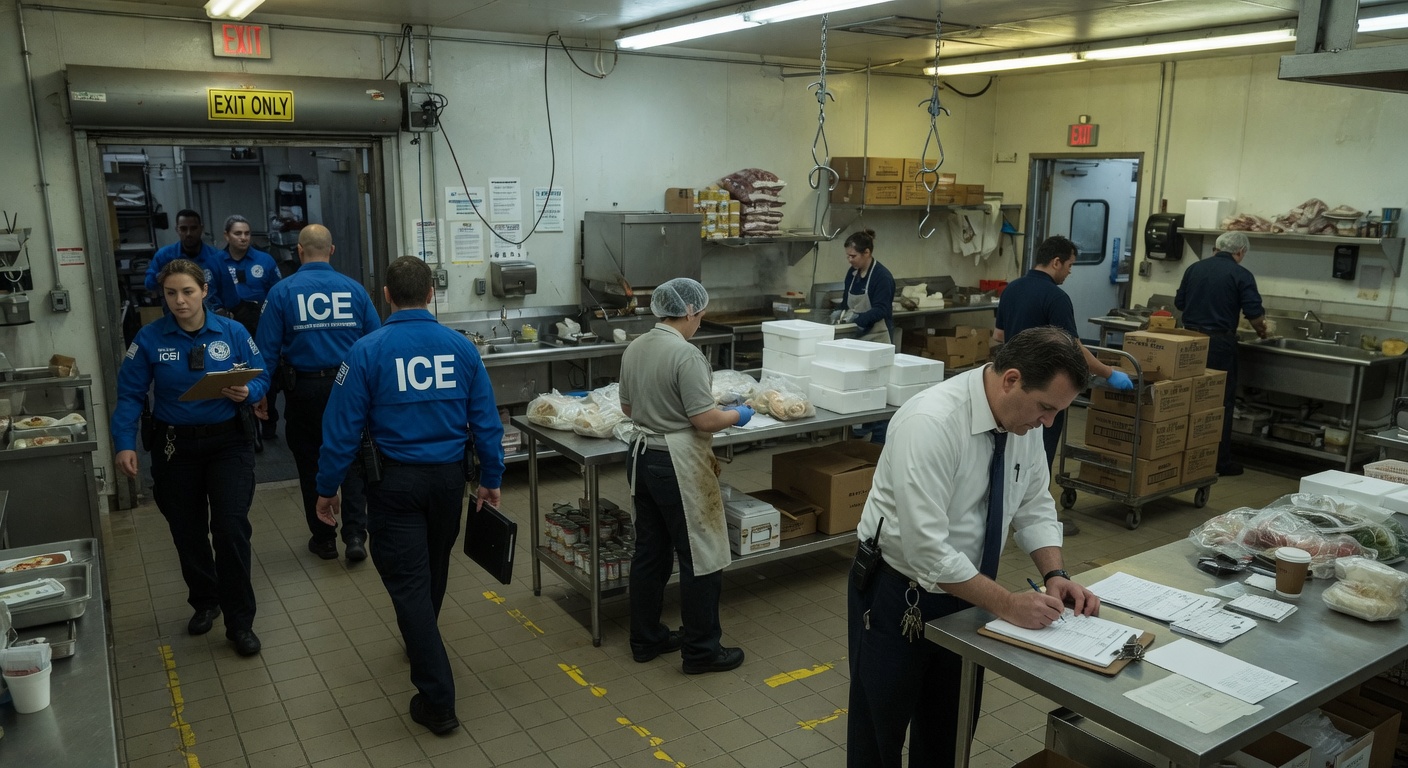
A raid is a physical entry by armed ICE/HSI agents, usually unannounced, often early morning, with the goal of identifying unauthorized workers, executing administrative arrests, and sometimes executing a criminal search warrant against the business itself.
Two legal authorities, very different consequences:
- Administrative warrant — ICE Form I-200 (arrest warrant) or I-205 (warrant of removal). Signed by an ICE supervisor, not a judge. Does NOT authorize entry to non-public areas of a private workplace. ICE may enter public-facing areas (a lobby, a restaurant dining room) but needs consent or a judicial warrant to access employee-only areas, offices, kitchens, warehouses, back rooms.
- Judicial search warrant — signed by a federal magistrate or state judge based on probable cause. Authorizes entry, search, and seizure within the scope of the warrant. The four corners of the warrant matter: dates, locations, items to be seized.
The Fourth Amendment line: employees and employers have a reasonable expectation of privacy in non-public workspace. ICE knows this. ICE also knows that, in the heat of a raid, managers and workers almost always consent to entry. That consent waives the warrant question entirely.
What workers can do during a raid
Workers have constitutional rights regardless of immigration status. The exercise of these rights is not a basis for adverse inference and cannot be used in immigration proceedings as evidence of removability.
The Fifth Amendment
- Right to remain silent. You do not have to answer any question about your immigration status, country of origin, name, or where you live. The safe response: "I want to speak to my attorney." Repeat as needed.
- You do not have to sign anything, including I-826 Notice of Rights, I-877 Stipulated Removal, I-862 Notice to Appear, or any waiver of rights. Signing a stipulated removal or voluntary departure form without counsel is the single fastest way to lose your case.
The Fourth Amendment
- Do not consent to a search. If asked "Do you mind if I look in your bag/locker/desk?" the answer is "I do not consent to a search."
- If ICE produces a warrant, ask to see it. Read the top: is it a federal/state judge's signature (judicial warrant) or an ICE officer's signature (administrative warrant)? Only the judicial warrant authorizes a search of private spaces.
What to physically do
- Do not run. Running can trigger force. It can also be used against you in future proceedings.
- Do not lie or present false documents. False documents create criminal liability under 18 U.S.C. § 1546 beyond the underlying immigration issue.
- Do not flee to a designated "secure" area unless you are certain it is private and the agents lack a judicial warrant. Often this is theater that just delays the inevitable interview by a few minutes; sometimes it triggers additional charges.
- If detained, ask immediately: "Am I free to leave?" If no, ask: "What is the basis for my detention?" If they will not say, ask for an attorney and stop talking.
What employers can do
Employers face civil and criminal liability, business interruption, and reputational harm from raids. The first 30 minutes determine everything.
Before the raid
- Annual I-9 self-audit with counsel. Document the audit. Voluntary remediation is a defense to "knowing-hire" allegations.
- Designate a raid-response contact — a senior employee plus outside counsel on speed dial.
- Train front-line managers on the warrant distinction (judicial vs. administrative), where the public/private line runs at your facility, and what to say to ICE.
- Maintain a clean, current I-9 file. Re-verify expired work authorizations on time; do not retain expired I-9s beyond the statutory period (3 years after hire OR 1 year after termination, whichever is later).
When ICE arrives
- Demand the warrant in writing. Read it. Note the issuing judge or supervisor, the scope, the date range.
- Do not consent to access beyond the warrant. If the warrant covers payroll records only, ICE does not get to walk through the kitchen. If the warrant covers a specific cooler, they do not get to look in the office.
- Call counsel before producing documents. Counsel will appear (often by phone) within minutes; ICE typically does not refuse a brief delay to allow counsel to arrive.
- Document everything. Names and badge numbers of agents present, time of arrival, scope of the search, what was seized. Have one designated person record (audio, video if state law permits).
- Do not lie, alter records, or destroy documents. Obstruction charges under 18 U.S.C. § 1519 apply even to deletion of routine records once a federal investigation is known to be underway.
After the raid
- Inventory what was seized; request a copy of the warrant return.
- Notify counsel of any worker detained or interviewed on-site; counsel can attempt to locate them in ICE custody within 24 hours.
- Preserve all electronic records (HR, payroll, security footage) related to the raid period — you will need them whether the case goes civil, criminal, or just generates an NOI follow-up.
- Anticipate a follow-up NOI. The raid almost always produces a parallel I-9 audit on the same employer.
The administrative warrant problem in 2026
The single most important legal point in this article: an ICE administrative warrant (Form I-200 or I-205) is not a search warrant. It is an order directing ICE officers to arrest a named individual. It is signed by an ICE supervisor, not a judge. It does not authorize entry into private space.
ICE agents know this. They also know that 80% of the time, when they hand a uniformed-looking document to a panicked manager, they get consent to enter. The Supreme Court has been clear since Camara v. Municipal Court (1967) and Wyman v. James (1971) that administrative warrants do not equal search warrants. The Department of Homeland Security's own guidance acknowledges this.
The practical rule for employers: train front-line managers to identify the issuing signature. If the bottom of the warrant says "Immigration Officer" or "Field Office Director," it is administrative. If it says "U.S. District Judge" or "U.S. Magistrate Judge," it is judicial. The difference is the difference between "ICE may take this employee with you" and "ICE may walk through your building, open lockers, and seize records."
Sanctuary cities and 287(g) overlap
Worksite enforcement intersects with state and local cooperation. In a 287(g) jurisdiction (sheriff's deputies are deputized as ICE officers), the raid response timeline collapses — local LEOs are already on scene and have full enforcement authority. In a sanctuary jurisdiction, local police generally will not assist ICE, may not detain on ICE detainers, and may not allow ICE access to local jails for transfers.
For employers and counsel, know which side of that line your worksite is on. The same raid in San Francisco and Phoenix produces radically different downstream outcomes for the workers detained.
Frequently asked questions
Can ICE come into my workplace without a warrant?
Into the public-facing areas, yes (lobby, restaurant dining room, retail floor). Into private/employee-only areas, only with (a) a judicial search warrant, or (b) the employer's consent. Administrative warrants do not authorize entry to private space.
Do I have to tell ICE my immigration status if I am at work?
No. The Fifth Amendment right to silence applies regardless of immigration status. You do not have to answer questions about where you were born, your country of origin, or how you entered the U.S. You can say: "I want to speak to my attorney." That is not an admission and cannot be used against you.
If ICE asks for my ID, do I have to give it?
Some states have stop-and-identify laws that require providing identifying information to law enforcement in a Terry stop. Federal immigration officers generally fall under different rules. The safe answer is to ask: "Am I being detained? Am I free to leave?" If they will not answer, you may decline to answer further questions until you speak with an attorney.
I am a U.S. citizen / lawful permanent resident. Am I still at risk in a raid?
Yes — U.S. citizens and LPRs have been detained in worksite raids, particularly when they cannot immediately produce documentation. Always carry physical evidence of status if you work in a high-enforcement industry: a U.S. passport, certificate of naturalization, or unexpired green card. A driver's license alone may not be enough.
What happens if my employer asks me to lie to ICE?
Do not lie. Telling ICE you are a U.S. citizen when you are not creates a permanent inadmissibility bar under INA § 212(a)(6)(C)(ii) and is a separate federal crime under 18 U.S.C. § 911. An employer asking you to lie may be exposing themselves to 8 U.S.C. § 1324 harboring charges.
If I get an NOI, how much time do I have to respond?
Three business days from receipt. Most employers request and receive a written extension. Use it to retain immigration counsel, conduct an internal audit, and prepare for the inspection — not to scramble.
Can ICE detain workers during an I-9 audit?
The audit itself is a paper inspection — no detention. But if the audit produces evidence of unauthorized workers, ICE may follow up with arrests later. Workers identified through I-9 violations are often arrested off-site (at home, during commute) rather than on-site, to minimize disruption and avoid Fourth Amendment issues.
If I am arrested at work, can my employer fire me?
Employers may terminate workers who lose work authorization or who are arrested for cause. However, terminating in retaliation for asserting rights, or terminating only certain national-origin workers, can create separate liability under Title VII or state employment law. Counsel before firing.
A Modern Law Group practice note
The clients we see in May 2026 are not the clients we saw in February. The IRS data-sharing agreement has dramatically expanded the targeting universe. We are now representing workers detained at medium-sized employers — 50-200 employees, formerly off the radar — who never thought a raid was a realistic threat. We are also seeing the first wave of criminal-referral cases against employers, where prior audits produced a record of "knowing hire" findings that DHS is now using to charge under 8 U.S.C. § 1324.
Two pieces of advice that consistently move the needle. For workers: a written attorney-of-record letter, carried on your person, makes a 10-minute difference at the moment of arrest — ICE will call counsel before they transport when they know one exists. For employers: an annual I-9 self-audit, documented and conducted with counsel, is the strongest defense against knowing-hire charges. Both interventions cost meaningfully less than the consequences of skipping them.
If you, a family member, or an employer is facing an NOI, a raid, or worksite-arrest follow-up, get to counsel the same day. The timeline collapses fast.