



Quick answer
The N-600 Application for Certificate of Citizenship is for people who are already U.S. citizens but never received a document proving it — usually children who derived citizenship automatically from a U.S. citizen parent under INA § 320 after February 27, 2001, or who acquired citizenship at birth abroad under INA § 301, INA § 309, or the older transmission statutes. The N-400 Application for Naturalization is for lawful permanent residents who need to become U.S. citizens. Filing the wrong form is a common, expensive mistake: a derivative U.S. citizen who files N-400 may be told to first prove status; a permanent resident who files N-600 wastes a $1,170 filing fee and several years of processing time. Two practical anchors: (1) if either of your parents was a U.S. citizen when you turned 18 and you lived with them in the U.S. as a green card holder before that, file N-600, not N-400; (2) if you became a green card holder as an adult and never had a U.S. citizen parent in your life, file N-400.
The two forms exist for different people
Many people walk into our practice carrying the wrong form. They downloaded Form N-400 because they want to be a U.S. citizen and N-400 is the “become a citizen” form they have heard about. What they often do not realize is that under the Child Citizenship Act of 2000 (codified at INA § 320, 8 U.S.C. § 1431), many of them already are U.S. citizens by operation of law — the moment all the statutory conditions were met. In those cases, naturalization is the wrong tool. The right tool is the N-600 Application for Certificate of Citizenship, which asks USCIS to document the citizenship that already exists.
The form choice matters because:
- The N-600 is faster, costs less, and does not require a citizenship test, civics exam, or oath ceremony.
- The N-400 is slower, costs more, and requires an in-person interview, biometrics, an English/civics test, and an oath ceremony.
- If you file N-400 when you should have filed N-600, USCIS may still adjudicate it — but you have paid the higher fee, spent the time, and you may also be asked to prove eligibility for naturalization (continuous residence, physical presence, good moral character) that you should never have had to prove because you were already a citizen.
- If you file N-600 when you should have filed N-400, USCIS will deny because you do not yet hold citizenship, and you have lost a $1,170 filing fee.
Who files N-600?
The N-600 is filed by a person who is already a U.S. citizen through one of two routes: (1) acquired citizenship at birth abroad to a U.S. citizen parent, or (2) derivative citizenship obtained automatically before age 18 under the Child Citizenship Act.
Derivative citizenship under INA § 320 (Child Citizenship Act of 2000)
The Child Citizenship Act took effect February 27, 2001. Under INA § 320, a child automatically becomes a U.S. citizen on the date all of the following conditions are simultaneously met before the child turns 18:
- At least one parent is a U.S. citizen by birth or naturalization;
- The child is under 18 years of age;
- The child is a lawful permanent resident; and
- The child is residing in the United States in the legal and physical custody of the U.S. citizen parent.
Citizenship under § 320 is automatic. The child does not need to apply, take a test, or attend a ceremony. The moment the last condition is satisfied, the child is a U.S. citizen. The N-600 simply documents that pre-existing status — it does not confer it.
One frequent trap: the parent must be a U.S. citizen before the child turns 18. If the parent naturalizes when the child is 17 years and 9 months old and all other conditions are met, the child derives citizenship. If the parent naturalizes one week after the child’s 18th birthday, the child does not derive citizenship under § 320, and the path forward is N-400 (after at least 5 years as a green card holder, or 3 years if married to a U.S. citizen).
Acquired citizenship at birth abroad under INA § 301 and § 309
A person born outside the United States to a U.S. citizen parent may be a U.S. citizen at birth under INA § 301 (children of U.S. citizen parents) or INA § 309 (children born out of wedlock to a U.S. citizen parent). The transmission rules depend on:
- Whether one or both parents were U.S. citizens at the time of birth;
- How long the U.S. citizen parent was physically present in the United States before the child’s birth (the “transmission” requirement);
- The applicable version of the statute (the rules have changed multiple times since 1934).
If you were born abroad and your parent or grandparent was a U.S. citizen, the N-600 is the form to document your citizenship at birth. The Consular Report of Birth Abroad (CRBA) is the alternative way to document citizenship for children born abroad, but it must usually be obtained before the child turns 18 and through a U.S. consulate. Adults who never got a CRBA file N-600.
Other acquisition statutes (older laws)
People born before February 27, 2001 may also have acquired citizenship under former INA § 321 (repealed and replaced by § 320). The old § 321 required that both parents naturalize before the child turned 18 (or one parent if the other was deceased or there had been a legal separation). Many adults who were children in the 1980s and 1990s are U.S. citizens under the old § 321 and never knew it because their parents both naturalized when they were minors.
Who files N-400?
The N-400 is filed by a lawful permanent resident who wants to become a U.S. citizen through naturalization under INA § 316 (general naturalization) or INA § 319 (naturalization based on marriage to a U.S. citizen). To qualify, the applicant must:
- Be at least 18 years old;
- Have continuous residence in the U.S. as a lawful permanent resident for at least 5 years (or 3 years if married to and living with the same U.S. citizen spouse for the entire 3 years);
- Be physically present in the U.S. for at least half of that period;
- Demonstrate good moral character;
- Demonstrate basic English (reading, writing, speaking) and pass a civics test;
- Demonstrate attachment to the principles of the U.S. Constitution; and
- Take the Oath of Allegiance.
If you are an adult who became a permanent resident on your own, the green card is yours, neither of your parents was a U.S. citizen when you were under 18, and you want to be a citizen — the N-400 is the right form.
Common misfiles and how to avoid them
The adult who is already a citizen but does not know it
An adult walks in with a green card, says they want to file N-400, and discovers in the intake conversation that one parent naturalized when they were 14. They lived with that parent in the United States as a green card holder. Under § 320, they became a citizen automatically the day the parent naturalized. The right form is N-600, not N-400. We have seen this scenario more than a hundred times in our practice. The first interview question that surfaces it: “Was either of your parents a U.S. citizen before you turned 18, and were you a green card holder living with them at the time?”
The U.S. citizen born abroad who never got a CRBA
A person born in another country to a U.S. citizen parent files N-400 because they think they need to naturalize. They are already a citizen under INA § 301. The right form is N-600. The CRBA path is closed because they are now an adult, but N-600 plus documentation of the parent’s citizenship and transmission requirements will produce a Certificate of Citizenship.
The permanent resident who files N-600
A permanent resident who never had a U.S. citizen parent files N-600 thinking it is a faster route. It is denied because there is no underlying citizenship to document. The $1,170 filing fee is lost. The right form was N-400, which requires the residence, physical presence, English, civics, and good moral character analysis.
The stepchild trap
A stepchild is not a “child” for citizenship and naturalization purposes unless the U.S. citizen stepparent legally adopted the stepchild and the adoption meets the requirements in INA § 101(b)(1)(E). Many families assume the stepparent’s naturalization automatically gives the stepchild citizenship under § 320. It does not, unless there was a qualifying adoption.
Cost, timing, and what the process actually looks like
N-600 filing
- Fee: $1,170 (paper filing) or $1,170 (online filing). Fee waivers available in some categories.
- Processing time: roughly 12–18 months at most service centers.
- Interview: usually not required for adults with clear documentation; sometimes required for older derivative cases or where parental documents are weak.
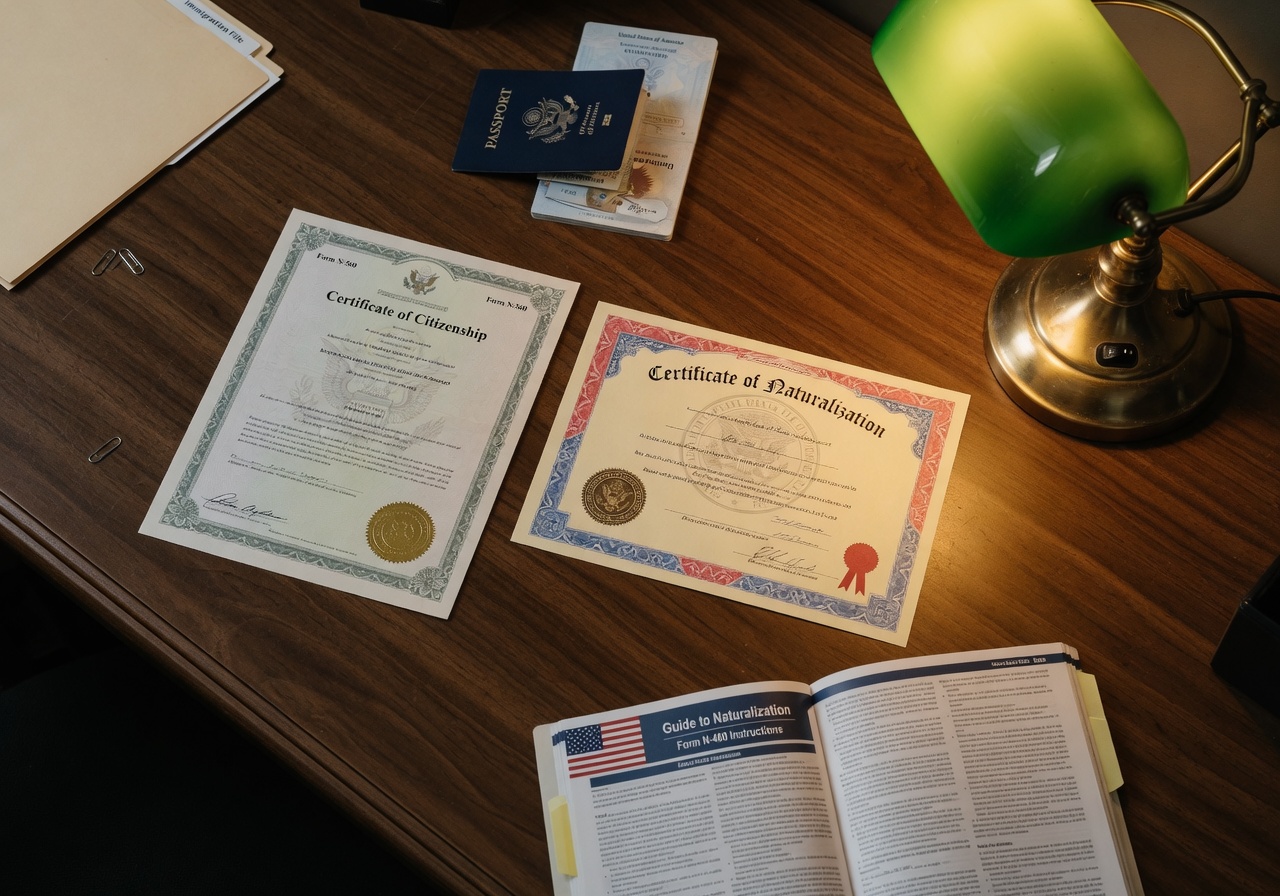
- Outcome: Certificate of Citizenship (Form N-560), which is acceptable proof of U.S. citizenship for U.S. passport application, federal employment, voting registration, and any other citizenship verification.
N-400 filing
- Fee: $760 (online) or $760 (paper) plus $85 biometrics in some categories.
- Processing time: roughly 8–14 months at most field offices in 2026, with significant variation.
- Interview: always required, in person at a USCIS field office.
- Test: English reading, writing, speaking, plus the civics test (10 questions, must answer 6 correctly under the 2008 test; revised 2020 test was rescinded).
- Outcome: Certificate of Naturalization (Form N-550), issued after the oath ceremony.
What to bring before you file either form
For N-600
- Your birth certificate (with translation if not in English);
- U.S. citizen parent’s birth certificate or naturalization certificate;
- Parent’s marriage certificate, if relevant to derivative claim;
- Proof that the U.S. citizen parent was physically present in the U.S. for the required transmission period (for acquired citizenship under § 301/§ 309);
- Your green card (front and back) if claiming derivative citizenship under § 320;
- Evidence of legal and physical custody (court orders, school records, custody agreements) if relevant;
- Two passport-style photos;
- Filing fee or fee waiver request.
For N-400
- Your green card (front and back);
- Travel records covering the entire 5-year (or 3-year) residence period;
- Tax transcripts for the last 5 years (3 if filing under § 319);
- Selective Service registration confirmation (males between 18 and 26 who held LPR status during that age range);
- Court dispositions for any arrest, charge, or citation, no matter how old;
- Marriage and divorce certificates;
- Evidence of continuing marital union for § 319 cases;
- Two passport-style photos;
- Filing fee.
Frequently asked questions
I am 35 years old. My mother naturalized when I was 12 and I had a green card. Am I already a U.S. citizen?
If the Child Citizenship Act (effective February 27, 2001) was in effect when you turned 18 and your mother had legal and physical custody of you in the U.S. as a permanent resident at the time she naturalized, yes — you became a U.S. citizen automatically the day she naturalized. The right form is N-600.
What about the old § 321? My parents both naturalized in the 1980s before I turned 18.
You may have acquired citizenship under former § 321. The requirements were that both parents naturalize before you turned 18 (or one parent if the other was deceased or there was a legal separation in which the custodial parent naturalized), and you must have been a lawful permanent resident at the time. If those facts fit, N-600 is the form.
Can I file N-400 even though I qualify for N-600?
You can file either, but the practical answer is that filing N-400 when you are already a citizen creates avoidable risk. USCIS may discover the derivative claim during the N-400 review and treat the application as misfiled. Filing N-600 is the cleaner path, costs less, and avoids the English/civics test and oath ceremony.
Does filing N-600 require me to take an English or civics test?
Generally no. The N-600 documents pre-existing citizenship; no test is required for adult applicants in most cases. USCIS may ask documentary questions but does not administer the naturalization tests on an N-600.
Is a U.S. passport enough proof of citizenship, or do I still need N-600?
A U.S. passport is acceptable proof of citizenship in most contexts. However, the Certificate of Citizenship (Form N-560) issued after N-600 approval is the strongest and most permanent proof, especially useful when applying for federal employment, applying for state benefits that require citizenship verification, or proving citizenship for children of a derivative citizen. Some practitioners recommend both passport and N-600 for derivative-citizen clients with complex documentary histories.
What if my U.S. citizen parent transmitted citizenship to me at birth abroad, but I have not been to the U.S. since infancy?
If you meet the transmission requirements at the time of your birth, you were a U.S. citizen at birth regardless of where you have lived since. The N-600 documents that. You may also need to address transmission of citizenship to your own children if they were also born abroad, because the transmission rules have minimum-residence requirements that the U.S. citizen parent must meet before the child’s birth.
Can the N-400 be denied because I am already a derivative citizen?
USCIS has, in some cases, treated such filings as moot or directed the applicant to file N-600 instead. In other cases, the N-400 has been adjudicated with the underlying derivative claim treated as a defense. The cleaner practice is to file N-600 when derivative citizenship is established.
Will filing the wrong form put me in deportation proceedings?
Filing N-400 when you are not a permanent resident, or when your permanent residence was improperly obtained, can trigger fraud review. For lawful permanent residents who are simply confused about whether they are already citizens, the risk is usually limited to wasted fees and delay. For people whose underlying status is in question, both forms warrant counsel review before filing.
A Modern Law Group practice note
The single highest-value intake question we ask every new citizenship client is: “Was either of your parents a U.S. citizen before you turned 18, and were you a green card holder living with them at the time?” That one question has saved more than a hundred clients in our practice a year of N-400 processing, a $760 filing fee, the English and civics tests, and the oath ceremony — because the answer revealed they were already U.S. citizens and the right next step was a six-page N-600 with the parent’s naturalization certificate attached.
If you have any chance of being a derivative or acquired U.S. citizen — either parent ever held U.S. citizenship, you spent any part of your childhood in the U.S., or you were born abroad to a parent who held a U.S. passport — do the analysis before filing N-400. The check is cheap. The mistake is not.