





⚖️ What Just Happened
On June 25, 2026, the Supreme Court ruled 6-3 in Mullin v. Al Otro Lado, 609 U.S. ___ (2026), that the federal government can legally cap the number of asylum seekers allowed to present themselves at a port of entry each day. CBP's metering policy — turning people away at the border and telling them to wait in Mexico until there is "capacity" — does not violate the federal asylum statute, the conservative majority held. Justice Alito wrote the opinion. Justice Sotomayor dissented from the bench — an unusual public act — and called the ruling a tragedy. Alito fired back from the bench too, which almost never happens. The policy is not currently in use, but the ruling clears the path for the Trump administration to reinstate it at any moment.
What Just Happened: The Supreme Court's 6-3 Ruling
This morning, the Supreme Court issued its decision in Mullin v. Al Otro Lado, 609 U.S. ___ (2026) — a case that had been working its way through the federal courts since the Obama era and had become the central legal battleground for what happens to asylum seekers before they even reach American soil. The answer, as of today, is that the government can make them wait indefinitely in Mexico.
The vote was 6-3 along the Court's ideological divide. The six-justice conservative majority — Roberts, Thomas, Alito, Gorsuch, Kavanaugh, and Barrett — held that CBP's practice of "metering," capping the daily number of asylum seekers who can present themselves at a port of entry and turning the rest away, does not violate federal asylum law. The three liberal justices — Sotomayor, Kagan, and Jackson — dissented.
The case was brought by Al Otro Lado, an advocacy organization, and individual asylum seekers who had been turned away at ports of entry under metering. They argued that under INA § 208, any person who "arrives in the United States" is entitled to apply for asylum — and that showing up at the port of entry is arriving. The government's position was the opposite: that a person turned away without being allowed through has not legally "arrived," and therefore the asylum statute's protections do not yet apply.
The Court sided with the government. Justice Alito's majority opinion rested on a specific reading of what it means to "arrive in the United States" — a reading that, as Sotomayor put it in dissent, transforms an act of Congress designed to protect refugees into something that can be negated by a CBP officer simply refusing to open the door.
Today's ruling is one of the most significant asylum decisions the Court has issued in decades. It does not just resolve the immediate question of metering. It establishes that control over the port of entry queue — the literal line of people waiting to seek protection — belongs entirely to the executive branch, with no statutory check from Congress's asylum law as long as the person has not yet been formally processed.
What Is Metering? The History of a Policy Both Parties Used
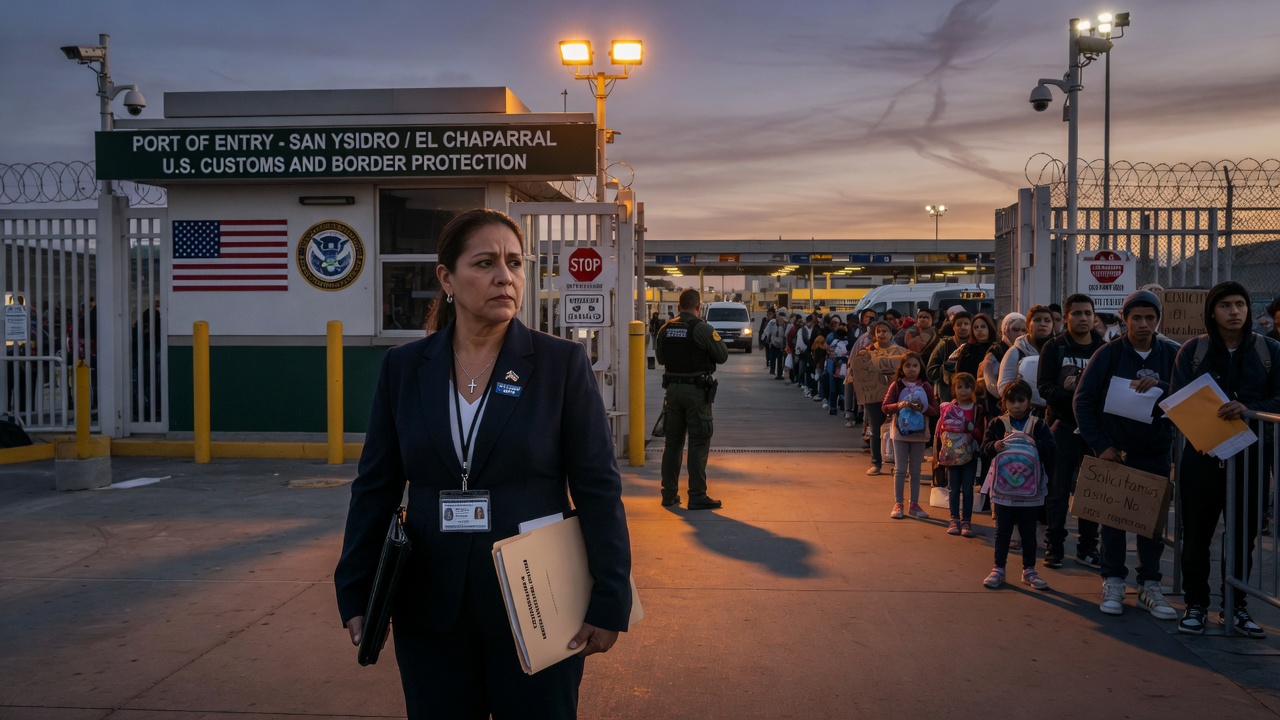
Metering sounds bureaucratic. In practice, it looks like this: a family fleeing gang violence arrives at the port of entry in Tijuana, Matamoros, or Laredo. They walk up to the bridge or the checkpoint. A CBP officer stops them before they cross into the United States and tells them the port is at capacity for the day — or the week. The officer gives them a number on a list and tells them to come back when their number is called. They turn around and go back into Mexico, where they wait.
While they wait, they are in Mexico — a country where, for many asylum seekers, the dangers they fled or similar ones follow them. The cartels that control border towns have exploited metering wait lists, extorting people for "spots" on the list, kidnapping them while they wait, or forcing them into trafficking situations. Advocacy groups documented thousands of people in makeshift encampments in Mexican border cities during the peak of metering under Trump's first term — people sleeping in tents or in the street, often for months, waiting for a number that kept getting pushed back.
The policy did not start with Trump. It began under the Obama administration, initially at the San Diego/Tijuana crossing, primarily in response to a surge of Haitian asylum seekers. The framing at the time was capacity management: CBP argued that its processing facilities had limited space and that it could only responsibly process a certain number of people per day. Critics argued it was an immigration enforcement tool dressed up as an administrative constraint.
Under Trump's first term, metering expanded dramatically — applied to all southern border crossings from Mexico, not just San Diego. The daily quotas became increasingly restrictive. In some locations, the wait stretched to many months. The policy became one of the signature tools of the "Remain in Mexico" era, creating a de facto barrier to asylum access at the legal ports of entry that pushed many people toward crossing between ports, which then created a different set of legal and physical hazards.
Biden rescinded metering in 2021 as part of a broader reversal of Trump-era border policies. A federal judge in California had already ruled that metering violated federal asylum law — specifically, that turning away someone who presents themselves at a port of entry violates the statute's command that any person who "arrives in the United States" can apply for asylum. The Ninth Circuit panel upheld that ruling. The full Ninth Circuit came very close to reversing it, with a nearly even split, but ultimately did not. Then the Supreme Court took the case — and today reversed the lower court holdings that had found metering unlawful.
What the Court Actually Said: Alito's "Knocking on the Door" Logic
Justice Alito's majority opinion turns on a single question of statutory interpretation: what does it mean to "arrive in the United States" under INA § 208? The statute says that any alien "who arrives in the United States (whether or not at a designated port of arrival)" may apply for asylum. The plaintiffs argued that showing up at the port — presenting yourself to a CBP officer and asking for protection — is arriving. The government argued it is not.
Alito accepted the government's position with an analogy that will be quoted in immigration law briefs and law review articles for years: "A guest does not arrive in a house when he knocks on the front door."
The logic is that "arriving" requires actually entering — crossing the threshold — not merely presenting yourself at the boundary. Under this reasoning, a person who walks up to the port, asks a CBP officer to let them in to apply for asylum, and is told to wait in Mexico has not yet arrived in the United States for statutory purposes. They are, in the majority's framing, like the visitor who has knocked but has not been admitted. The door has not opened. They have not arrived.
The majority leaned on the phrase "whether or not at a designated port of arrival" as supporting its reading rather than undermining it. Alito argued this clause was meant to ensure that people who crossed between ports — who physically entered US territory in the desert or the river — could also seek asylum, not to extend asylum access to people who were stopped before crossing into US territory.
The majority also pointed to the history of metering under two presidents — Obama and Trump — as evidence that the executive branch has long understood itself to have this authority, and that Congress has never passed legislation to strip it. If Congress wanted to say that presenting yourself at a port of entry is sufficient to trigger asylum access, the majority suggested, it would have said so explicitly.
That last point is, in a sense, the most sweeping part of the holding. It is not just that metering is permitted — it is that the executive branch's control over who gets to enter the port of entry queue is essentially unconstrained by the asylum statute unless Congress acts to specifically override it.
Sotomayor's Bench Dissent — and Alito's Extraordinary Response
What made today unusual — even by the standards of a major immigration ruling — was what happened in the courtroom when the decision was announced.
Justice Sotomayor dissented from the bench. This is not common. Justices write dissents all the time, but reading one aloud in open court is reserved for decisions the dissenting justice considers so wrong, so significant, or so threatening that the written opinion is not enough — that the justice needs to speak directly to the public and to history in that moment. Sotomayor has done it before, but only in cases where she felt the majority had crossed a line that words on paper alone could not adequately mark.
In her bench statement today, Sotomayor declared that today's ruling "regrettably and tragically extinguishes the light of the torch of the Statue of Liberty." The image is deliberate — the Statue of Liberty's torch as a beacon to those seeking refuge, now darkened by the Court's ruling. She argued that the majority's reading of the asylum statute eliminates the distinction Congress drew between people who present themselves at a legal port of entry — doing everything right, asking for protection through the legal process — and people who cross illegally between ports. Under the majority's logic, she argued, the legal applicants have no more statutory right to access asylum processing than someone who has not shown up at all.
Sotomayor's dissent characterized the ruling as a judicial rewriting of the asylum statute — taking a law Congress passed in the wake of the Holocaust specifically to ensure that the United States would not turn away people fleeing persecution, and reading it to permit exactly that, at least at the threshold stage of the queue.
Then came Alito's response — which was itself extraordinary. After Sotomayor delivered her bench statement, Alito spoke from the bench in reply. Justices almost never respond to dissents in open court. The bench dissent is typically the final word in the public courtroom. Alito's decision to respond broke with that convention.
Alito defended metering's history: it had been used under two presidents, he noted, including a Democratic one. He implied that Sotomayor's rhetoric was more political than legal. And then, with a deliberate finality, he said: "I won't add anything more to that."
That exchange — a dissenting justice invoking the Statue of Liberty's torch, a majority justice responding with a pointed rebuttal and a door-closing phrase — captured something about where American asylum law now stands. It is a place of deep disagreement, not just about legal interpretation but about what the United States is supposed to be.
What This Ruling Means Practically: The Mechanics of Metering
Let's be clear about what has and has not changed for asylum seekers as a result of today's ruling.
The ruling does not ban asylum. It does not eliminate the credible fear process. It does not deport people who are already in the United States in removal proceedings. It does not affect asylum claims filed by people who are already inside the country.
What it does is this: it gives CBP the legal green light — confirmed now by the Supreme Court — to operate a waiting list at ports of entry and to turn people away when the list is "full" for the day. If the Trump administration reinstates metering (which the policy is not currently in use, but the ruling removes the legal obstacle to doing so), CBP officers at every port of entry on the southern border can implement a daily cap on how many asylum seekers they process. Everyone else is told to wait in Mexico.
In practical terms, that means:
- No right to same-day processing. Even if you present yourself lawfully at a port of entry and ask for asylum, CBP can legally turn you away and put you on a list. The statutory right to apply for asylum does not, under this ruling, create a right to enter the processing queue on any particular day.
- Indefinite waits in Mexico. The ruling sets no limit on how long the wait can be. If CBP caps daily admissions at a low number and the queue is long, people could wait for months or longer — as they did during peak metering under Trump's first term.
- No judicial intervention at the queue stage. The ruling removes the strongest federal court hook that advocates had used to challenge metering. Courts can still review other aspects of the process, but the core act of capping daily admissions is now settled as lawful.
- Mexico conditions become legally irrelevant to CBP's authority. The majority did not address what happens to people waiting in Mexico — the violence, the extortion, the trafficking. Those conditions may still be relevant in other legal proceedings, but they do not, under this ruling, invalidate CBP's authority to run the queue as it sees fit.
The ruling clears the path for reinstatement. Whether and when the Trump administration actually reinstates metering is a separate question — an executive branch decision that could happen quickly or not at all depending on operational, diplomatic, and political considerations. But today removed the last major legal obstacle.
Who Is Most Affected: Asylum Seekers at Land Ports of Entry
Metering, by definition, only applies at ports of entry — the bridges, checkpoints, and official crossing points on the border. People who enter between ports of entry (crossing the desert or the river, outside of official checkpoints) are already in the United States when they encounter CBP, and this ruling does not affect their ability to claim asylum in that circumstance.
The people most directly affected by today's ruling are:
- Asylum seekers currently waiting in Mexico near land ports of entry — people who have been waiting in border cities like Tijuana, Ciudad Juárez, Matamoros, Nogales, or Nuevo Laredo for the chance to present themselves at the port. Today's ruling does not remove them from the queue, but it confirms that CBP has no legal obligation to process them on any particular timeline.
- Families and individuals who had been planning to present at a port of entry rather than crossing between ports, specifically because presenting at the port is the legal route. Under metering, the "right way" becomes the slowest and most uncertain way — a dynamic that advocates say pushes desperate people toward more dangerous crossings.
- Nationals from countries where legal pathways to the US are limited. For many nationalities — Venezuelans, Salvadorans, Guatemalans, Hondurans, Haitians, and others — a US port of entry represents the only realistic access point to asylum protection. Other visa categories are unavailable or practically inaccessible. Metering hits these populations hardest.
- People with urgent protection needs who cannot afford to wait. Metering does not prioritize vulnerability. A domestic violence survivor, a journalist facing death threats, a LGBTQ+ person fleeing persecution — all go into the same queue as everyone else, subject to the same cap. The urgency of the protection need does not shorten the wait.
Advocates and legal aid organizations working on the US-Mexico border have documented the consequences of metering in granular detail. The evidence submitted in the Al Otro Lado litigation itself showed kidnappings, assaults, extortion of people on wait lists, and deaths among people waiting in Mexican border cities during earlier metering periods. Today's ruling does not make those consequences disappear. It simply establishes that they are not a constitutional or statutory basis to block CBP's authority to run the queue.
Does This Mean Your Asylum Case Is Over?
This is probably the most important question for our clients and for anyone reading this who is currently in the asylum process or considering it. The answer is clear: no, this ruling does not end pending asylum cases or eliminate asylum for people already in the United States.
Here is what the ruling does and does not affect, broken down by situation:
If you are already inside the United States and have applied for asylum: This ruling has no direct effect on your case. Asylum proceedings for people inside the country go through immigration courts, where separate procedures and legal standards apply. The metering ruling is about the port of entry queue — not about what happens after someone is processed and in the immigration system.
If you are in removal proceedings and have an asylum claim pending: Same answer. Your case proceeds through immigration court. The question of whether CBP can cap daily admissions at the border is irrelevant to your hearing before a judge.
If you have received a Notice to Appear: The ruling does not change your proceedings. The Notice to Appear places you in formal removal proceedings, where you have the right to appear before an immigration judge and present your claims.
If you have passed a credible fear interview: You are already in the system. The metering ruling does not reach back and undo that. Your case moves forward on its merits.
If you are waiting in Mexico at a port of entry: This ruling is directly relevant to you. CBP now has confirmed legal authority to maintain a wait list and turn you away on any given day. Your access to the port — and through it, to the asylum process — depends on the policy decisions of the executive branch.
If you are considering presenting at a port of entry: You should consult with an immigration attorney before making any decisions. The legal landscape at the port has shifted significantly with this ruling, and the practical options depend on factors that vary by port, nationality, and individual circumstance.
Key Takeaway
Today's Supreme Court ruling in Mullin v. Al Otro Lado confirms that CBP can legally cap daily asylum presentations at ports of entry and turn people away to wait in Mexico. This does not eliminate asylum as a form of protection — it only affects the initial queue at ports of entry. If you are already inside the United States and in the asylum process, this ruling does not change your case. If you are approaching a port of entry or waiting in Mexico, this ruling is directly relevant and you should speak with an immigration attorney before making any decisions about how to proceed.
What Options Remain for Asylum Seekers
Even with today's ruling, meaningful options still exist. None of them are simple, and none of them eliminate the practical hardships that metering creates. But they are real, and understanding them is the starting point for making informed decisions.
1. Persist Through the Queue
If metering is reinstated, the wait list does not disappear — it just controls access to the queue. People can still get on the list and wait for their turn. This is the hardest option in terms of endurance and safety in Mexican border cities, but it is the one that most closely follows the legal port of entry pathway. Organizations like Al Otro Lado and Human Rights First have legal monitors at several crossings who can provide information about wait times, list conditions, and advocacy resources.
The practical advice for anyone planning to wait in a border city is to connect with local legal aid and advocacy organizations immediately. They have relationships with CBP, knowledge of local conditions, and resources that individuals waiting alone do not have access to.
2. Express Credible Fear — The CBP Obligation That Survives This Ruling
Even under metering, if you express a fear of return to your home country at the port of entry, CBP is legally obligated to refer you to an asylum officer for a credible fear interview. This obligation did not disappear with today's ruling. The metering decision is about CBP's authority to manage the queue — not about its obligation to respond to expressed fear claims.
This means that if you present yourself at the port and, when turned away, clearly articulate that you fear for your life if returned to your home country, the officer has a legal duty to refer you for a credible fear interview rather than simply sending you back to Mexico. The credible fear interview is conducted by an asylum officer, not CBP, and a positive determination gets you into formal removal proceedings where you can fully present your asylum claim before an immigration judge.
The critical word is "express." You must say it, clearly and directly. The burden is on you to articulate the fear in that moment at the port, not to assume the officer will ask. If you are turned away under metering without having expressed a fear of return, you have missed the procedural hook that creates the referral obligation.
3. Legal Entry on a Visa
For individuals who qualify for any US visa category — a visitor visa, a student visa, a work visa, or any other category — legal entry on a visa bypasses the metering queue entirely. A person who enters the United States legally on a valid visa is inside the country, and asylum applications by people inside the country are unaffected by today's ruling.
This option is not available to everyone — visa approval is itself a process with its own requirements and bars, and many asylum seekers come from countries where US visa approval rates are very low. But for anyone who might qualify for any visa category, exploring that pathway is worth doing immediately and with an attorney's help.
4. Withholding of Removal and CAT Protection
Asylum is not the only form of protection available to people fleeing persecution or torture. Withholding of removal under INA § 241(b)(3) and protection under the Convention Against Torture (CAT) are separate legal standards that provide different but meaningful protection. They have different bars and different procedures, but for some individuals — including people who are barred from asylum on other grounds — they may be available even if asylum is not. An immigration attorney can evaluate whether these forms of protection are applicable to a specific situation.
5. Consult an Immigration Attorney Now
The most important thing anyone affected by this ruling can do is consult with a qualified immigration attorney before making any decisions about how to proceed. The landscape at the border is complicated, and individual circumstances — nationality, family composition, prior immigration history, prior removal orders, health conditions — all affect which options are available and how to pursue them most effectively. General information is not a substitute for advice specific to your case.
If You Are Currently Waiting at the Border or in Mexico
Connect immediately with legal aid organizations operating in your border city. In Tijuana: Al Otro Lado. In Matamoros and the Rio Grande Valley: RAICES, CLINIC affiliates, and local legal aid. These organizations have legal monitors at crossings, know the current conditions, and can help you document your situation and understand your options in light of today's ruling. Do not make decisions about crossing methods or legal strategy without speaking to a legal professional first.
The Broader Legal Landscape: What Comes Next
Today's ruling resolves the specific question of CBP's metering authority, but it does not close the book on asylum litigation at the Supreme Court or in the lower courts. Several related legal questions are still being litigated in various stages:
The Remain in Mexico program (Migrant Protection Protocols): This is a separate policy that goes beyond metering — it requires asylum seekers to wait in Mexico not just while in the queue, but throughout their immigration court proceedings after being processed. The legal status of Remain in Mexico, though addressed in prior Supreme Court cases, continues to generate litigation over its implementation details.
Safe third country agreements: The Trump administration has pursued agreements with Mexico and Central American countries that would require asylum seekers to first seek protection in those countries before claiming US asylum. These agreements raise separate legal questions about whether the US can effectively bar asylum claims from people who transited through other countries — questions that today's ruling did not address.
Credible fear standards: The administration has also moved to tighten the standard for passing a credible fear interview, which is the checkpoint between initial screening and formal removal proceedings. Changes to credible fear standards are subject to separate regulatory and judicial review.
The net effect of today's ruling, placed in context, is to consolidate executive control over one additional key leverage point in the asylum process — the initial queue at the port of entry. Added to the administration's existing enforcement posture on expedited removal, Remain in Mexico, and credible fear standards, metering reinstatement would significantly compress the pathway through which someone can access US asylum protection through the legal, formal route.
Advocates have already signaled they will pursue every available avenue: legislative lobbying for statutory clarity, continued litigation on related questions, international scrutiny through human rights bodies, and pressure on the administration not to reinstate metering even though today's ruling permits it. None of those paths is fast, and none of them changes the legal landscape that exists right now.
Modern Law Group: We Handle Asylum Cases Across the Country
At Modern Law Group, we have helped hundreds of asylum seekers navigate a system that has never been easy and that has become significantly more complicated with each new policy shift. We know what the credible fear process looks like from the inside. We know how to build asylum cases before immigration judges, how to handle appeals, and how to respond quickly when enforcement situations arise unexpectedly.
If you are currently in the asylum process — at any stage — today's ruling is a good reason to review your case with an attorney to make sure your strategy accounts for the current legal environment. Not because the ruling changes what is already pending before an immigration judge, but because the broader context affects how courts and agencies approach asylum claims, and staying ahead of that context is part of good legal representation.
If you are approaching the border or currently waiting in a Mexican border city, today's ruling is directly relevant to how you should proceed. Please do not make decisions about how to cross — or whether to cross, or what to say when you do — without legal advice specific to your situation. Call us at (888) 902-9285.
If a family member has been detained, is subject to a removal order, or is in an expedited removal situation, call us immediately. These cases move fast, and early intervention matters enormously.
"The Court's ruling today does not end asylum in America. But it does extend the government's authority over who gets to stand in line to ask for it. For people fleeing persecution, the line just got harder to find — and the wait in Mexico more dangerous." — Deron Smallcomb, Esq., Modern Law Group
Frequently Asked Questions
What did the Supreme Court decide in Mullin v. Al Otro Lado?
On June 25, 2026, the Supreme Court ruled 6-3 in Mullin v. Al Otro Lado, 609 U.S. ___ (2026), that CBP's metering policy — capping how many asylum seekers can present themselves at a port of entry each day and turning the rest away to wait in Mexico — does not violate federal asylum law. The conservative majority held that a person who is turned away at the port without being allowed to enter has not "arrived in the United States" for purposes of INA § 208, and therefore cannot invoke the statutory right to apply for asylum at that moment. Justice Alito wrote the majority. Justices Sotomayor, Kagan, and Jackson dissented.
What is metering and how does it work in practice?
Metering is a CBP policy under which officers at a port of entry cap the number of people who can present an asylum claim each day. When the daily limit is reached, CBP officers turn away additional asylum seekers — telling them the port is at capacity and to return another day. People turned away often wait in Mexico in makeshift camps or shelters, sometimes for weeks or months, in conditions that advocacy organizations have documented as dangerous and in some cases life-threatening. Metering originated under the Obama administration at the San Diego/Tijuana crossing for Haitian arrivals and was expanded under Trump's first term to all southern border crossings from Mexico. Biden rescinded it in 2021. Today's ruling clears the path for reinstatement.
Does this ruling mean my asylum case is over?
No. This ruling only affects people who are approaching a port of entry and have not yet been processed. If you are already inside the United States, have been through a credible fear interview, have a Notice to Appear, or are in formal removal proceedings, this ruling does not change your case. Asylum law and procedures for people already in the immigration system remain intact. The metering ruling is specifically about CBP's authority to manage the queue at the port — not about what happens to people who are already in the process.
What options remain for asylum seekers after this ruling?
Several options remain. First, if CBP metering is reinstated, you can still wait in the queue and present yourself when the port has capacity. Second, if you express a credible fear of persecution or torture at the port, CBP must refer you for a credible fear interview regardless of metering. Third, legal entry on a visa remains an option for those who qualify. Fourth, withholding of removal and Convention Against Torture protection are available to some individuals even when asylum is not. Fifth, consulting with an immigration attorney to identify the best pathway given your specific circumstances is the most important step you can take right now.
Is metering currently being used at the border?
As of the date of this ruling (June 25, 2026), metering is not currently in active use at all ports of entry. The Supreme Court's ruling clears the legal path for the Trump administration to reinstate it. Whether and when reinstatement happens is a policy and operational decision by the executive branch. The ruling removes the legal obstacle — it does not itself restart metering. Watch for DHS and CBP announcements in the days and weeks following the ruling, and consult with an attorney if your situation may be affected by a reinstatement.
Schedule a Consultation
Today's ruling from the Supreme Court is significant — and it is worth understanding what it does and does not mean for your specific situation. Whether you are currently in the asylum process, considering presenting at a port of entry, or waiting in Mexico, the legal terrain has shifted and the best decisions are informed ones made with qualified legal counsel.
Modern Law Group represents asylum seekers and immigrants in removal proceedings across the country. Our attorneys understand how to navigate a system that keeps changing, how to protect your rights at every stage of the process, and how to move quickly when situations become urgent. If you have questions about how today's ruling affects your case or your family's options, Schedule a Consultation today. You can also reach us directly at (888) 902-9285.
This is not the moment to wait and see. The people who fare best in immigration cases are the ones who understand their options early and have legal guidance before the critical moments — not after them. Let's talk about where you stand.