


Quick answer
Executive Order 14165 (Jan. 20, 2025), § 8, directed the State Department, DOJ, and DHS to enter Safe Third Country Agreements (STCAs) and related third-country removal arrangements. The statutory hook is INA § 208(a)(2)(A) (8 U.S.C. § 1158(a)(2)(A)), which bars asylum for any noncitizen who can be removed under a bilateral agreement to a country where their life or freedom would not be threatened and where they would have access to a "full and fair procedure." In 2026, active STCAs cover Canada (entire land border under the Additional Protocol), Guatemala, Honduras, and El Salvador; newer cooperation arrangements with Costa Rica, Panama, Paraguay, Ecuador, Rwanda, Eswatini, and South Sudan operate as third-country removal deals after a removal order. STCAs bar asylum — they do not bar withholding of removal under INA § 241(b)(3) or relief under the Convention Against Torture. The single biggest case-killer in 2026 is showing up to a credible-fear interview without an attorney and without documentary proof of the family-unity, unaccompanied-minor, or country-of-nationality exception. Get counsel before the interview, not after.
What is a Safe Third Country Agreement?
A Safe Third Country Agreement (STCA) is a bilateral treaty that lets the United States refuse to consider an asylum claim if the applicant passed through, or could have applied for protection in, the partner country first. The statutory hook is INA § 208(a)(2)(A) (8 U.S.C. § 1158(a)(2)(A)), which bars asylum for any noncitizen who "may be removed, pursuant to a bilateral or multilateral agreement, to a country (other than the country of the alien's nationality) in which the alien's life or freedom would not be threatened" and in which the alien would have access to a "full and fair procedure" for adjudication.
That sounds narrow. In practice, the 2026 wave of STCAs and related third-country removal arrangements has stripped the asylum option from huge categories of cases that would have been adjudicated on the merits two years ago.
How we got here: EO 14165 and the policy reset
On January 20, 2025, President Trump signed Executive Order 14165, "Securing Our Borders." Section 8 directed the Secretary of State, in coordination with DOJ and DHS, "to take all appropriate action to facilitate additional international cooperation agreements to deter and prevent the illegal entry of noncitizens into the United States," including new Safe Third Country Agreements under INA § 208(a)(2)(A) or any other applicable provision of law.
That last clause is the lever. It lets the administration use two parallel tools:
- Formal Safe Third Country Agreements (STCAs / "Asylum Cooperative Agreements" / ACAs). These are public treaties. They block asylum eligibility outright and trigger removal to the partner country.
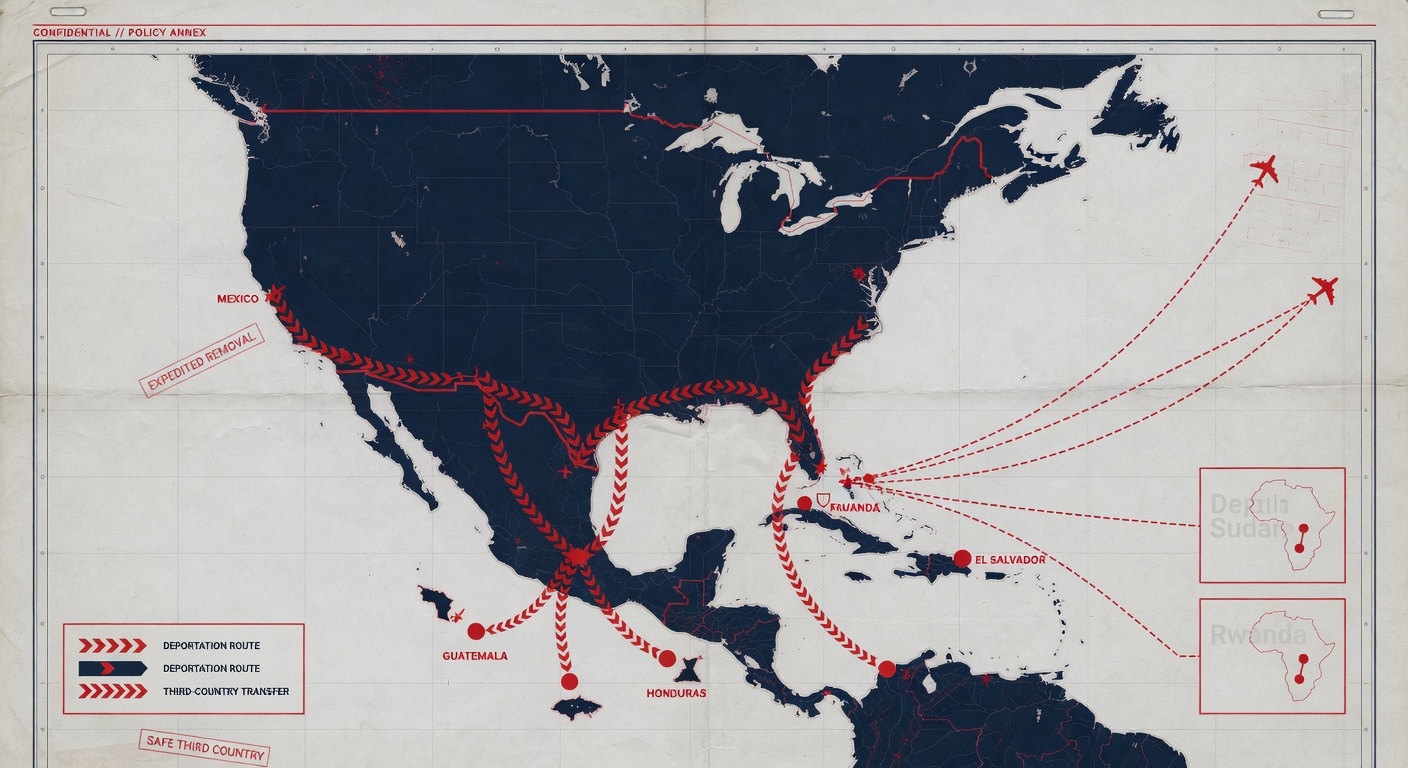
- Third-country removal arrangements. These are typically non-public, do not block asylum on their face, and operate after a removal order is already entered. DHS uses them to send people to countries they have no tie to — El Salvador, South Sudan, Rwanda, Eswatini — when the home country will not accept them.
The agreements active in 2026
The Trump-era ACAs with Guatemala, Honduras, and El Salvador were terminated under President Biden in February 2021. They are back, expanded, and joined by new arrangements:
- Canada (Additional Protocol) — effective March 25, 2023, reaffirmed in January 2026. Extended the original STCA to the entire 5,500-mile land border, not just ports of entry. Anyone crossing into the U.S. from Canada (or vice versa) must seek asylum in the country of last presence. CBP enforces a 14-day window after crossing.
- Guatemala — reinstated ACA in 2025. People who transited Guatemala on their way to the U.S. southern border can be removed there to pursue asylum.
- El Salvador — reinstated and broadened. The administration has used a separate third-country removal arrangement to send Venezuelan, Cuban, and other nationals to CECOT (the Salvadoran mega-prison) under the Alien Enemies Act — a use the Supreme Court has partially constrained but not eliminated.
- Honduras — reinstated ACA in 2025.
- Costa Rica, Panama, Paraguay, Ecuador — newer 2025–2026 cooperation agreements that allow third-country removals after a final removal order.
- Rwanda, Eswatini, South Sudan — non-public removal arrangements used as destinations of last resort for nationals whose home countries will not accept them or where torture / persecution concerns block return.
The administration has signaled additional agreements with several Caribbean and Sub-Saharan African states in 2026. Presidential Proclamation 10998 (effective January 1, 2026) also imposed entry bans on nationals of Dominica and Antigua and Barbuda, among others, which interacts with the STCA framework when those nationals show up at the southern border.
What changes in your case
If you have a pending asylum claim or are considering filing one, the practical effect of the 2026 STCA framework looks like this:
1. Asylum officers can deny on STCA grounds at the credible-fear interview stage
Under the regulations implementing INA § 208(a)(2)(A), an asylum officer can find STCA-bar applicability at the credible-fear or reasonable-fear interview. The applicant gets a threshold screening for whether they would face persecution or torture in the third country — not a full hearing. The standard is low ("more likely than not"), the burden is on the applicant, and there is no right to counsel at the interview.
2. Withholding of removal and CAT are still available
STCAs do not bar withholding of removal under INA § 241(b)(3) or relief under the Convention Against Torture. Both are mandatory if the statutory standards are met. Both are harder to win — the burden is "more likely than not" rather than "well-founded fear" — but they survive the STCA bar.
3. Third-country removal is a moving target
Even with a CAT grant, the government can sometimes execute removal to a third country that has not been adjudicated. The agency's position is that CAT protects against return to the country where the person fears torture, not against removal to a different country. Several federal courts have ordered procedural protections — advance notice of the destination, an opportunity to raise fear — but the law is unsettled and litigation is active in 2026.
4. The Canadian land-border bar is now nationwide
If you crossed into the U.S. from Canada (anywhere along the border, not just at a POE) after March 25, 2023, you have 14 days to be apprehended before the STCA bar applies to most claims. After 14 days you can usually file in the U.S. There are STCA exceptions (unaccompanied minors, family members in the U.S., certain document holders, public-interest cases) — raise them early.
Who is exempt from the Safe Third Country bar?
Under 8 CFR § 1208.30(e)(6)(iii) and the implementing regulations for each agreement, the categorical exceptions are narrow but important:
- Unaccompanied minors — never barred under any current STCA.
- Family unity — if a spouse, parent, or unmarried child under 18 is in the U.S. with lawful status (or a pending claim), the STCA does not apply.
- Lawful U.S. document holders — people with a valid U.S. visa, refugee/asylee status, or other lawful entry document.
- Public-interest exception — case-by-case, requires DHS approval. Rarely granted; almost always requires an attorney.
- Country of nationality exception — the STCA does not apply to a national or habitual resident of the partner country (you can't be sent to Guatemala if you are Guatemalan).
Documenting these exceptions at the moment of apprehension matters. Asylum officers will not infer them. Bring proof — family relationship documents, U.S. visa records, school enrollment for minors — to every interaction with CBP, ICE, or USCIS.
What withholding of removal and CAT look like in practice
If asylum is barred by an STCA, the case typically routes to an immigration judge for withholding-only proceedings. Three doctrines do most of the work:
- Withholding under INA § 241(b)(3). Bars removal to a country where life or freedom would be threatened on account of a protected ground (race, religion, nationality, political opinion, particular social group). Standard: "more likely than not." Country-specific. Does not confer permanent status or a path to a green card.
- Withholding under CAT. Bars removal to a country where torture by or with the acquiescence of a public official is more likely than not. No protected-ground requirement.
- Deferral under CAT. A weaker form — available even to people barred from withholding (e.g., aggravated felons). Holds removal in abeyance to a specific country.
The strategic insight in 2026: a CAT case built on detailed country-conditions evidence, expert declarations, and prior-harm documentation can win even when an STCA closes the asylum door. We see this most clearly in Venezuelan, Cuban, Haitian, Nicaraguan, and certain Central American cases.
The active legal challenges
The 2026 STCA framework is being attacked on multiple fronts:
- Procedural due process. A pending D.C. Circuit case challenges the use of non-public third-country removal arrangements without adequate notice or fear-based screening.
- Refugee Convention compliance. Human Rights First and Refugees International have published reports documenting that Guatemala, Honduras, El Salvador, and Rwanda do not meet the statutory "full and fair procedure" standard. Several STCAs are being litigated on this basis.
- Alien Enemies Act removals. The Supreme Court's March 2025 ruling allowed AEA-based removals to continue but required minimum notice and a habeas mechanism. Implementation is still contested in district courts.
- Canadian STCA equality challenge. A 2023 Supreme Court of Canada decision upheld the bilateral agreement but ordered Canada to monitor U.S. detention conditions. The 2026 reaffirmation may trigger new litigation.
If your case is still alive: what to do this week
- Document your route. Receipts, bus tickets, photos with timestamps, social media posts, hotel records. The STCA analysis turns on whether you "transited" or had a "meaningful opportunity" in the third country. Vague transit through an airport is different from a four-month stay.
- Document family in the U.S. Birth certificates, marriage certificate, evidence of the relative's status. Family-unity exceptions require proof at the interview.
- Document country conditions. Even for the partner country — persecution or torture risk in Guatemala or El Salvador is your basis for the threshold-screening exception.
- Get an attorney before the credible-fear interview. The biggest case-killer in 2026 is showing up to the interview without representation. Asylum officers will not slow down. Decisions issue same-day in many cases.
- If you are in withholding-only proceedings, start building a CAT case in parallel. Expert country-conditions declarations, medical and psychological evaluations, and corroborating evidence are how these cases win.
- If you receive a third-country removal notice, contact counsel immediately. You may have hours, not days, to file an emergency habeas petition or stay request.
Frequently asked questions
Can the government send me to a country I've never been to?
Yes — if you have a final removal order, your home country will not accept you, and DHS has a removal arrangement with the destination country. The government must give you notice and an opportunity to raise a fear of torture. The adequacy of that notice is being litigated in 2026.
Does an STCA apply to my I-589 that's already pending?
It depends when you filed and when you entered. If you entered before the relevant agreement was in force, the bar generally does not apply retroactively. If you entered after the effective date and the STCA covers your route, the bar applies even to a pending application. This is a fact-specific analysis — do not assume.
What if I'm Mexican?
The U.S.–Mexico cooperation framework is not a formal STCA under INA § 208(a)(2)(A) as of mid-2026. Mexican nationals filing in the U.S. are generally not barred by the third-country agreements with Guatemala, Honduras, or El Salvador. Other expedited-removal and credible-fear rules apply.
What if I'm unaccompanied (UAC)?
Unaccompanied children under 18 are statutorily exempt from STCA bars and from expedited removal under the Trafficking Victims Protection Reauthorization Act (TVPRA). UACs are placed into removal proceedings before an immigration judge, with the right to apply for asylum on the merits. Pursue that path.
What if I'm already in withholding-only proceedings?
You can still win withholding under INA § 241(b)(3) or CAT. The country conditions evidence has to be specific, current, and tied to your individual risk. Withholding does not give you permanent status, but it stops the removal and gives you work authorization. You can later apply for adjustment if a basis emerges.
A Modern Law Group practice note
We are seeing more credible-fear denials in 2026 than at any point since 2019. The driver is not the merits of the underlying claims — it is the new STCA framework being applied at the threshold. The clients who survive the screening are the ones who walk in with documents, a clear narrative of why the partner country is not safe for them specifically, and counsel who has tried these arguments before. The ones who lose are the ones who try to figure it out at the interview.
If you, a family member, or a client is facing a credible-fear interview, third-country removal notice, or withholding-only proceedings under any of the 2026 agreements, get to a lawyer the same day. Speed and documentation are what move these cases.