



🚨 Breaking: What TPS Holders Need to Know NOW
On June 25, 2026, the U.S. Supreme Court ruled 6-3 in Mullin v. Doe that federal courts cannot review most challenges to TPS termination decisions. Here is what that means in plain terms:
- ~350,000 Haitian TPS holders and ~6,000 Syrian TPS holders lose the court protection that was blocking their terminations.
- 1.3 million TPS holders from 17 countries can no longer rely on the courts to stop terminations on statutory grounds.
- The Trump administration has already moved to terminate TPS for 13 countries. Nicaragua, Honduras, and El Salvador — with designations 25+ years old — are now also in the crosshairs.
- The only surviving legal hook is a constitutional equal protection claim — and even the majority opinion signals that bar is very high.
- Do not wait for the courts to rescue you. Consult an immigration attorney immediately to identify what options you have right now.
What the Court Actually Decided
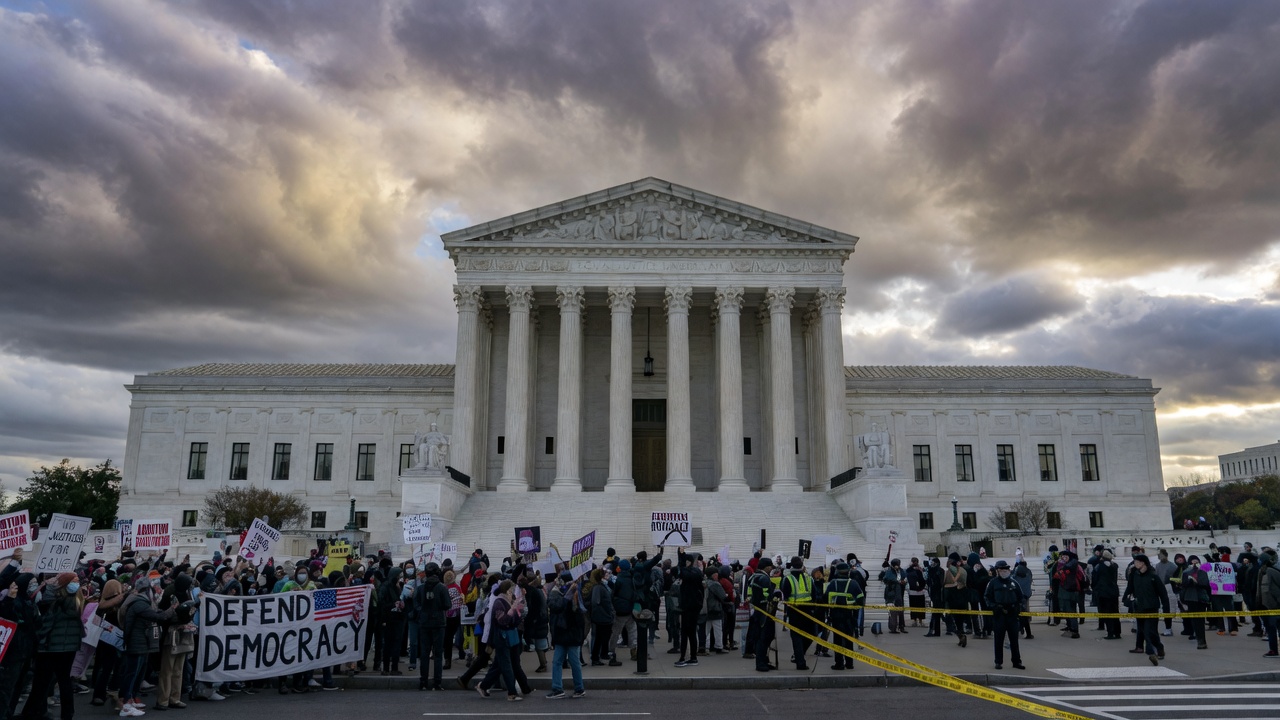
On June 25, 2026, the Supreme Court handed down one of the most consequential immigration rulings in decades. In Mullin v. Doe (consolidated with Trump v. Miot), 609 U.S. ___ (2026), a 6-3 majority held that the Temporary Protected Status statute — 8 U.S.C. § 1254a(b)(5)(A) — bars federal courts from reviewing non-constitutional challenges to TPS termination decisions made by the Department of Homeland Security.
Justice Samuel Alito wrote the majority opinion, joined by Chief Justice John Roberts and Justices Clarence Thomas, Neil Gorsuch, Brett Kavanaugh, and Amy Coney Barrett. The six-justice majority was aligned entirely along ideological lines. Dissenting were Justices Elena Kagan, Sonia Sotomayor, and Ketanji Brown Jackson, with Kagan authoring the dissent.
The statutory text at the center of the dispute is 8 U.S.C. § 1254a(b)(5)(A), which provides:
"There is no judicial review of any determination of the Secretary with respect to the designation, or termination or extension of a designation, of a foreign state under this subsection."
Justice Alito found that language dispositive. Writing for the Court, Alito held: "The TPS statute plainly bars consideration of respondents' non-constitutional claims. It allows 'no judicial review of any determination ... with respect to the ... termination of a TPS designation.'" Alito described the statutory language as both "clear" and "very broad," meaning that Congress deliberately stripped the courts of the power to second-guess DHS's TPS decisions — at least on statutory grounds.
The lower courts had reached the opposite conclusion. Multiple district courts had blocked the Trump administration's termination of TPS for Haiti and Syria, finding that the administration had failed to follow proper procedures and had not adequately considered conditions on the ground in those countries. The First and Ninth Circuits had affirmed those blocks. The Supreme Court reversed those decisions entirely, leaving no statutory judicial backstop in place.
The practical effect is stark: DHS can now terminate TPS for any designated country, at any time, and a federal court cannot review that decision on statutory grounds — whether the challenge is based on arbitrary agency action, failure to follow required procedures, inadequate consideration of country conditions, or any other non-constitutional claim. The only thing a court can still review is a constitutional challenge, most likely an equal protection argument that the termination was motivated by racial or national-origin animus rather than legitimate policy grounds.
Even that narrow window is barely open. Justice Alito's majority opinion addressed the equal protection claim raised by the plaintiffs and found it "unlikely to succeed." While that language is technically dicta — meaning the Court was not definitively ruling on the equal protection question — it sends a clear signal about how the Court would approach such challenges if and when they reach the high court again.
Why the Judicial Review Bar Is the Most Dangerous Part of This Ruling
To understand why the loss of judicial review is so significant, it helps to understand what judicial review has actually done for TPS holders over the past several years.
When the Trump administration first moved to terminate TPS for Haiti in 2018, federal courts stepped in. A district court in California issued a preliminary injunction blocking the termination, finding that the challengers had demonstrated a likelihood of success on the merits — that DHS had not followed proper procedures and that the decision was infected with discriminatory animus. That injunction held for years, during which time hundreds of thousands of Haitian TPS holders continued to live and work legally in the United States, build businesses, raise families, and contribute to their communities.
The same pattern played out for El Salvador, Honduras, Nepal, Nicaragua, Sudan, and Syria. Courts across the country repeatedly blocked TPS terminations, finding procedural violations, arbitrary decision-making, and in some cases evidence of discriminatory motivation. Even when those blocks were eventually lifted on appeal, the litigation bought time — months and years during which TPS holders could explore other options, build stronger cases for alternative relief, and prepare for eventual transitions in their status.
After Mullin v. Doe, that entire mechanism is gone. DHS does not need to follow any particular procedure that a court can enforce. DHS does not need to demonstrate that conditions in a designated country have improved to the point where return is safe. DHS does not need to respond to challenges that it considered the wrong factors or weighed evidence incorrectly. Whatever DHS decides about TPS termination is, in effect, unreviewable — and it is final.
DHS General Counsel Percival, speaking after the ruling, put it bluntly: "The T in TPS stands for TEMPORARY." That statement captures exactly where the administration stands: TPS is not meant to be permanent, it is not meant to become a substitute for other immigration benefits, and the Court has now confirmed that DHS has unilateral authority to act on that view without judicial interference.
🚫 What Courts Can No Longer Do
After Mullin v. Doe, federal courts cannot: block TPS terminations based on procedural violations; second-guess DHS's assessment of conditions in designated countries; review whether DHS applied the correct legal standard; enjoin terminations based on claims that the agency acted arbitrarily or capriciously; or hear any statutory challenge to TPS terminations whatsoever. The only remaining judicial role is review of constitutional claims — a narrow path with a very high bar.
The implications extend well beyond Haiti and Syria. The ruling applies to every TPS designation, past, present, and future. It means that if DHS moves to terminate TPS for El Salvador — a designation that has been in place for more than 25 years following devastating earthquakes in 2001, and which covers roughly 250,000 people — those holders have no meaningful court recourse on statutory grounds. The same is true for the 60,000 Honduran TPS holders whose designation dates to Hurricane Mitch in 1998, and the 4,500 Nicaraguan TPS holders who have been protected since that same storm.
The Trump administration has already terminated TPS for 13 countries since taking office. With Mullin v. Doe in hand, the pace of terminations could accelerate significantly, because the administration no longer faces the prospect of injunctions blocking action while litigation proceeds through the courts.
Who Is Affected Right Now
Haitian TPS Holders: 350,000 People at Immediate Risk
Haiti's TPS designation has a long history. It was first established following the catastrophic 2010 earthquake that killed more than 200,000 people and left over 1.5 million homeless. It was extended and re-designated multiple times in the years that followed, encompassing Haitians who were already in the United States and those who arrived through the CHNV parole program. At its peak, Haiti's TPS designation covered approximately 350,000 people.
The Trump administration moved to terminate Haiti's TPS designation almost immediately after taking office in January 2025. Courts initially blocked those efforts. With Mullin v. Doe, those blocks are gone. The approximately 350,000 Haitians who have been living and working legally in the United States under TPS protection now face the prospect of that protection being terminated without any remaining judicial check on the process.
Haiti remains in extraordinarily difficult circumstances. The country has been plagued by gang violence, political instability, and severe economic distress in the years following the 2010 earthquake and a second major earthquake in 2021. The U.S. State Department currently rates Haiti at Level 4 — Do Not Travel — its highest advisory level, which it reserves for countries with extreme danger. None of that, under Mullin v. Doe, is something a court can use as a basis to block TPS termination.
Syrian TPS Holders: 6,000 People in Legal Limbo
Syria's TPS designation covers approximately 6,000 people who fled the devastating civil war that began in 2011 and has left much of the country in ruins. Syria's situation remains fragile. While some areas are under different governance now following the fall of the Assad regime, the U.S. State Department also advises against travel to Syria, citing ongoing armed conflict, terrorism, and civil unrest in various regions.
For the 6,000 Syrians holding TPS, the ruling creates immediate legal uncertainty. Their ability to continue working legally, to remain in the United States without fear of deportation, and to plan their futures depends entirely on DHS's discretionary decision-making — with no court available to review whether that decision-making is lawful, rational, or fair.
The Broader Threat: 1.3 Million TPS Holders Across 17 Countries
The full scope of who is now at risk extends far beyond Haiti and Syria. As of the time of this ruling, approximately 1.3 million people from 17 countries hold TPS in the United States. These individuals come from countries across the Western Hemisphere, Africa, Asia, and the Middle East, including:
- El Salvador — approximately 250,000 TPS holders, with a designation dating to 2001 following devastating earthquakes. This is the largest TPS population in the country.
- Honduras — approximately 60,000 TPS holders, with a designation dating to 1998 following Hurricane Mitch.
- Nicaragua — approximately 4,500 TPS holders, also dating to Hurricane Mitch in 1998.
- Venezuela — one of the more recent and larger designations, covering Venezuelans who fled economic collapse and political repression under the Maduro government.
- Ukraine — TPS holders who fled Russia's full-scale invasion beginning in February 2022.
- Yemen, South Sudan, Sudan, Somalia, Myanmar, Afghanistan, Ethiopia, Cameroon, Nepal, and others — each with their own designation based on country-specific crises.
For each of these 1.3 million people, Mullin v. Doe removes the judicial safety net that has — at various points in recent years — been the only thing standing between them and the loss of their legal status. The court no longer plays that role. DHS alone will decide who keeps TPS and who loses it, on whatever timeline DHS chooses, without any meaningful opportunity for judicial review of that decision.
The three longest-standing designations — El Salvador, Honduras, and Nicaragua — are particularly worth noting. People who received TPS in 1998 or 2001 have now been in the United States for 25 or more years. Many have U.S.-born children, have built businesses, have paid taxes, and have established deep community ties. The designation that made their presence in the United States legal was "temporary" in the statutory sense — but for quarter-century TPS holders, "temporary" has lasted longer than some of their children have been alive. After Mullin v. Doe, none of that history provides any protection from a DHS termination decision.
The Dissent: Justice Kagan's Warning
Justice Elena Kagan's dissent — joined by Justices Sotomayor and Jackson — is remarkable both for its substance and its rhetorical sharpness. Kagan did not mince words about what she believed the majority had done.
"I dissent from the Court's decision that [TPS beneficiaries] may … be put on the next plane."
That sentence crystallizes the dissent's core concern: the majority's ruling does not merely resolve a legal dispute about the scope of judicial review. It has direct, concrete, immediate human consequences. The people affected are not abstractions. They are individuals who have built lives in the United States under the protection of a legal status that Congress created precisely because their home countries were too dangerous or devastated to return to. The majority's ruling strips the courts of any meaningful ability to check whether the government's decision to end that protection was lawful.
Kagan argued at length that the majority misread the statute. The judicial review bar in § 1254a(b)(5)(A), she contended, was not meant to strip courts of the ability to review procedural challenges and arbitrary agency action — only the specific factual determination about whether country conditions meet the TPS threshold. Under the dissent's reading, courts retain authority to ensure that DHS followed proper procedures, considered the right factors, and did not act arbitrarily or capriciously, even if they cannot second-guess DHS's ultimate judgment about country conditions.
Kagan's dissent also emphasized the majority's signal about the equal protection claim. In what the dissent characterized as an advisory opinion on a question not properly before the Court, the majority telegraphed that equal protection challenges to TPS terminations were likely to fail — a message that, Kagan argued, effectively forecloses even the narrow avenue of review the majority claimed to preserve.
Perhaps most pointedly, Kagan argued that the majority's ruling strips courts of any meaningful role in one of the most consequential areas of immigration policy, handing the executive branch essentially unchecked authority over the legal status of more than a million people. "When the Court strips courts of any role in reviewing executive action," she wrote, "it removes one of the core structural protections that makes constitutional government function."
The dissent is not controlling — it is the view of three justices, not the majority. But it matters for several reasons. It frames the strongest arguments against the ruling, which advocates and lawyers will continue to press in contexts where those arguments remain available. It signals that three justices are prepared to look seriously at constitutional challenges to TPS terminations if those challenges reach the Court. And it documents, for the historical record, exactly what the majority decided and what was lost in the process.
What Legal Options TPS Holders Have Left
The loss of judicial review on statutory grounds is a severe blow, but it is not the end of the road for every TPS holder. There are six meaningful legal paths that remain available, depending on individual circumstances. The critical caveat is that none of these paths is automatic, none applies to everyone, and all of them require prompt legal consultation to evaluate properly.
Path 1: Adjustment of Status Through a Family Member or Employer
If you have a qualifying U.S. citizen or Lawful Permanent Resident (LPR) family member — a spouse, parent, or child who is a U.S. citizen, or a parent or sibling who is an LPR — or if you have an employer willing to sponsor you for a green card, adjustment of status may be available. For immediate relatives of U.S. citizens (spouses, unmarried children under 21, and parents), there is no visa backlog — a visa number is immediately available and adjustment can proceed relatively quickly. For other family preference categories and employment-based petitions, wait times vary significantly by category and country of birth.
It is important to note that TPS holders may face additional complexity in the adjustment process depending on their entry history. The interplay between TPS, unlawful presence, entry without inspection, and the grounds of inadmissibility is technical and fact-specific. An immigration attorney can analyze whether adjustment is available for you and what procedural route makes most sense given your history.
Path 2: Asylum
If you have a genuine, well-founded fear of persecution in your home country on account of your race, religion, nationality, political opinion, or membership in a particular social group, you may be eligible for asylum. Asylum provides both protection from removal and a path to permanent residence and eventually citizenship.
However, asylum has significant limitations as a TPS alternative. You generally must apply within one year of arriving in the United States (with narrow exceptions for changed or extraordinary circumstances). If you have been in the United States on TPS for many years, the one-year filing deadline may have long since passed unless you qualify for an exception. Additionally, even if you are eligible to apply, the current asylum process is extremely backlogged, and approval rates have shifted significantly in recent years.
That said, for TPS holders from countries experiencing acute persecution — Haitian activists facing gang violence that constitutes persecution, Syrian nationals facing targeted violence, Venezuelans facing political repression — there may be viable asylum claims worth exploring with an experienced asylum attorney.
Path 3: U Visa or T Visa (Crime Victims and Trafficking Survivors)
If you have been the victim of a serious crime in the United States and have cooperated with law enforcement in the investigation or prosecution of that crime, you may be eligible for a U nonimmigrant visa. The U visa provides temporary legal status and work authorization for up to four years, and U visa holders can eventually apply for a green card.
Similarly, if you have been a victim of human trafficking, you may be eligible for a T nonimmigrant visa, which also provides temporary status and a path to permanent residence.
Both the U and T visa programs have long waiting lists — the U visa cap is 10,000 per year, and the demand far exceeds that number. However, applicants who are placed on a waiting list may receive deferred action, which provides de facto protection from removal while waiting for a visa to become available.
Path 4: Cancellation of Removal in Immigration Court
If you are in removal proceedings before an immigration judge, you may be eligible for cancellation of removal if you can demonstrate: (1) ten years of continuous physical presence in the United States; (2) good moral character throughout that period; and (3) that your removal would result in "exceptional and extremely unusual hardship" to a qualifying U.S. citizen or LPR spouse, parent, or child.
Cancellation of removal is difficult to obtain. The "exceptional and extremely unusual hardship" standard is demanding — courts have held that hardship beyond what would normally be expected from family separation is required. But for long-time TPS holders with deep roots in the United States and U.S. citizen children, it is a path worth exploring with counsel.
One critical point: cancellation of removal is only available in immigration court, meaning you generally must be in removal proceedings to apply. If you are not currently in proceedings, you cannot proactively apply for cancellation. An attorney can help you understand when and how removal proceedings might arise and whether you would be well-positioned to apply for cancellation if they do.
Path 5: Re-Parole (Limited and Uncertain)
Some TPS holders may have entered the United States through humanitarian parole programs — including the CHNV parole program that admitted Cubans, Haitians, Nicaraguans, and Venezuelans in large numbers in recent years. For those individuals, re-parole may be theoretically available in limited circumstances. However, the CHNV program has itself been terminated by the Trump administration, and re-parole options are extremely limited and uncertain in the current environment. This is the weakest of the available paths and applies only in narrow circumstances.
Path 6: Constitutional Equal Protection Challenge (Very Narrow, Very High Bar)
As discussed above, Mullin v. Doe preserves judicial review for constitutional claims. An equal protection challenge argues that the TPS termination was motivated by discriminatory animus — specifically, racial or national-origin discrimination — rather than legitimate policy reasons.
This is an extremely difficult claim to win. Discriminatory animus in government policy is hard to prove. Even with statements from administration officials suggesting hostility to certain groups of immigrants, courts applying the equal protection doctrine in the immigration context have generally given the executive branch substantial deference. Justice Alito's majority opinion further narrowed this path by finding the equal protection claim in this case "unlikely to succeed" — a strong signal that the Court would not look favorably on similar challenges.
Constitutional equal protection challenges may still be worth pursuing in specific cases — particularly where there is strong evidence of discriminatory motivation and where an organization or law firm is prepared to carry the litigation. But individual TPS holders should not plan their personal strategy around the hope of winning an equal protection case in the current legal environment. That path should be seen as a supplement to individual relief options, not a substitute for them.
A Note on the Equal Protection Exception
Because the equal protection exception is the only surviving path through the courts, it is worth examining carefully — both to understand what it might accomplish and to set realistic expectations about its limits.
An equal protection challenge to a TPS termination would argue that the decision was motivated by racial or national-origin animus — that DHS terminated TPS for Haiti (a predominantly Black country) or Syria (a predominantly Arab, Muslim country) not because of genuine policy analysis, but because of discriminatory hostility toward the people of those nations.
There is, in fact, evidence that courts and litigants could point to in support of such claims. President Trump, in a now-famous 2018 meeting, reportedly referred to Haiti and other African nations using a derogatory term. Administration officials have made statements that immigrant advocates argue reflect generalized hostility to certain immigrant communities. Some lower courts, in the litigation that preceded Mullin v. Doe, found that this evidence was sufficient to support a preliminary finding of discriminatory animus at the pleading stage.
But winning on the merits of an equal protection claim is a different matter. Courts reviewing executive action in the immigration context apply rational basis review — asking only whether there is any conceivable legitimate reason for the policy, not whether the stated reasons are the actual reasons. Under rational basis review, the government almost always wins. Even if there is some evidence of discriminatory animus, if the government can articulate any plausible policy justification — and limiting TPS to genuinely temporary circumstances is an obvious one — courts may decline to find an equal protection violation.
The Supreme Court's recent precedent in Trump v. Hawaii (2018) — the travel ban case — is instructive and sobering. There, the Court upheld a travel ban affecting several Muslim-majority countries even in the face of substantial evidence of anti-Muslim motivation, holding that the President's broad national security authority was sufficient to sustain the policy. Mullin v. Doe echoes that deference in the TPS context, with the majority's signal that equal protection claims challenging TPS terminations are "unlikely to succeed."
None of this means equal protection challenges are pointless. They may delay terminations while litigation proceeds. They may ultimately succeed in a changed legal environment. Organizations like the ACLU and NAACP Legal Defense Fund are well-equipped to pursue these challenges at scale. But for an individual TPS holder deciding what to do right now to protect themselves and their family, an equal protection challenge is not a reliable personal plan. The actionable paths are the six described in the previous section — particularly adjustment of status and asylum for those who qualify.
✅ The Single Most Important Thing You Can Do Right Now
If you hold TPS from any country — Haiti, Syria, El Salvador, Honduras, Nicaragua, Venezuela, or any other — schedule a consultation with an immigration attorney today. Not next month. Not when you receive a notice. Today. An attorney can review your full history, identify every legal option available to you, and help you begin taking steps that could make the difference between remaining in the United States legally and facing deportation. The courts are no longer a backstop. Proactive legal planning is your protection now.
What Modern Law Group Is Seeing and Doing
At Modern Law Group, our immigration team has been tracking the Mullin v. Doe litigation closely since the first circuit court rulings. The Supreme Court's decision, while not unexpected given the statutory text, is nevertheless a significant shift in the legal landscape for our clients and for TPS holders generally.
We have represented clients from Haiti, El Salvador, Honduras, Venezuela, and other TPS-designated countries. We understand the specific circumstances that affect TPS holders in ways that general immigration attorneys may not: the interplay between TPS and unlawful presence bars; the question of whether TPS grants a legal basis for adjustment of status after entry without inspection (a question the Supreme Court resolved in favor of TPS holders in Sanchez v. Mayorkas in 2021, but which remains subject to careful case-by-case analysis); the asylum implications for clients from countries with active armed conflict; and the cancellation of removal landscape for long-time residents with U.S. citizen children.
After Mullin v. Doe, our advice to every TPS holder we work with is the same: act now, act proactively, and do not count on the courts to step in. The legal environment has changed fundamentally. The strategies that worked — waiting for courts to block terminations while exploring other options — no longer work the same way. The pace at which you need to build your alternative legal position has accelerated.
If you are a TPS holder and you have any qualifying family member who is a U.S. citizen or LPR, that conversation with an immigration attorney needs to happen immediately. If you have been the victim of a crime in the United States and have cooperated with police, a U visa case may be available to you. If you have a genuine fear of returning to your home country based on your specific circumstances, an asylum claim may be viable. And if you have been in the United States for more than a decade, have U.S. citizen children, and have maintained good moral character, cancellation of removal may be worth exploring even though it is a difficult standard to meet.
We also want to be direct about what Mullin v. Doe does not mean: it does not mean that deportation is inevitable for every TPS holder, and it does not mean that every TPS holder is without options. What it means is that the options that exist need to be found and pursued through proactive individual legal planning, not through hope that a court will step in to stop a termination. Those are two very different strategies, and the first one — the one that requires engaging with an attorney now — is the only one that is still available.
"The Supreme Court has made clear that courts will no longer be the last line of defense for TPS holders. That means every TPS holder needs their own legal plan — and that plan needs to start now, not after a notice arrives."
Frequently Asked Questions
What did the Supreme Court decide in Mullin v. Doe?
On June 25, 2026, the Supreme Court ruled 6-3 in Mullin v. Doe (consolidated with Trump v. Miot), 609 U.S. ___ (2026), that the TPS statute — 8 U.S.C. § 1254a(b)(5)(A) — bars federal courts from reviewing non-constitutional challenges to TPS termination decisions. Justice Alito wrote for the majority that the statute allows "no judicial review of any determination ... with respect to the ... termination of a TPS designation," and that this language is "clear" and "very broad." The only surviving avenue of judicial review is a constitutional equal protection challenge, which the majority itself signaled is "unlikely to succeed" in this context.
Who is immediately affected by this ruling?
Approximately 350,000 Haitian TPS holders and approximately 6,000 Syrian TPS holders face immediate loss of the court protection that was blocking their terminations. Beyond those two groups, the ruling affects 1.3 million TPS holders from 17 countries, because it removes the courts as a check against any future termination decisions. Countries with the largest TPS populations — El Salvador (250,000), Honduras (60,000), Nicaragua (4,500), and Venezuela — are all now at heightened risk, as are TPS holders from Ukraine, Yemen, South Sudan, Sudan, Somalia, Myanmar, Afghanistan, Ethiopia, Cameroon, Nepal, and others.
Can I still go to court to challenge a TPS termination?
Courts can no longer hear non-constitutional challenges to TPS terminations. The only remaining path through the courts is a constitutional equal protection claim — arguing that the termination was motivated by racial or national-origin animus. That is a very narrow path with a very high bar. Justice Alito's majority opinion found the equal protection claim in this case "unlikely to succeed," which signals that the Court is skeptical of such challenges. For individual TPS holders, relying on equal protection litigation as a personal defense strategy is not realistic. The focus should be on identifying and pursuing available forms of individual immigration relief.
What legal options do TPS holders have after this ruling?
There are six potential paths: (1) Adjustment of status through a qualifying U.S. citizen or LPR family member, or through an employer sponsor; (2) Asylum if you have a genuine, credible fear of persecution on a protected ground; (3) U visa if you have been a victim of a qualifying crime in the United States and cooperated with law enforcement; (4) T visa if you have been a victim of human trafficking; (5) Cancellation of removal in immigration court, which requires 10 years of continuous presence, good moral character, and proof that removal would cause exceptional and extremely unusual hardship to a qualifying U.S. citizen or LPR family member; (6) Re-parole in very limited circumstances. Not every path is available to every TPS holder — a consultation with an immigration attorney is essential to assess which options apply to your specific situation.
Does losing TPS mean I will be immediately deported?
Not necessarily immediately. Losing TPS removes your legal status and work authorization, making you subject to removal proceedings. However, removal is not instantaneous — it requires DHS to initiate a case, and there may be significant time between a TPS termination and any enforcement action. That time should be used proactively: consulting an attorney, identifying other forms of relief you may qualify for, and beginning any applications that could establish or protect your status. The worst outcome is doing nothing and being caught without any alternative legal basis when enforcement actions begin.
What is TPS, and why was it created?
Temporary Protected Status (TPS) is a humanitarian immigration benefit established by the Immigration and Nationality Act. The Secretary of Homeland Security can designate a foreign country for TPS when conditions there — such as armed conflict, natural disaster, epidemic, or other extraordinary conditions — make it unsafe for nationals of that country to return. TPS provides two key protections: a stay of deportation (you cannot be removed to the designated country) and work authorization. TPS does not by itself provide a path to permanent residence or citizenship. Designations are supposed to be renewed or terminated based on an ongoing assessment of country conditions, but Mullin v. Doe has now established that courts cannot review whether that assessment was correctly made.
If I have TPS, should I apply for something else right now?
Yes. After Mullin v. Doe, TPS alone is not a stable long-term strategy. If you have any independent basis for another immigration benefit — a qualifying family member, a fear of persecution, a qualifying crime victimization, a long-time employer willing to sponsor you — you should explore those options immediately. The sooner you consult an attorney and begin identifying your alternatives, the more options you are likely to have. Waiting until your TPS is actually terminated before seeking other relief may significantly narrow your options and compress your timeline in ways that are very difficult to manage. Schedule a Consultation with Modern Law Group today.
Schedule a Consultation — Your Legal Plan Starts Now
The Supreme Court's ruling in Mullin v. Doe is not a warning about something that might happen someday. It is the announcement that the legal landscape has already changed — permanently and fundamentally. The courts that were blocking TPS terminations for Haiti, Syria, and a dozen other countries are no longer in that role. DHS has what the majority called "clear" and "very broad" authority to terminate TPS for any designated country, and no court will second-guess that decision on statutory grounds.
That means the protection that hundreds of thousands of TPS holders have been counting on — the injunctions, the stays, the circuit court victories — is gone. The strategy of waiting for courts to step in no longer works. What replaces it is proactive individual legal planning: identifying what other forms of relief you may qualify for, beginning those applications now, and building the strongest possible case for remaining in the United States on an alternative legal basis.
At Modern Law Group, we have handled TPS-related matters, adjustment of status, asylum cases, deportation defense, and the full range of immigration issues that arise when legal status is at risk. We know this landscape, we know how it has changed, and we know how to help you build a plan that does not depend on courts that are no longer available to help you.
This is not the moment to wait and see what happens. It is the moment to act. Schedule a Consultation with our immigration attorneys today. You can also call us directly at (888) 902-9285 or text us at (619) 889-6476. If you have a family member who is already detained, call immediately — every hour matters in those situations.
Modern Law Group's attorneys serve clients across the country. We are ready to review your situation, explain your options, and help you take the concrete steps that the current legal environment demands. Do not wait for a notice in the mail to prompt you to act. Act now, while you still have time to do it on your terms.
TPS Holder? Your Options Are Narrowing. Act Now.
The Supreme Court has removed the courts as a check on TPS terminations. Your protection now depends on having an independent legal basis to remain in the United States. Modern Law Group can help you identify what that basis is — and begin building it.
Schedule a Consultation (888) 902-9285