





Quick answer
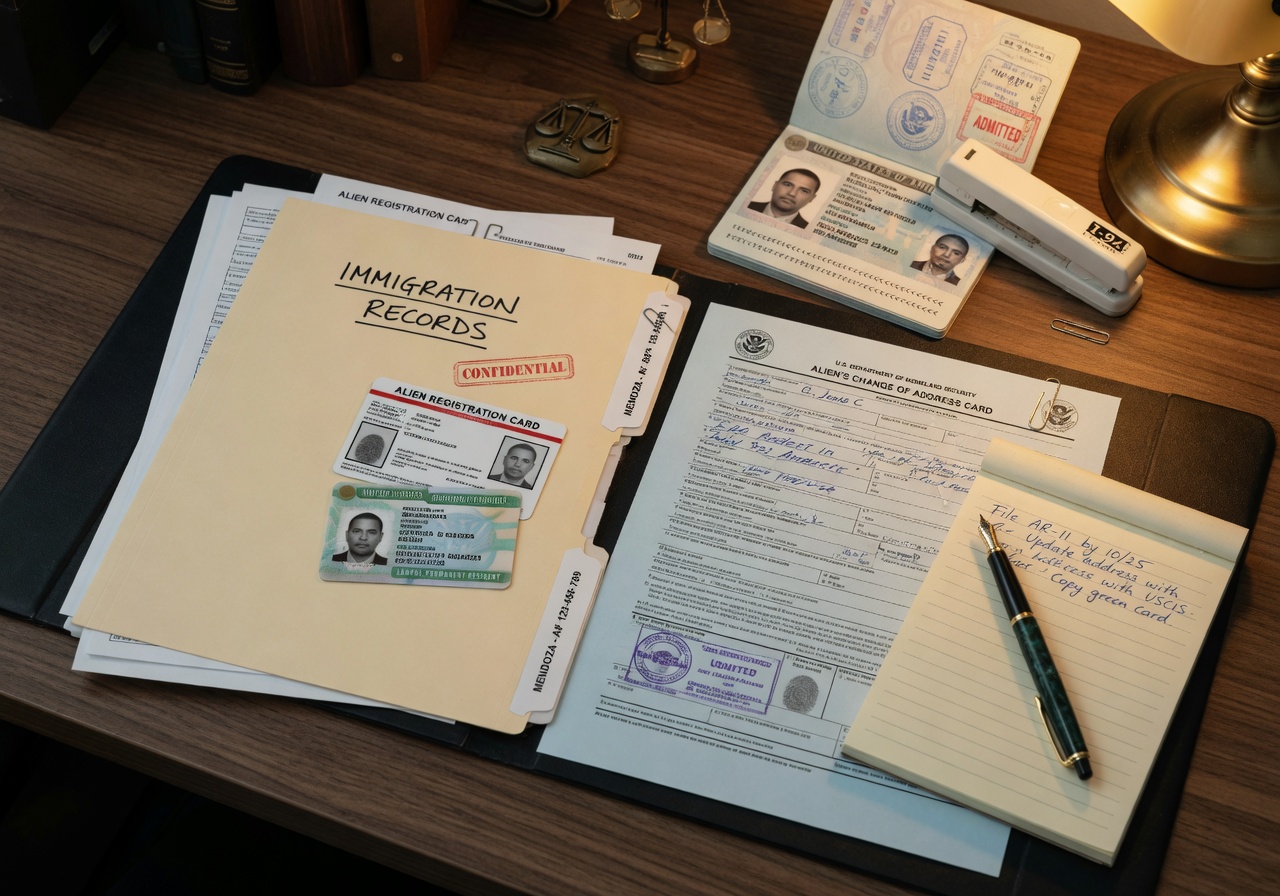
Under INA § 262 (8 U.S.C. § 1302) and 8 C.F.R. § 264, every noncitizen 14 years of age or older who is in the United States for 30 days or longer must register and be fingerprinted with the federal government. Most lawful entrants — LPRs, visa holders, parolees, asylees — were registered automatically when they applied at a consulate, were inspected at a port of entry, or received status from USCIS. Anyone who entered without inspection and has not since obtained status was not automatically registered, and the Trump administration's 2025-2026 enforcement push has put this duty back in the spotlight. Three rules every noncitizen should know cold: (1) register if you have not already (Form G-325R, electronic, no fee); (2) carry your registration document with you at all times once issued (INA § 264(e), criminal misdemeanor not to); (3) file Form AR-11 within 10 days of every move (INA § 265, also a criminal violation if willful).
The legal duty: INA § 262, § 264, and § 265
The Immigration and Nationality Act has required noncitizen registration since the Alien Registration Act of 1940. The duty was never repealed; it was simply absorbed into the larger immigration system through automatic registration at consulates, ports of entry, and USCIS adjudications. The 2025 DHS final rule revived enforcement of the standalone duty under INA § 262, 8 U.S.C. § 1302, with practical effect through Form G-325R (Biographic Information for Registration). The relevant statutes are:
- INA § 262 (8 U.S.C. § 1302) — "every alien" 14 or older in the U.S. 30 days or more must apply for registration and be fingerprinted.
- INA § 264 (8 U.S.C. § 1304) — sets out the registration document (Form I-94, I-551 green card, EAD, or the alien registration receipt) and requires the noncitizen to carry proof of registration at all times. Failure to do so is a federal misdemeanor — up to 30 days, up to $100 fine.
- INA § 265 (8 U.S.C. § 1305) — requires every registered noncitizen to notify the Attorney General (now DHS) of every change of address within 10 days. Willful failure is a misdemeanor — up to 30 days, up to $200 fine — and is also a discretionary basis for removal under INA § 237(a)(3)(A).
- INA § 266 (8 U.S.C. § 1306) — criminal penalties for willful failure to register, fraudulent statements, or counterfeiting registration documents. Willful failure to register can be up to 6 months and up to $1,000.
None of these sections was ever quietly repealed. What changed in 2025-2026 is that DHS has begun treating them as standalone enforcement vehicles, not just background duties. Practitioners are seeing ICE agents at street arrests asking specifically about registration documents and address-change history.
Who was already registered (and may not need to do anything)
Most noncitizens reading this article are already registered. You were registered if any of the following is true:
- You are a lawful permanent resident with a Form I-551 green card.
- You were inspected and admitted at a port of entry and received a Form I-94.
- You were issued an Employment Authorization Document (EAD) by USCIS.
- You filed an application for asylum (Form I-589) or adjustment of status (Form I-485) and were fingerprinted.
- You were paroled into the U.S. (humanitarian parole, advance parole, etc.) and received a parole document.
- You were issued a Notice to Appear (NTA) in removal proceedings, were fingerprinted, and received an A-number.
- You were issued a Border Crossing Card.
If any of these applies, your registration document is already in your file. The remaining duties — carry it, update address — still apply. The G-325R registration is not for you.
Who must register now (and how to do it)
You must register through Form G-325R if you are a noncitizen 14 or older, you have been in the U.S. 30 days or more, and you do not already have one of the registration documents listed above. The clearest examples:
- Adults who entered without inspection (EWI) and have never been encountered by DHS.
- Children under 14 whose parents previously registered them — the child must register within 30 days of turning 14 (8 C.F.R. § 264.1(b)).
- Canadian visitors admitted for more than 30 days who were not issued an I-94 at the time of entry.
- People who entered on a visa, overstayed past 30 days, and never received a follow-on document tied to a USCIS application.
The registration is electronic. The applicant creates a myUSCIS account, files Form G-325R online, attends a biometrics appointment, and is issued a registration receipt. There is no filing fee for G-325R itself. The registration document received is what must be carried under INA § 264(e).
An important caveat: filing G-325R does not grant any immigration benefit. It is purely a compliance step. It also does not insulate the registrant from removal — an unauthorized noncitizen who registers and is later encountered by ICE remains removable. The point of the registration duty is not amnesty; the point is criminal exposure for those who do not register. Talking to counsel before filing G-325R is strongly recommended, particularly for anyone with prior orders, prior removals, or criminal history.
The duty to carry your registration document
Under INA § 264(e), every noncitizen 18 or older must carry their registration document at all times. The document depends on status:
- LPR: Form I-551 green card (the physical card, not a photocopy).
- Nonimmigrant: Form I-94 (the electronic I-94 printout from i94.cbp.dhs.gov) plus a current passport with admission stamp.
- EAD holder: Form I-766 Employment Authorization Document.
- Asylum applicant: Form I-589 receipt and any USCIS-issued document referencing the pending case.
- G-325R registrant: The registration receipt issued by USCIS.
"At all times" is broad. The practical interpretation is: when you leave home, carry the document or a clear, legible photo on your phone plus the physical card or printout at home for ICE/USCIS encounters. A photo alone is not statutorily sufficient, but it is a practical fallback if the wallet card is stolen or lost while you process a replacement.
The criminal exposure under INA § 264(e) is low — up to 30 days and up to $100 — but the immigration consequence is bigger. ICE officers can use the absence of registration documentation to support a determination of removability, particularly for clients who entered without inspection and have not registered.
Address changes: AR-11 within 10 days, every time
This is the duty practitioners see violated most often. Under INA § 265, every registered noncitizen must notify DHS within 10 days of every change of address. The form is AR-11, and it is now filed electronically through the USCIS online portal. There is no fee. The 10 days run from the date of the move, not from when the lease was signed or when the boxes were unpacked.
Why this matters: missed AR-11 filings cause two parallel disasters:
- Criminal exposure under INA § 266(b) — willful failure is a misdemeanor punishable by up to 30 days and up to $200.
- Removability under INA § 237(a)(3)(A) — any noncitizen who fails to comply with § 265 is deportable unless they can show the failure was reasonably excusable or was not willful.
- Missed notices and in absentia orders — if you have a pending case (I-485, N-400, I-589) or removal proceedings, your AR-11 update is the only way USCIS or EOIR knows where to send your interview notice, biometrics appointment, hearing notice, or RFE. A missed AR-11 is the single most common cause of in absentia removal orders we see in practice.
Practical rule: file AR-11 the same day the lease is signed. Do not wait until you have moved. If you have an active case before EOIR, also file EOIR-33/IC with the immigration court within 5 working days of the move — AR-11 alone does not update the court file. The two filings are separate, both required.
What happens if you do not register at all?
The 2025-2026 enforcement environment has changed what was previously a low-risk omission into a meaningful exposure. Concretely:
- Failure to register under INA § 262 is a misdemeanor (INA § 266(a)) — up to 6 months, up to $1,000.
- Carrying no registration document under INA § 264(e) is a misdemeanor — up to 30 days, up to $100.
- Failure to file AR-11 under INA § 265 is a misdemeanor under INA § 266(b) — up to 30 days, up to $200 — and a basis for removal under INA § 237(a)(3)(A).
- Each missed AR-11 filing is treated as a separate violation, so years of moves without filing can stack.
Beyond the statutes, ICE in 2026 is using registration questions as leverage during interior arrests and even during traffic stops where local law enforcement cooperates with ICE. A respondent who is unable to produce any registration document is an easier removability case for DHS to make. The opposite is also true: a registered noncitizen who can produce a current registration receipt and a current AR-11 confirmation has documentary evidence of compliance with federal duty — not a defense to removal, but a meaningful procedural footing.
Should an undocumented person file G-325R?
This is the hardest question in this practice area, and the honest answer is: it depends, and it should be discussed with counsel before filing.
The case for filing:
- Removes criminal exposure under INA § 266(a).
- Creates a documentary record of the registrant's identity, residence, and family ties that may support future relief.
- Aligns the registrant with the statutory duty — which matters if a future immigration form ever asks about prior registration history.
The case against filing without counsel:
- Filing creates an A-number, a fingerprint record, and a current address on file with DHS. For someone with prior removal orders, prior immigration violations, or pending criminal matters, this is a meaningful exposure.
- The G-325R fingerprint record links to FBI databases, which can surface prior immigration encounters, prior orders, or local arrest records the applicant has forgotten about.
- Form G-325R is signed under penalty of perjury. Misstatements about prior immigration history can lead to denials and inadmissibility under INA § 212(a)(6)(C).
The practitioner default: if you have a clean immigration history (no prior orders, no removals, no criminal record), filing G-325R is probably right. If you have any complicating history, do not file alone — talk to a lawyer first. PM-602-0199 has tightened the I-485 path, and any prior G-325R filing will be visible in your file forever.
Frequently asked questions
I am here on a tourist visa for 45 days. Do I need to register?
If you were issued an I-94 at the port of entry (almost all visa entries), you are already registered. Carry your I-94 printout and current passport. No G-325R needed.
My child turned 14 last month. Do I need to do anything?
If the child is an LPR, the green card serves as the registration document. If the child holds a nonimmigrant status with an I-94, the I-94 serves. If the child is unregistered (for example, entered without inspection), the child must register within 30 days of the 14th birthday under 8 C.F.R. § 264.1(b).
I moved three times in the last year and never filed AR-11. What now?
File AR-11 now with your current address, by mail or online. The filing is not retroactive but it closes the ongoing violation. Talk to counsel if you have an active case before USCIS or EOIR — missed AR-11 filings may have caused missed notices and you may be facing an in absentia order you do not yet know about.
Does filing G-325R protect me from deportation?
No. G-325R is a compliance step, not relief. It does not grant any benefit and does not insulate the registrant from removal. It removes criminal exposure under INA § 266(a) only.
What if I lost my green card? Am I committing a crime by not carrying it?
Technically yes — INA § 264(e) requires you to carry the document. Practically, file Form I-90 to replace the card and carry the I-90 receipt notice in the interim. Most ICE and CBP officers accept I-90 receipt documentation. Carry a clear photo of your card on your phone as a backup.
How Modern Law Group handles registration compliance
We treat alien registration as a baseline compliance item alongside the main immigration matter. Our standard workflow:
- Audit the client's registration history during intake — LPR card, I-94, EAD, prior G-325R, any A-number history.
- If the client is unregistered and removal-risk factors are absent, walk through G-325R filing and biometrics with counsel oversight.
- If the client has an active case before USCIS or EOIR, calendar AR-11 and EOIR-33/IC filing as a single combined step at every move.
- Issue clients a one-page "what to carry" reference card listing their required registration documents and emergency counsel contact.
- For families with mixed status, audit each household member's registration separately — the duties run individual to individual.
If you are unsure whether you are registered, have moved recently and never filed AR-11, or are considering filing G-325R for the first time, schedule a consultation. The criminal-exposure floor in this area is low; the practical exposure during 2026 enforcement is meaningful and growing.